Mars probe to crash into ocean Sunday: Russia
Jan 11, 2012
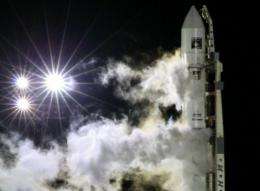
A Zenit-2SB rocket carrying the Phobos-Grunt spacecraft stands at a launch pad of the Russian leased Kazakhstan's Baikonur cosmodrome just before its blasted off toward Mars in November. Russia's space agency on Wednesday pinpointed the likely trajectory of its stranded Mars probe, Phobos-Grunt, predicting it would crash into the Indian Ocean west of Jakarta later this week.

Russia's space agency on Wednesday pinpointed the likely trajectory of its stranded Mars probe, Phobos-Grunt, predicting it would crash into the Indian Ocean west of Jakarta later this week.

"The predicted window for the fragments of the Phobos-Grunt to fall to Earth is between January 14 and 16, with the central point on January 15 at 1:18 pm Moscow time (09:18 GMT), the Roskosmos agency said in a statement.

It also published a map showing the path of the gradually descending probe, with its location at the predicted time west of Jakarta, apparently falling into the Indian Ocean.

But it said the predicted time and place could change as the probe gradually descends.

In an embarrassing setback, the $165-million probe designed to travel to the Mars moon of Phobos and bring back , blasted off on November 9 but failed to leave the Earth's orbit.

The said last month that 20 to 30 fragments weighing a total of no more than 200 kilogrammes were expected to fall to Earth, with the spacecraft's highly toxic fuel burning up on entering the Earth's atmosphere.

The ambitious and high-stakes project aimed to revive Russia's interplanetary programme, which has not seen a successful mission since the fall of the Soviet Union, and prepare the way for a manned mission to Mars.

Russia has experienced a series of serious space failures in the past year.

An unmanned Progress supply ship bound for the crashed into Siberia in August last year after its launch by a Soyuz rocket, forcing the rockets' temporary grounding.

Russia also lost three , an advanced military satellite and a .

In the latest setback, a fragment of a Russian communications satellite crashed into a Siberian village in December after it failed to reach orbit due to the failure of its .

The head of Russia's space programme, Vladimir Popovkin, hinted this week

foreign powers may be behind the string of failures, adding that the launches went awry at precisely the moment the spacecraft were travelling through areas invisible to Russian radar.

Explore further: Dark, massive asteroid to fly by Earth on May 31

add to favorites email to friend print save as pdf

Related Stories

Russia Mars probe considered lost: report

Nov 12, 2011

Efforts to resume contact with a Russian space mission to Mars stuck in Earth orbit after launch have failed and the probe must be considered lost, Interfax news agency reported Saturday.

Russia Mars probe may fall to Earth in January

Nov 14, 2011

A Russian probe that was to visit a moon of Mars but is stuck in orbit around the Earth could burn up in the Earth's atmosphere in January, the head of the Russian space agency said Monday.

Russian satellite hits Siberia's 'Cosmonaut Street'

Dec 24, 2011

A fragment of a Russian satellite that crashed into Siberia in the latest setback for Russia's space programme hit a residential house on a street named after cosmonauts, officials said Saturday. ...

Russian spacecraft delivers 3 to orbiting station

Dec 25, 2011

A Soyuz spacecraft safely delivered a Russian, an American and a Dutchman to the International Space Station on Friday, restoring the permanent crew to six members for the first time since September.

Recommended for you

Dark, massive asteroid to fly by Earth on May 31

May 24, 2013

It's 1.7 miles long. Its surface is covered in a sticky black substance similar to the gunk at the bottom of a barbecue. If it impacted Earth it would probably result in global extinction. Good thing it is ...

Research team explains 'Lazarus' comets

May 24, 2013

Astronomers from the University of Antioquia have discovered a graveyard of comets. These once-dormant comets, dubbed by astronomers as "The Lazarus comets," are now rejuvenated.

NASA ships sensors for seafaring satellite to France

May 24, 2013

(Phys.org) —Three NASA-built instruments that are integral components of the next in a series of U.S./European ocean altimetry satellites have arrived in France for integration with their spacecraft in ...

Trip into space with DiCaprio costs $1.55m

May 24, 2013

Leonardo DiCaprio is going to get closer to stars of a different kind as he heads into space aboard the Virgin Galactic, and a well-heeled bidder at the Cannes Film Festival has paid 1.2 million euros (1.5 million) to be ...

User comments : 0

More news stories

Galaxies fed by funnels of fuel

(Phys.org) —Computer simulations of galaxies growing over billions of years have revealed a likely scenario for how they feed: a cosmic version of swirly straws.

Century-old science helps confirm global warming

(Phys.org) —Ocean measurements taken more than 135 years ago during the scientific expedition of HMS Challenger have provided further confirmation of human-produced global warming over the past century.

Yahoo, pay-TV operators among Hulu bidders

Online video site Hulu is again up for sale, with Yahoo and pay TV operators DirecTV and Time Warner Cable among the seven bidders, according to a person with direct knowledge of the matter.