US may be behind Mars probe failure: Russia
January 17, 2012

Phobos-Grunt was one of the more high-profile mishaps costing $165 million

Enlarge

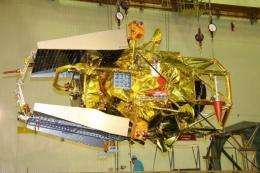
The Phobos-Grunt space probe being fitted to a delivery rocket. Russia said the failure of its Phobos-Grunt probe for Mars could have been caused by radiation from US radars, in its latest allegation of Western interference in its space programme.

Russia on Tuesday said the failure of its Phobos-Grunt probe for Mars could have been caused by radiation from US radars, in its latest allegation of Western interference in its space programme.

"There is such a theory," Yury Koptev the head of the scientific committee of state technology company Russian Technologies told the RIA-Novosti news agency.

"To test (the theory), an equipment block similar to the one on Phobos-Grunt will be exposed to radiation from the possible unintentional exposure to American radars," said Koptev, a former head of .

Roscosmos is currently looking into the possible causes of its latest major mishap, after the probe, which was launched in November, met an inglorious end Sunday when it crashed back into Earth over the Pacific Ocean.

Deputy Prime Minister Dmitry Rogozin said Tuesday that most of the agency's failures were aftershocks following the industry's dark period of the 1990s, when poor funding could have led to production of faulty equipment.

"If we confirm the fact of a foreign influence on our space equipment over the part of Earth we cannot see, we will come to different conclusions," he told Interfax in apparent reference to the West.

Roscosmos mentioned the possibility of foreign interference last week when the current agency chief Vladimir Popovkin openly asked why its failures often occurred when craft were over the western hemisphere.

"I do not want to blame anyone, but today there are some very powerful countermeasures that can be used against spacecraft whose use we cannot exclude," he told the Izvestia daily on January 10.

Phobos-Grunt was one of the more high-profile mishaps costing $165 million and carrying also a it was supposed to release in the Mars orbit.

It struck less than three months after an unmanned Progress supply ship bound for the crashed into Siberia.

Russia also lost three as well as an advanced military satellite and a telecommunications satellite in the past year.

(c) 2012 AFP

4.6 /5 (5 votes)  

Filter


Move the slider to adjust rank threshold, so that you can hide some of the comments.


Display comments: newest first

rawa1
Jan 17, 2012

Rank: 5 / 5 (7)
It's always easier to cover incompetence with accusation of some hidden/external enemy. On the graphs bellow are comparison of success rate of USA and Russian spaceprobes of Mars.

http://www.aether...tory.gif http://www.aether...ory1.gif

In the light of these statistics the poor Phobos-Ground probe had only 16% chance of success. The recent failure of four space-probes in the single line indicates clearly, where the real problem or Russian space technologies is.

Considering the sort of security lapses that allowed a Russian woman to sneak into a Russian rocket facility and take dozens of photos http://lana-sator...176.html - perhaps they should look internally for the source of their problems.
NotAsleep
Jan 17, 2012

Rank: 5 / 5 (2)
If the US has ground based radar that is both strong and accurate enough to knock a rocket out of the sky without getting noticed then we've got bigger secrets under cover...
Deathclock
Jan 17, 2012

Rank: 4.5 / 5 (2)
we've got bigger secrets under cover...


This is pretty much guaranteed.
Rank 4.6 /5 (5 votes)
Relevant PhysicsForums posts
  • Distance of planets from stars and revolution
    created6 hours ago
  • revamping general concept and cosmological principle
    createdMay 25, 2012
  • Transiting Exoplanet Light Curve
    createdMay 25, 2012
  • Math behind Theoretical Physics
    createdMay 24, 2012
  • Do we know whats at the center of galaxies yet?
    createdMay 23, 2012
  • Structure of the Milky Way?
    createdMay 20, 2012
  • More from Physics Forums - General Astronomy

More news stories

Land and sea species differ in climate change response: study

(Phys.org) -- Marine and terrestrial species will likely differ in their responses to climate warming, new research by Simon Fraser University and Australia’s University of Tasmania has found.

Space & Earth / Environment

created 4 hours ago | popularity 3.7 / 5 (3) | comments 5 | with audio podcast

Yale study concludes public apathy over climate change unrelated to science literacy

Are members of the public divided about climate change because they don't understand the science behind it? If Americans knew more basic science and were more proficient in technical reasoning, would public consensus match ...

Space & Earth / Environment

created 6 hours ago | popularity 4.8 / 5 (4) | comments 11 | with audio podcast

10 million years needed to recover from mass extinction

It took some 10 million years for Earth to recover from the greatest mass extinction of all time, latest research has revealed.

Space & Earth / Earth Sciences

created 6 hours ago | popularity 5 / 5 (3) | comments 1 | with audio podcast

Sophisticated simulations predict future warming

The chances of our planet being hit by a global warming of 3 degrees Celsius by 2050 is as likely as it being hit by an increase of 1.4 degrees, new research shows. Presented in the journal Nature Geoscience, the British study ...

Space & Earth / Earth Sciences

created May 22, 2012 | popularity 4.4 / 5 (9) | comments 51

Aliens don't want to eat us, says former SETI director

Alien life probably isn’t interested in having us for dinner, enslaving us or laying eggs in our bellies, according to a recent statement by former SETI director Jill Tarter.

Space & Earth / Space Exploration

created May 25, 2012 | popularity 4.4 / 5 (14) | comments 41


Stunning image of smallest possible five-ringed structure

Scientists have created and imaged the smallest possible five-ringed structure – about 100,000 times thinner than a human hair – and you'll probably recognise its shape.

'Unzipped' carbon nanotubes could help energize fuel cells, batteries

Multi-walled carbon nanotubes riddled with defects and impurities on the outside could replace some of the expensive platinum catalysts used in fuel cells and metal-air batteries, according to scientists at ...

Change in developmental timing was crucial in the evolutionary shift from dinosaurs to birds: study

At first glance, it's hard to see how a common house sparrow and a Tyrannosaurus Rex might have anything in common. After all, one is a bird that weighs less than an ounce, and the other is a dinosaur that ...

Computer model used to pinpoint prime materials for efficient carbon capture

When power plants begin capturing their carbon emissions to reduce greenhouse gases – and to most in the electric power industry, it's a question of when, not if – it will be an expensive undertaking.

T cells 'hunt' parasites like animal predators seek prey, study shows

By pairing an intimate knowledge of immune-system function with a deep understanding of statistical physics, a cross-disciplinary team at the University of Pennsylvania has arrived at a surprising finding: T cells use a movement ...

Scientists develop ultra-sensitive test that detects diseases in their earliest stages

Scientists have developed an ultra-sensitive test that should enable them to detect signs of a disease in its earliest stages, in research published today in the journal Nature Materials.