Markerless motion capture offers a new angle on tennis injuries
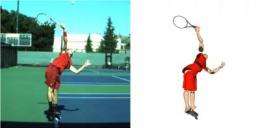
A new approach to motion capture technology is offering fresh insights into tennis injuries – and orthopedic injuries in general.
Researchers studied three types of tennis serves, and identified one in particular, called a "kick" serve, which creates the highest potential for shoulder injury.
The results, published in a recent issue of Annals of Biomedical Engineering, could aid sports training and rehab, said Alison Sheets, assistant professor of mechanical engineering at Ohio State University.
With further development, she added, doctors could use her "markerless motion capture" technique to diagnose patients.
"The potential for markerless motion capture in medicine is vast and exciting, because it can quantify how a person moves without the need to attach electronic markers or other equipment to their body," Sheets said. "People can move naturally, and in a natural setting outside of a laboratory."
Traditional motion capture technology works by attaching markers to a subject's skin or clothing and tracking them as the subject moves, she explained. The markers can emit an electronic signal or reflect light, and the associated wiring and other equipment can limit or otherwise influence people's movement. Moreover, the tracking has to take place in a laboratory setting, where lighting and background are carefully controlled.
Sheets and her colleagues are working to do away with the markers and take motion capture out of the laboratory.
For a project at Stanford University – where Sheets was a postdoctoral researcher before coming to Ohio State – she was part of a team that designed a system of eight video cameras that record a person's movements at the same time, each shooting from a different angle.
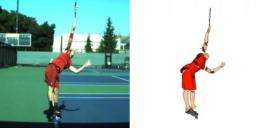
A computer program combines the images to identify the 3D volume and shape of the person in each video frame. By comparing this shape to precise body measurements of the person under study, researchers can pinpoint the parts of the body that engage for a particular action, such as serving a tennis ball.
Study coauthor Marc Safran, MD, an expert in shoulder surgery at Stanford, proposed the project in order to investigate why he'd seen an uptick in the number of tennis players with shoulder injuries. Safran's own 2005 research had shown that tennis injury rates had risen to as high as 20 injuries per 1,000 hours played, with most injuries to the upper body.
"To understand the cause of these injuries, we wanted to study how players move in a real, game-like situation," Sheets said.
They recruited seven members of the Stanford men's varsity tennis team for the study. The serve is the most often performed stroke in the game, so researchers focused on gauging the effects of three common types of serves on the players' back, arm, and shoulder joints.
A tennis serve is analogous to a baseball pitch, in that a player must deliver the ball to particular location. In baseball, it's the "strike zone," and in tennis it's the "service box," an in-bounds section of the opposite side of the court. And – just like a pitcher – a server artfully delivers the ball to make it harder to hit.
The first serve in the study, the "flat" serve, is a straight shot down the center of the court – similar to a pitcher's fastball. The second, the "slice" serve, requires the player to brush the racquet against the ball sideways during the hit. That gives the ball a slight spin that makes it skid across the ground and take an unpredictable bounce – somewhat analogous to the unpredictable flight of baseball's knuckle ball.
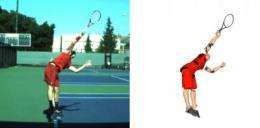
The last, the "kick" serve, requires the player to brush the ball upwards from underneath, giving it a lot of topspin. Just like a pitcher's curve ball, the kick serve sends the ball sideways along a wide arc. Ideally, it drops into the opponent's service box from high above, and produces an equally steep bounce.
Sheets draws one big difference between a tennis serve and a baseball pitch, however.
"In baseball, a pitcher uses the arm like a whip. The movement is sequential – shoulder, elbow, wrist. But in tennis, the shoulder and elbow move together toward the ball, followed by the elbow alone and then finally the wrist, so that the racquet is moving the fastest right before ball impact."
"For the flat serve, the player puts almost of all of the energy into moving the racquet in the forward direction," she continued. "But for the kick serve, the player is also trying to precisely time upwards and sideways racquet movements to generate that characteristic spin."
The study examined the difference in body positioning for the three serves. Researchers measured the distance between the vertical center line of a player's body and the hitting surface of the racquet when the player hit the ball. For the kick serve, players swung the racquet closer to the center -- about 21 cm (8 inches) and 16 cm (6 inches) closer than for the flat serve and slice serve, respectively. The players also extended the racquet farther behind them for the kick serve: 8 cm (3 inches) farther than for the flat serve.
Those measurements suggest that the kick serve generates larger forces on muscles crossing the shoulder joint than the other two serves, which could promote injury, Sheets said.
She's now working with Ajit Chaudhari and Timothy Hewitt of OSU Sports Medicine, who study ACL injuries – a tearing of a ligament in the knee joint. She also has a new project with D. Michele Basso, professor of physical medicine and rehabilitation, to use the technique with animals in order to develop more effective spinal cord injury rehabilitation protocols.
Sheets envisions that tennis coaches could use motion capture analysis of their players – both to prevent injury and improve performance. She doesn't think the kick serve itself is going to change anytime soon, though.
"I can see how motion capture might change training and rehab, but I don't think it'll change how the game is played," she said. "In tennis as in all sports, you do whatever it takes to keep your opponent on their toes."
Provided by The Ohio State University


