Learning-based tourism an opportunity for industry expansion
January 30, 2012

Learning-based tourism an opportunity for industry expansion

Enlarge

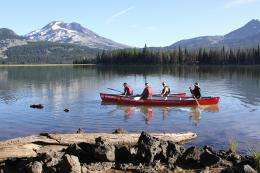
A guide on Sparks Lake in the Oregon Cascade Range explains the geologic history and ecology of the area to tourists, in the shadow of the South Sister volcano. (Photo courtesy of Oregon State University)

New research suggests that major growth in the travel, leisure and tourism industry in the coming century may be possible as more people begin to define recreation as a learning and educational opportunity – a way to explore new ideas and cultures, art, science and history.

Some of this is already happening, although the expansion of in much of the 20th century was often focused on amusement parks and tropical resorts – not that there's anything wrong with them.

But in a recent study published in the Annals of Tourism Research, experts say that increasingly affluent and educated people around the world are ready to see in less conventional ways, and that lifelong and personal enrichment can compete favorably with sandy beaches or thrill rides.

"The idea of travel as a learning experience isn't new, it's been around a long time," said John Falk, a professor of science education at Oregon State University and international leader in the "free-choice learning" movement, which taps into personal interests to help boost intellectual growth beyond what's taught in schools and through formal education.

In the 1700s and 1800s, a "Grand Tour" of Europe was considered an educational rite of passage for upper-class citizens of the gentry or nobility, in which months of travel throughout the continent offered education about art, culture, language, everything from history to science, fencing and dancing.

There may not be as much demand today to perfect one's skills with a sword, but the concept is the same.

"For a long time the travel industry has been focused on hedonistic escapism," Falk said. "That's okay, but as more and more people have the time, means and opportunity to travel, a lot of them are ready to go beyond that. There are many other interesting things to do, and people are voting with their feet.

"You're already seeing many tour operators and travel agencies offer educational opportunities, things like whale watching, ecotourism," Falk said. "The National Park Service does a great job with its resources, teaching people about science, geology and history. The push for more international travel experiences as a part of formal education for students is an outgrowth of this concept.

"We're convinced this is just the beginning of a major shift in how people want to spend their leisure time, and one that could have important implications for intellectual and cultural growth around the world," he said.

Among the observations the researchers make in their study:

  • More leisure time and lower relative cost of travel near the end of the 20th century has opened the door for people to consider different types of recreation focused on intellectual engagement.
  • A growing appetite for lifelong learning is being underserved by the existing tourism industry.
  • A major expansion of learning-based tourism will require both participants and the to overcome a long-standing bias that recreation and education are opposite ends of the spectrum – to accept that learning can be fun.
  • The cultural impact of "being there" makes for a memorable learning experience of great personal value to participants, and is often just the beginning of a continued interest in a topic.
  • People seek experiences that are sensation-rich, alter their view of the world, or instill a sense of wonder, beauty and appreciation.
  • A down side to travel and learning can occur if tourists use the experience to reinforce colonialist, racial or cultural stereotypes.
  • Tourism activities are most successful if the participant feels active and engaged, rather than just receiving a recitation of facts to correct a "knowledge deficit."
Collaborators on this research were from the University of Queensland in Australia.

"It is expected that tourism will become ever more centered upon a quest for something larger, something more personally fulfilling," the researchers wrote in their report. "It is argued that the quest for knowledge and understanding, enacted through travel, will continue to be a dominant theme of the new century."

Provided by Oregon State University search and more info website


Rank not rated yet
Relevant PhysicsForums posts
  • Consumption rivalry
    createdMay 25, 2012
  • Bilateral trade between all countries
    createdMay 24, 2012
  • Is the economic foundation of social media in jeopardy?
    createdMay 20, 2012
  • Psychology: Rosenthal and Hawthorne Effect
    createdMay 15, 2012
  • Is GDP and National Income the Same Thing?
    createdMay 13, 2012
  • Difference between hourly wage and real GDP per hour worked?
    createdMay 12, 2012
  • More from Physics Forums - Social Sciences

More news stories

Change in developmental timing was crucial in the evolutionary shift from dinosaurs to birds: study

At first glance, it's hard to see how a common house sparrow and a Tyrannosaurus Rex might have anything in common. After all, one is a bird that weighs less than an ounce, and the other is a dinosaur that ...

Other Sciences / Archaeology & Fossils

created 6 hours ago | popularity 5 / 5 (4) | comments 0 | with audio podcast

Social welfare cuts ultimately come with heavy price, researchers say

(Phys.org) -- Slashing government funding for Medicaid, food stamps and other programs that serve the poor – while politically popular with some lawmakers and many conservatives – may do more harm ...

Other Sciences / Social Sciences

created May 24, 2012 | popularity 4.2 / 5 (20) | comments 155

Ancient Bethlehem seal unearthed in Jerusalem

Israeli archaeologists have discovered a 2,700-year-old seal that bears the inscription "Bethlehem," the Israel Antiquities Authority announced Wednesday, in what experts believe to be the oldest artifact ...

Other Sciences / Archaeology & Fossils

created May 23, 2012 | popularity 3.3 / 5 (15) | comments 24

Dollars and sense: Why are some people morally against tax?

As the U.S. presidential election campaigns heat up, the economic debate is dominated by bailouts, austerity and, inevitably, taxation. Now a new study published in Symbolic Interaction asks why tax is such an important issue ...

Other Sciences / Social Sciences

created May 23, 2012 | popularity 2.3 / 5 (3) | comments 16

Oldest Jewish archaeological evidence on the Iberian Peninsula

German archaeologists of the Friedrich Schiller University Jena found one of the oldest archaeological evidence so far of Jewish Culture on the Iberian Peninsula at an excavation site in the south of Portugal, ...

Other Sciences / Archaeology & Fossils

created May 25, 2012 | popularity 4.2 / 5 (6) | comments 12


Stunning image of smallest possible five-ringed structure

Scientists have created and imaged the smallest possible five-ringed structure – about 100,000 times thinner than a human hair – and you'll probably recognise its shape.

'Unzipped' carbon nanotubes could help energize fuel cells, batteries

Multi-walled carbon nanotubes riddled with defects and impurities on the outside could replace some of the expensive platinum catalysts used in fuel cells and metal-air batteries, according to scientists at ...

Computer model used to pinpoint prime materials for efficient carbon capture

When power plants begin capturing their carbon emissions to reduce greenhouse gases – and to most in the electric power industry, it's a question of when, not if – it will be an expensive undertaking.

T cells 'hunt' parasites like animal predators seek prey, study shows

By pairing an intimate knowledge of immune-system function with a deep understanding of statistical physics, a cross-disciplinary team at the University of Pennsylvania has arrived at a surprising finding: T cells use a movement ...

Land and sea species differ in climate change response: study

(Phys.org) -- Marine and terrestrial species will likely differ in their responses to climate warming, new research by Simon Fraser University and Australia’s University of Tasmania has found.

Yale study concludes public apathy over climate change unrelated to science literacy

Are members of the public divided about climate change because they don't understand the science behind it? If Americans knew more basic science and were more proficient in technical reasoning, would public consensus match ...