Krawczynski group receives NASA grant to spy on black holes
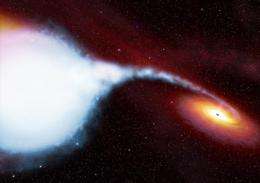
(PhysOrg.com) -- Henric Krawczynski, PhD, professor of physics in Arts & Sciences at Washington University in St. Louis, is a big-game hunter of the astrophysical variety — he hunts celestial beasts, not beasts of the forest. The more exotic and wilier the prey, the keener he becomes, and the more his eyes light up.
The National Aeronautics and Space Administration (NASA) has just funded Krawczynski and his colleague, assistant research professor Matthias Beilicke, PhD, to chase some of the most exotic astronomical prey: black holes, those famously elusive quarry that cleverly swallow most of the evidence of their existence.
He will be doing it with an instrument Jules Verne would appreciate, a balloon-borne telescope sensitive to the polarization of light that will float at an altitude of 130,000 feet for a day. During that time, the balloon will stare fixedly at two black holes in our galaxy, an extragalactic black hole, an accreting neutron star, the Crab nebula, and other targets yet to be chosen.
Called X-Calibur, the instrument, which is sensitive to “hard” X-rays with energies between 20,000 and 60,000 electron volts, is scheduled to go up in the spring 2013 or fall 2014. It will be flown at roughly the same time as another mission, GEMS, a satellite-borne instrument sensitive to “soft” X-rays, with energies between 2,000 and 10,000 electron volts. For comparison, visible light has energies between 2 and 3 electrons volts.
Krawczynski leads the X-Calibur experiment, whose development was sponsored by the McDonnell Center for the Space Sciences at Washington University. Krawczynski is a science collaborator on the GEMS experiment, which is led by Jean Swank, PhD, of the Goddard Space Flight Center.
To date, astronomers have measured X-ray polarization from only one astronomical source outside the solar system, the Crab Nebula, a supernova remnant in the constellation Taurus. GEMS is two orders of magnitude more sensitive than the instrument that looked at the Crab. X-Calibur extends the energy coverage into the hard X-ray regime, Krawczynski says.
Like polarized sunglasses only better
“Whenever you look at the sky at a different wavelength,” Krawczynski says, “you see something completely different.”
So, astrophysicists, ever hungry for new insights, have launched a fleet of telescopes that cover most of the electromagnetic spectrum, from the lazy infrared to the jazzed-up gamma rays.
“We are in a golden age of astrophysics,” Krawczynski says, “because we have great observatories. But it has also become more difficult to make the case for a new scientific tool. We need a technological breakthrough or new observables,” he says.
X-Calibur offers a little of both, but its main claim to fame are two new observables: the polarization degree and direction of X-rays, which provide information about cosmic sources that is not available in any other way.
Electromagnetic waves (light, inclu) are composed of electric and magnetic waves that vibrate at right angles to one another and to the direction of travel of the light wave. When light is unpolarized, the direction of vibration of the electric or magnetic wave is random. When the light is polarized, the waves vibrate in a particular direction.
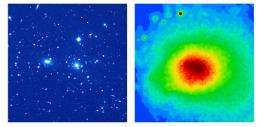
Light can be polarized by various processes, including reflection and passing through certain materials.
Most everyone has limited experience with polarization in the form of glare-free sunglasses. Some animals, like shrimp and bees, live in a vividly polarized world and use polarization-sensitive eyes to see what other species cannot see.
“But designing an instrument to detect polarization is difficult,” Krawczynski says, “because we need a lot of photons to measure it accurately. Whereas physicists can measure the energy or direction of a single photon, they need as many as 10,000 photons to detect a 5 percent polarization signal with high confidence.”
Inside X-Calibur
The scintillator rod at the heart of the X-Calibur experiment scatters X-rays into rings of detectors surrounding it.
The rod deflects X-rays by a process called Compton scattering, which was first observed by Arthur Holly Compton in 1923 at Washington University. The building that houses Krawczynski’s lab was named after Compton.
In this type of scattering, the X-ray photons colliding with electrons in the rod are scattered at an angle to their original direction of flight.
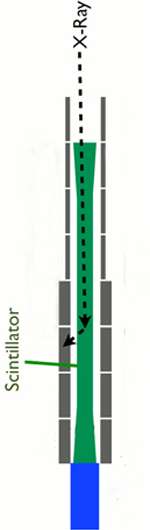
The rod is made of a “light” material that Compton scatters photons with a high likelihood towards “heavy” solid-state detectors, which efficiently absorb the photons.
If the incoming photons are polarized, the outgoing photons will be scattered preferentially perpendicular to the orientation of the vibrating electric field.
“If you can measure the directions in which the photons are scattered, you can infer the polarization direction of the X-rays,” Krawczynski says.
The assembled instrument will be flown in spring 2013 or fall 2014 in a 1,600-kilogram (3,500-pound) gondola developed by the Goddard Space Flight Center that will hang from a balloon at an altitude of 40 kilometers (25 miles).
“The gondola will swing a bit, but we need to focus the telescope on a celestial object with an accuracy of a sixtieth of degree,” Krawczynski says.
The telescope, which is slowly spinning to minimize systematic measurement errors, is suspended in the gondola by a single high-pressure ball joint. The telescope acts like the rotor in a gimbaled gyroscope. No matter how its surroundings move, its optical axis remains firmly pointed in the same direction.
Aboard the gondola is an X-ray mirror developed by Hideyo Kunieda and his team at Nagoya University. The mirror looks more like a giant apple slicer than the usual bathroom mirror.
If X-rays strike a mirror at angles close to the perpendicular, they are likely to be absorbed, not reflected. To be reflected, they must hit the mirrors at grazing angles, typically less than 2 degree. To accommodate these physics, an X-ray mirror consists not of a single reflective layer but instead of a 256 nested cylindrical mirrors. These concentric mirrors act as a lens, focusing the X-rays onto the tiny scintillator pin at a distance of 8 meters.
Because of the mirror and features of the instrument are designed to maximize Compton events and discard imposter events, X-Calibur detects many more of the incoming X-rays and is roughly one order of magnitude more sensitive than competing experiments in the high-energy range.
What the telescope might spy
Already on the target list for X-Calibur are one pulsar (the Crab Nebula), two galactic black holes (Cyngus X-1 and GRS 1915+105), an accreting neutron star (Hercules X-1), and one supermassive extragalactic black hole (Markarian 421).
“The most exciting targets for the telescope are the black holes and their plasma outflows,” Krawczynski says. “One of the things GEMS and X-Calibur will be able to measure is how fast the black holes are spinning.”
In the binary system Cygnus X-1, for example, a 15-solar-mass black hole gobbles up matter from a companion star. Like water going down the drain, the material spirals toward the black hole, forming a flat disk that gets hotter and hotter as the material gets closer and closer to the event horizon of the black hole.
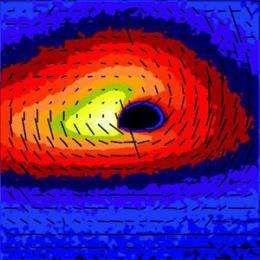
Near the outer edge of the accretion disk, Krawczynski says, the emitted X-rays are polarized parallel to the plane of the disk. Closer to the black hole, the black hole curves spacetime to such an extent that many X-rays originally traveling away from the disk return to the disk and are then scattered towards the observer.
“The net effect,” Krawczynski says, “is that we will see a 90-degree polarization swing produced by the gravity of the black hole.”
But that’s not all. The polarization swing will occur at an energy that depends on how fast the black hole is spinning.
“Black holes and their accretion disks shrink as they rotate,” Krawczynski says. “The faster the black hole spins, the closer is the accretion disk to the black hole, and the lower is the energy at which the polarization swing will be observed.
“The energy at which the polarization swings is thus a direct indicator of the spin of the black hole,” he says.
Black holes and pulsars are not the only celestial targets in Krawczynski’s sights. He mentions the possibility of testing the theory of general relativity near a black hole.
General relativity has been repeatedly validated in the wimpy gravitational fields of the Earth’s solar system. But what happens, Krawczynski wonders, close to a black hole where spacetime is tied into a knot, and the potential well plunges to infinity?
His eyes light up at the very thought.
Provided by Washington University in St. Louis


