Iridescence and superhydrophobicity combined on one surface
January 21, 2012 by Lisa Zyga
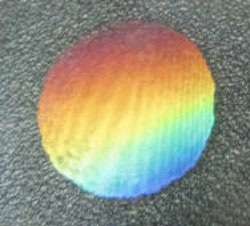
Biomimetic graphene oxide with iridescence like a butterfly's wing and superhydrophobicity like a rose petal. Image credit: Wang, et al. ©2012 Chemistry - An Asian Journal
(PhysOrg.com) -- Scientists have combined two properties on a single piece of graphene oxide that dont usually go together: iridescence (resulting in a rainbow-hued appearance) and superhydrophobicity (causing low-contact water droplets to strongly adhere to the surface). The engineered surface could have applications in liquid transportation and analysis, and due to graphenes good electronic properties, possibly even in future electronic devices.
The researchers, Jian-Nan Wang and coauthors from Jilin University in Changchun, China, achieved these properties by creating a microscopic texture on the graphene oxides surface. By shining two laser beams on the surface, they created an interference pattern that burned tiny grooves into the material. The surface immediately took on an iridescent appearance, shimmering like a butterflys wing. The scientists explained that the tiny grooves, which form highly ordered periodic structures, act as diffraction gratings that split white light into its various colored wavelengths.
The researchers discovered that the surface effects also caused the graphene oxide to exhibit highly adhesive superhydrophobicity. When they poured water on the surface, the water merged into nearly spherical droplets. Although the droplets are barely in contact with the graphene oxide, they adhere to the surface, not detaching even when the surface is held upside down. The researchers attributed this phenomenon to the surfaces microscopic unevenness and a decrease in surface energy caused during laser irradiation, which removes some hydrophilic oxygen groups.
The researchers predict that the combination of these two properties on one surface could have applications in microfluidic devices, where a superhydrophobic surface is useful for transporting small amounts of liquid in a controlled way. Graphene oxide might also be used as a biocompatible surface for growing cells, which requires controlled wetting.
The iridescence might be used for color-coding different states in microfluidic devices, as well as decorating for aesthetic purposes. Also, by altering the optical properties of graphene-based devices, it may open doors to new optical or electronic devices.
More information: Jian-Nan Wang, et al. Biomimetic Graphene Surfaces with Superhydrophobicity and Iridescence. Chemistry - An Asian Journal. DOI: 10.1002/asia.201100882
via: Chemistry World
© 2011 PhysOrg.com
-
From lemons to lemonade: Reaction uses carbon dioxide to make carbon-based semiconductor,
32 comments
-
Thioridazine kills cancer stem cells in human while avoiding toxic side-effects of conventional cancer treatments,
3 comments
-
SpaceX private rocket blasts off for space station (Update),
42 comments
-
Climate scientists say they have solved riddle of rising sea,
31 comments
-
SpaceX capsule has 'new car' smell, astronauts say (Update),
4 comments
-
How to find the concentration of nucleic acid solution using optical density?
25 minutes ago
-
How do I turn sodium acetate trihydrate into sodium acetate anhydrous and vice versa?
53 minutes ago
-
Calculating partial pressures Pa and Pw
3 hours ago
-
Gibbs Free Energy Change/Entropy
13 hours ago
-
What's the rule to covalent character
14 hours ago
-
Schwartz reagent-- NMR/MS/IR
May 26, 2012
- More from Physics Forums - Chemistry
More news stories
Computer model used to pinpoint prime materials for efficient carbon capture
When power plants begin capturing their carbon emissions to reduce greenhouse gases and to most in the electric power industry, it's a question of when, not if it will be an expensive undertaking.
6 hours ago |
not rated yet |
0
|
Scientists develop ultra-sensitive test that detects diseases in their earliest stages
Scientists have developed an ultra-sensitive test that should enable them to detect signs of a disease in its earliest stages, in research published today in the journal Nature Materials.
Chemistry / Analytical Chemistry
6 hours ago |
not rated yet |
0
|
New CO2-removing catalyst can take the heat
(Phys.org) -- The current method of removing the greenhouse gas carbon dioxide (CO2) from the flues of coal-fired power plants uses so much energy that no one bothers to use it. So says Roger Aines, principal ...
May 24, 2012 |
5 / 5 (9) |
11
|
High-speed method to aid search for solar energy storage catalysts
Eons ago, nature solved the problem of converting solar energy to fuels by inventing the process of photosynthesis.
May 25, 2012 |
5 / 5 (3) |
4
|
Researchers demonstrate possible primitive mechanism of chemical info self-replication
(Phys.org) -- When scientists think about the replication of information in chemistry, they usually have in mind something akin to what happens in living organisms when DNA gets copied: a double-stranded molecule ...
May 25, 2012 |
5 / 5 (4) |
2
|
Stunning image of smallest possible five-ringed structure
Scientists have created and imaged the smallest possible five-ringed structure about 100,000 times thinner than a human hair and you'll probably recognise its shape.
'Unzipped' carbon nanotubes could help energize fuel cells, batteries
Multi-walled carbon nanotubes riddled with defects and impurities on the outside could replace some of the expensive platinum catalysts used in fuel cells and metal-air batteries, according to scientists at ...
Change in developmental timing was crucial in the evolutionary shift from dinosaurs to birds: study
At first glance, it's hard to see how a common house sparrow and a Tyrannosaurus Rex might have anything in common. After all, one is a bird that weighs less than an ounce, and the other is a dinosaur that ...
T cells 'hunt' parasites like animal predators seek prey, study shows
By pairing an intimate knowledge of immune-system function with a deep understanding of statistical physics, a cross-disciplinary team at the University of Pennsylvania has arrived at a surprising finding: T cells use a movement ...
Land and sea species differ in climate change response: study
(Phys.org) -- Marine and terrestrial species will likely differ in their responses to climate warming, new research by Simon Fraser University and Australia’s University of Tasmania has found.
Yale study concludes public apathy over climate change unrelated to science literacy
Are members of the public divided about climate change because they don't understand the science behind it? If Americans knew more basic science and were more proficient in technical reasoning, would public consensus match ...
Jan 20, 2012
Rank: not rated yet
Jan 20, 2012
Rank: 5 / 5 (1)
Jan 20, 2012
Rank: not rated yet
Jan 20, 2012
Rank: 5 / 5 (3)