India has Red Planet Fever
January 16, 2012 By Amy Shira Teitel, Universe Today

India has Red Planet Fever

Enlarge

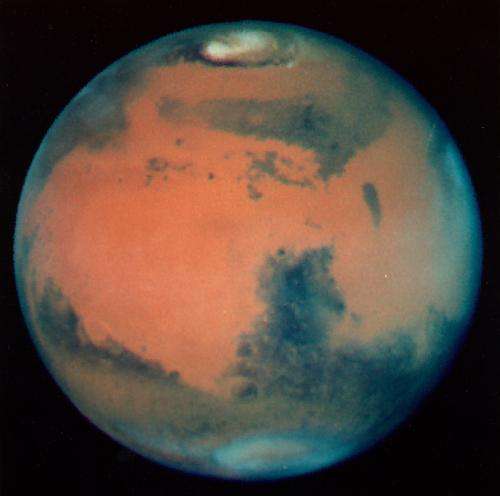
Mars, the possible focal point for India's future space endeavours. Credit: NASA/courtesy of nasaimages.org

Mars fever has gripped India. In a recent report from the Planetary Science and Exploration conference that was held in December 2011, scientists from the Indian Space Research Organization (ISRO) are making preliminary plans for a robotic mission to the Red Planet sometime next year. 

The possibility of an Indian mission to first came up during a brainstorming session at the Physical Research Laboratory (PRL), an affiliate of the ISRO, last March. For two days, scientists and students developed their plans and proposals for a mission to the .

A Mars Mission Study Team has been established to review proposed scenarios for the future mission, and an Indian chapter of the Mars Society formed last year at IIT-Mumbai.

The report from the meeting last month gives a concrete look at what Indian scientists have on their Martian wish list. In all, ten instruments and experiments comprise the ultimate mission.

En route to Mars, a Mars Radiation Spectrometer (Maris) will measure and characterize background levels of charged particles in interplanetary space. This data will play a vital role in determining radiation levels facing humans going to Mars.

Once at Mars, the proposed Indian mission will focus on the Martian atmosphere.

A Probe For Infrared Spectroscopy for Mars (Prism) is designed to study the spatial and seasonal variations of atmospheric gases on Mars’ atmosphere throughout the mission’s lifetime. The Mars Exospheric Neutral Composition Analyzer (Menca) is designed to analyze the planet’s upper atmosphere-exosphere, the region roughly 400 km (248 miles) above the surface.

Specific instruments are designed to study the composition of the atmosphere. A Methane Sensor For Mars (MSM) has been proposed to detect traces of the gas in the atmosphere. Another instrument, Tis, will measure thermal emissions to help scientists generate a map reflecting the composition and mineralogy of the planet. It will also help the team monitor carbon dioxide levels.

A Plasma and Current Experiment (Pace) will assess the escape rate of the atmosphere and the structure of the “tail” this escaping atmosphere creates. Radio and microwave instruments will also be on board the spacecraft to measure the planet’s surface activity. A suite of instruments will also be on hand to detect plasma waves in the atmosphere.

Visual measurements are also part of the proposed mission. The Mars Color Camera (MCC) is designed to photograph the Martian surface from a highly elliptical orbit, roughly 500 km by 80,000 km (310 miles by 49,700 miles). The camera will be able to take high resolution images of the topography of the surface and map the polar caps, both of which are expected to help scientists understand surface events like dust storms.

According to ISRO scientists, the proposed mission could launch as early as November 2013, which would have the spacecraft enter into orbit around Mars in September 2014. A launch so relatively soon is appealing to many Indian scientists, many of whom argue that a mission to Mars should take priority over a mission to the Moon.

After all, has already reached the Moon with the successful Chandrayaan-2 spacecraft. Why not keep the momentum going and aim for a new and exciting target with the next mission?

Source: Universe Today

4.8 /5 (11 votes)  

Filter


Move the slider to adjust rank threshold, so that you can hide some of the comments.


Display comments: newest first

Xbw
Jan 16, 2012

Rank: 2.9 / 5 (15)
If the Indian government signs on to the idea, I say all power to them. The more scientific interest in our neighbor planet, the better.
deatopmg
Jan 16, 2012

Rank: 1.3 / 5 (14)
Great for India!!!
Maybe they'll release full resolution RAW images vs. the highly compressed and tampered images from MSSS, but I'm not holding my breath.
PosterusNeticus
Jan 16, 2012

Rank: 4.5 / 5 (10)
Deatopmg:
conspiracy wingnut drivel


It must be exhausting to go through life with a brain that's been miswired for excess paranoia. I feel for you. Honestly. I wish people like you could get the help you need.

As to the proposed mission, this is fantastic. The more eyes and brains focusing on Mars, the better. Sounds like they have a very well thought out plan in terms of what kinds of information they're going after.
samarth
Jan 16, 2012

Rank: 5 / 5 (2)
"After all, India has already reached the Moon with the successful Chandrayaan-2 spacecraft. " A minor correction, That was chandrayaan 1 spacecraft. Chandrayaan is set to be launched sometime in 2014.

Vendicar_Decarian
Jan 17, 2012

Rank: 5 / 5 (7)
For a time, America had Cat scratch fever, and it was driving them wild.
Rank 4.8 /5 (11 votes)
Relevant PhysicsForums posts
  • Distance of planets from stars and revolution
    created6 hours ago
  • revamping general concept and cosmological principle
    createdMay 25, 2012
  • Transiting Exoplanet Light Curve
    createdMay 25, 2012
  • Math behind Theoretical Physics
    createdMay 24, 2012
  • Do we know whats at the center of galaxies yet?
    createdMay 23, 2012
  • Structure of the Milky Way?
    createdMay 20, 2012
  • More from Physics Forums - General Astronomy

More news stories

Land and sea species differ in climate change response: study

(Phys.org) -- Marine and terrestrial species will likely differ in their responses to climate warming, new research by Simon Fraser University and Australia’s University of Tasmania has found.

Space & Earth / Environment

created 4 hours ago | popularity 3.7 / 5 (3) | comments 5 | with audio podcast

Yale study concludes public apathy over climate change unrelated to science literacy

Are members of the public divided about climate change because they don't understand the science behind it? If Americans knew more basic science and were more proficient in technical reasoning, would public consensus match ...

Space & Earth / Environment

created 6 hours ago | popularity 4.8 / 5 (4) | comments 11 | with audio podcast

10 million years needed to recover from mass extinction

It took some 10 million years for Earth to recover from the greatest mass extinction of all time, latest research has revealed.

Space & Earth / Earth Sciences

created 6 hours ago | popularity 5 / 5 (3) | comments 1 | with audio podcast

Sophisticated simulations predict future warming

The chances of our planet being hit by a global warming of 3 degrees Celsius by 2050 is as likely as it being hit by an increase of 1.4 degrees, new research shows. Presented in the journal Nature Geoscience, the British study ...

Space & Earth / Earth Sciences

created May 22, 2012 | popularity 4.4 / 5 (9) | comments 51

Aliens don't want to eat us, says former SETI director

Alien life probably isn’t interested in having us for dinner, enslaving us or laying eggs in our bellies, according to a recent statement by former SETI director Jill Tarter.

Space & Earth / Space Exploration

created May 25, 2012 | popularity 4.4 / 5 (14) | comments 41


Stunning image of smallest possible five-ringed structure

Scientists have created and imaged the smallest possible five-ringed structure – about 100,000 times thinner than a human hair – and you'll probably recognise its shape.

'Unzipped' carbon nanotubes could help energize fuel cells, batteries

Multi-walled carbon nanotubes riddled with defects and impurities on the outside could replace some of the expensive platinum catalysts used in fuel cells and metal-air batteries, according to scientists at ...

Change in developmental timing was crucial in the evolutionary shift from dinosaurs to birds: study

At first glance, it's hard to see how a common house sparrow and a Tyrannosaurus Rex might have anything in common. After all, one is a bird that weighs less than an ounce, and the other is a dinosaur that ...

Computer model used to pinpoint prime materials for efficient carbon capture

When power plants begin capturing their carbon emissions to reduce greenhouse gases – and to most in the electric power industry, it's a question of when, not if – it will be an expensive undertaking.

T cells 'hunt' parasites like animal predators seek prey, study shows

By pairing an intimate knowledge of immune-system function with a deep understanding of statistical physics, a cross-disciplinary team at the University of Pennsylvania has arrived at a surprising finding: T cells use a movement ...

Scientists develop ultra-sensitive test that detects diseases in their earliest stages

Scientists have developed an ultra-sensitive test that should enable them to detect signs of a disease in its earliest stages, in research published today in the journal Nature Materials.