The Ichthyosaurs survived longer than was thought
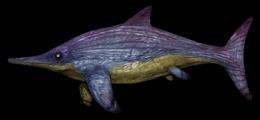
Acamptonectes densus. Credit: C. M. Kosemen 2012, c.m.kosemen@gmail.com
(PhysOrg.com) -- The discovery of a new species of ichthyosaurs considerably changes our understanding of the evolution and the extinction of these dinosaur age sea reptiles, according to a study published this week in PLoS ONE by an international team of Belgian, British and German scientists.
This work shows that the ichthyosaurs were not subject to a major extinction at the end of the Jurassic era (145 million years ago). It furthermore also shows that the ichthyosaurs remained very diversified until their definitive extinction, around 94 million years ago. These two results, springing from joint work produced by university and museum researchers in Belgium, the United Kingdom and Germany, and published in the Tuesday, January 3, 2012 edition of the open access journal PLoS One, contradicts earlier theories which considered the cretaceous ichthyosaurs as the final survivors of a group in its death throes.
The ichthyosaurs are known for being sea reptiles which superficially resemble sharks and dolphins. Their size could range from less than 1m in length to giants measuring over 20m. They all gave birth to their offspring directly in the sea, and certain of them were swift swimmers which could quickly dive to great depths, and had enormous eyeballs and a so-called hot blooded physiology, says the studys first author, Valentin Fischer, who works at the University of Liège (Belgium). The ichthyosaurs were a major component of the sea ecosystems during the age of the dinosaurs, and occupied numerous ecological niches.
Up until recently it was thought that a major extinction on the Jurassic-Cretaceous Boundary had eradicated the diversified forms of the Jurassic era, to the benefit of less specialised forms. These few survivors of the Cretaceous period were thought to have subsequently some fifty million years later, over the course of the Cenomanian era (Late Cretaceous). Nonetheless, the cruel lack of fossils in the lower Cretaceous prevented a clear understanding of dynamics of the shift from the diversified ichthyosaurs of the Jurassic to the rare and generalised forms of the Cretaceous.
The team tackled the subject in two stages. The first was to examine the existing specimens of Cretaceous ichthyosaurs in order to determine how many different species they could constitute. Some of these fossils have been discovered recently whilst others have been in museum collections for decades. At least one new Cretaceous ichthyosaurus, known through English and German fossils, has been discovered over the course of the research process. The team has named it Acamptonectes densus. This name means a rigid and compact swimmer and refers to the fact that the skull and vertebral column of this ichthyosaurus were very strong and tightly locked together. This indicates that practically all the movements involved in swimming were restricted to the tail and the caudal fin, explains Valentin Fischer. The second stage of the research process was to use two techniques (phylogenetic analysis and survival/extinction rates) to evaluate the effect of the crisis of the Jurassic-Cretaceous Boundary on the ichthyosaurs.
No extinction on the Jurassic-Cretaceous Boundary ...
Several lines of ichthyosaurus appeared during the Middle Jurassic period. Whilst it had been thought that these Jurassic ichthyosaurs died a little later at the end of the Jurassic, the new discoveries show that in reality almost all of these lines survived across the Jurassic-Cretaceous Boundary. On the basis of this data, new information provided by the Acamptonectes and other research, the team has been able to show that the extinction rates were very low during the Jurassic-Cretaceous Boundary. In fact it seems that the ichthyosaurs were not affected by the Jurassic-Cretaceous Boundary extinction event, contrary to many other groups of marine animals. The reason why the ichthyosaurs did so well during this period in comparison with other groups of marine animals remains a mystery, and will be the subject of future research.
... But a severe final extinction
The results also indicate that the last ichthyosaurs were surprisingly diversified and belonged to distinct groups. The researchers can now affirm that the ichthyosaurs were more numerous and less rare during the Cretaceous era than had been thought up until now. The definitive extinction of the ichthyosaurs which occurred around 94 million years ago long after the famous extinction even at the end of the Cretaceous era, 65 million years ago was thus a more serious event than had been recently supposed.
More information: Valentin Fischer, et al. 2012. New ophthalmosaurid ichthyosaurs from the European Lower Cretaceous demonstrate extensive ichthyosaur survival across the Jurassic-Cretaceous boundary. PLoS ONE, (7(1) :e29234. DOI:10.1371/journal.pone.0029234
Journal reference:
PLoS ONE
Provided by University de Liege
-
From lemons to lemonade: Reaction uses carbon dioxide to make carbon-based semiconductor,
32 comments
-
Thioridazine kills cancer stem cells in human while avoiding toxic side-effects of conventional cancer treatments,
3 comments
-
SpaceX private rocket blasts off for space station (Update),
42 comments
-
Climate scientists say they have solved riddle of rising sea,
31 comments
-
SpaceX capsule has 'new car' smell, astronauts say (Update),
4 comments
-
What would stain as translucent on light-coloured fabric?
May 26, 2012
-
How do I identify different bacteria on culture plates?
May 26, 2012
-
Why Do Dogs do Strange things...
May 25, 2012
-
What does exophillic and endophillic mean in terms of mosquito and their control?
May 24, 2012
-
Semen stains glows under black lights (uv light)?
May 23, 2012
-
Question on Human Chromosome 2
May 23, 2012
- More from Physics Forums - Biology
More news stories
Change in developmental timing was crucial in the evolutionary shift from dinosaurs to birds: study
At first glance, it's hard to see how a common house sparrow and a Tyrannosaurus Rex might have anything in common. After all, one is a bird that weighs less than an ounce, and the other is a dinosaur that ...
Other Sciences / Archaeology & Fossils
7 hours ago |
5 / 5 (4) |
0
|
Social welfare cuts ultimately come with heavy price, researchers say
(Phys.org) -- Slashing government funding for Medicaid, food stamps and other programs that serve the poor while politically popular with some lawmakers and many conservatives may do more harm ...
Other Sciences / Social Sciences
May 24, 2012 |
4.2 / 5 (20) |
155
Ancient Bethlehem seal unearthed in Jerusalem
Israeli archaeologists have discovered a 2,700-year-old seal that bears the inscription "Bethlehem," the Israel Antiquities Authority announced Wednesday, in what experts believe to be the oldest artifact ...
Other Sciences / Archaeology & Fossils
May 23, 2012 |
3.3 / 5 (15) |
24
Dollars and sense: Why are some people morally against tax?
As the U.S. presidential election campaigns heat up, the economic debate is dominated by bailouts, austerity and, inevitably, taxation. Now a new study published in Symbolic Interaction asks why tax is such an important issue ...
Other Sciences / Social Sciences
May 23, 2012 |
2.3 / 5 (3) |
19
Oldest Jewish archaeological evidence on the Iberian Peninsula
German archaeologists of the Friedrich Schiller University Jena found one of the oldest archaeological evidence so far of Jewish Culture on the Iberian Peninsula at an excavation site in the south of Portugal, ...
Other Sciences / Archaeology & Fossils
May 25, 2012 |
4.2 / 5 (6) |
12
Stunning image of smallest possible five-ringed structure
Scientists have created and imaged the smallest possible five-ringed structure about 100,000 times thinner than a human hair and you'll probably recognise its shape.
'Unzipped' carbon nanotubes could help energize fuel cells, batteries
Multi-walled carbon nanotubes riddled with defects and impurities on the outside could replace some of the expensive platinum catalysts used in fuel cells and metal-air batteries, according to scientists at ...
Computer model used to pinpoint prime materials for efficient carbon capture
When power plants begin capturing their carbon emissions to reduce greenhouse gases and to most in the electric power industry, it's a question of when, not if it will be an expensive undertaking.
T cells 'hunt' parasites like animal predators seek prey, study shows
By pairing an intimate knowledge of immune-system function with a deep understanding of statistical physics, a cross-disciplinary team at the University of Pennsylvania has arrived at a surprising finding: T cells use a movement ...
Land and sea species differ in climate change response: study
(Phys.org) -- Marine and terrestrial species will likely differ in their responses to climate warming, new research by Simon Fraser University and Australia’s University of Tasmania has found.
Yale study concludes public apathy over climate change unrelated to science literacy
Are members of the public divided about climate change because they don't understand the science behind it? If Americans knew more basic science and were more proficient in technical reasoning, would public consensus match ...
Jan 05, 2012
Rank: 5 / 5 (5)
94 million years ago is 29 million years BEFORE 65 million years ago, not long after.
Jan 05, 2012
Rank: 5 / 5 (1)
That sentence is warped beyond correction.
My best guess is that they meant:
"The definitive extinction of the ichthyosaurs around 94 million years ago (50 million years after the jurassic extinction event) was a more serious event than had been recently supposed"
Mr Editor, Clarify this sentence!!!
I googled this and can only find information that says this means the same as warm blooded. how confusing. Say what you mean!!! They're either warm blooded like animals or 'luke warm blooded' like dinosaurs.
Jan 06, 2012
Rank: not rated yet
I'm not sure but assume it's similar to a tuna, they maintain a body temp of around 30 deg C (plus/minus about 5) even in water around 20 deg C or more colder.