High-power, 532 nm-wavelength compact green laser module with high efficiency, high-speed modulation capability
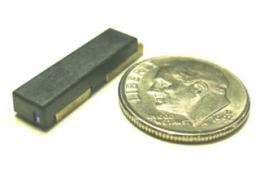
QD Laser, Inc., the Institute for Nano Quantum Information Electronics, the University of Tokyo, and Fujitsu Laboratories Limited today announced the successful development of a high-power 532 nm-wavelength compact green laser module with high efficiency and high-speed modulation capability.
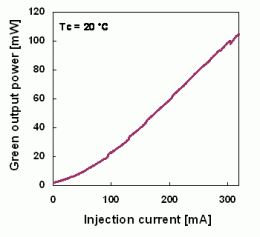
Combining the near-infrared high-power single-mode laser based on proprietary semiconductor DFB (Distributed feedback) laser technology with wavelength conversion technology realizes a compact laser module of about 0.5 cc that can provide high output power. An evaluation of the prototype module confirmed green light output of greater than 100 mW under CW (Continuous wave) conditions and high-speed modulation of more than 100 MHz. This module shows promise for a wide range of applications such as with florescence microscopes or spectral analysis in life science or biomedical applications, and precise measurements as well as nondestructive inspections in industry. Furthermore, it is also expected to apply to future ultra-compact projectors in consumer electronics. QD Laser is planning to start sample shipments of the new product, QLD0593-P50, with > 50 mW output power from the 2nd quarter of 2012 and to start mass-production from the 4th quarter.
A prototype of the green laser module will be exhibited at SPIE Photonics West, held from January 24, 2012, in San Francisco. This development is supported in part by the New Energy and Industrial Technology Development Organization (NEDO) and Project for Developing Innovation Systems conducted by the Ministry of Education, Culture, Sports, Science and Technology (MEXT), Japan.
Recently, high-power green lasers have been garnering much attention in many fields, including life sciences and with biomedical and industrial applications. Different from near-infrared lasers for optical communications and red and blue lasers for optical storage, semiconductor lasers provide limited output characteristics in the case of green lasers. Therefore, diode pumped solid state (DPSS) lasers are usually used in applications which require high output power at wavelengths around 530 nm. In these applications, it is imperative to have improved wavelength stability and high-speed modulation capability as well as low power consumption and compact size.
QD Laser developed 1064 nm high-power single-mode lasers optimized for wavelength conversion in collaboration with Fujitsu Laboratories and the University of Tokyo. This development was based on the collective core proprietary technologies of semiconductor crystal growth, precise grating fabrication, and device design technology. Furthermore, the newly developed module assembling technology enables precise integration of the laser chip and wavelength conversion crystal. As a result, a high output power of more than 100 mW at a wavelength of 532 nm from an ultra-compact package of just 0.5 cc was achieved. According to the test results of the prototype module, 100 mW output power was obtained with power dissipation of about 900 mW, which means high wall-plug efficiency of more than 10%. For the optical spectral characteristics, narrow linewidth of less than 0.01 nm with a high side-mode suppression ratio was obtained, which is particularly suitable for precise measurements using an optical interference or high resolution spectroscopy. In addition, confirmation was made of a high-speed optical modulation capability of more than 100 MHz and short pulse of less than 1 nsec operation. This was done with a simple direct current modulation scheme, which showed that it could be effective for time resolved spectroscopy and other fields. These unique characteristics of high-power, high-efficiency, and high-speed modulation with compact package are also expected to apply to future display applications like heads-up displays or ultra-compact mobile projectors, which are attracting much attention and growing in the market.
QD Laser has already started shipping samples of QLD0593-P05, a module with 5 mW output power. In addition, it plans to start shipping high power samples of QLD0593-P50, a module with > 50 mW output power, in April, 2012 with mass production commencing from the 4th quarter of 2012.
QD Laser markets 1064 nm band DFB laser modules, mainly for industrial applications including as a seed source for fiber lasers, and has already shipped them to more than 30 companies worldwide. QD Laser's in-house epitaxial growth and grating technology provides the flexibility to handle a wide range of wavelength bands and is now extending the wavelength lineup of DFB laser modules from 1030 to 1300 nm. QD Laser also has the potential to extend wavelength lineup by combining with a wavelength conversion technology in visible wavelength regions like 515 nm and 555 nm for special green laser or 560 nm and 590 nm for yellow to orange colors. QD Laser will continue these unique technical developments to meet market requirements.
Source: Fujitsu


