Haiti should brace for more devastating quakes: study

Jan 26, 2012
A man walks down the road by the sea near the settlement of Titanyen, an area north of Port au Prince, in 2011. The 2010 earthquake that devastated southern Haiti may have opened a new era of seismic activity and residents should brace for more massive temblors, said a US study on Thursday.

The 2010 earthquake that devastated southern Haiti may have opened a new era of seismic activity and residents should brace for more massive temblors, said a US study on Thursday.

The 7.0 that killed 250,000 people and leveled much of the capital Port-au-Prince, was of a magnitude unseen on the island since the 18th century, said the study in the .

A equivalent 6.6 level quake in 1701, centered in the same region and described in similar ways to the 2010 according to historical accounts, was followed by three big quakes -- two in 1751 and one in 1770, said the study.

Those quakes would be equal to about 7.5, 6.6 and 7.5 today, and were all located on or near the same crack in the Earth's crust known as the Enriquillo fault that extends along southern Haiti and the Dominican Republic.

The has accumulated "considerable potential slip" since the 18th century, and regional in the Earth may be sufficient to unleash more massive temblors in the coming years, said the research.

"The 2010 Haiti earthquake may mark the beginning of a new cycle of large earthquakes on the Enriquillo fault system after 240 years of seismic quiescence," said the study, led by William Bakun of the US Geological Survey.

"The entire Enriquillo fault system appears to be seismically active; Haiti and the Dominican Republic should prepare for future devastating earthquakes."

Bakun's study reviews the history of earthquakes and hurricanes on the known as Hispaniola since it was first discovered by Christopher Columbus in 1492 and was swiftly colonized by Europeans.
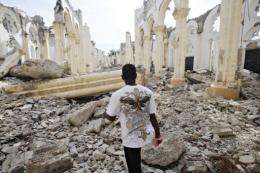
A Hatian man walks through the ruins of the Cathedral in Port-au-Prince in 2011. The 2010 earthquake that devastated southern Haiti may have opened a new era of seismic activity and residents should brace for more massive temblors, said a US study on Thursday.

"There are ample Spanish, French, and British accounts describing the social and physical conditions of Hispaniola in the past 500 years," said the study.

"The five centuries of of the is arguably the longest in the western hemisphere."

With that historical perspective, the island's seismic record is comparable to that of the San Andreas fault in California, where 56 years of "significant earthquake activity" beginning in 1850 culminated in San Francisco's 7.8 quake on the moment magnitude scale in 1906, Bakun wrote.

USGS analysts have predicted that there is a 62 percent probability of another major, damaging earthquake in the San Francisco area by 2031.

And while the science of predicting earthquakes is imprecise, seismologists are gaining better knowledge of risk rates using more advanced technologies and an examination of the historical record for clues.

There are no reports of earthquakes in the area before 1700, and no comparable ones until 2010, though there was a quake in 1860 that was centered further north on the island and is considered unrelated to the fault system.

An analysis of past patterns suggests that the 2010 quake was a re-rupture of the same zone as in 1701, indicating that the Enriquillo fault system may be on a 310 year cycle, said the study.

Bakun and colleagues noted that much of the devastation around the capital in 2010 was due to "inadequate building practices," and urged more seismic hazard mitigation efforts in future construction across southern Haiti and the Dominican Republic.

Explore further: Astonishing hi-resolution satellite views of the destruction from the Moore, Oklahoma tornado

add to favorites email to friend print save as pdf

Related Stories

Haiti fault capable of another big quake: study

Oct 24, 2010

The January 12 earthquake in Haiti failed to release all the tension in a notorious seismic fault, leaving its capital exposed to the risk of another seismic disaster, US scientists reported Sunday.

Scientists warned Haiti officials of quake in '08

Jan 15, 2010

(AP) -- Scientists who detected worrisome signs of growing stresses in the fault that unleashed this week's devastating earthquake in Haiti said Thursday they warned officials there two years ago that their country was ripe ...

What Happened in Haiti?

Jan 20, 2010

(PhysOrg.com) -- As the world focuses on the heart-wrenching losses and unbelievable devastation of the recent earthquake in Haiti, researchers at Michigan Technological University, discuss what happened there ...

After Haiti, Worries About Other Big Quakes

Jan 18, 2010

In the last several days, while the attention of the world has been focused on the human toll of Tuesday's earthquake in Haiti, scientists have begun to look at the quake's geological toll. What is the danger ...

Recommended for you

Strong earthquake at exceptional depth

May 24, 2013

This morning at 05:45 CEST, the earth trembled beneath the Okhotsk Sea in the Pacific Northwest. The quake, with a magnitude of 8.2, took place at an exceptional depth of 605 kilometers. Because of the great ...

Marine forecasting on the horizon for Indian Ocean Rim

May 24, 2013

Nearly all of the member countries of the Indian Ocean Rim Association for Regional Cooperation (IOR-ARC) will attend the week-long workshop to further cooperation and understanding on international ocean ...

Russia evacuates drifting Arctic research station

May 23, 2013

Russia has ordered the urgent evacuation of the 16-strong crew of a drifting Arctic research station after ice floe that hosts the floating laboratory began to disintegrate, officials said Thursday.

User comments : 1

Adjust slider to filter visible comments by rank

Display comments: newest first

jsdarkdestruction
not rated yet Jan 27, 2012
indeed, if they do not prepare themselves better the next big one could end up being a very tragic mistake costing many lives again. I hope that doesnt happen. The good part of mistakes is that you can learn from them.

More news stories

Galaxies fed by funnels of fuel

(Phys.org) —Computer simulations of galaxies growing over billions of years have revealed a likely scenario for how they feed: a cosmic version of swirly straws.

Source of life running out: water scientists

The majority of people on Earth people will face severe water shortages within a generation or two if pollution and waste continues unabated, scientists warned at a conference in Bonn Friday.

Dark, massive asteroid to fly by Earth on May 31

It's 1.7 miles long. Its surface is covered in a sticky black substance similar to the gunk at the bottom of a barbecue. If it impacted Earth it would probably result in global extinction. Good thing it is ...

Yahoo, pay-TV operators among Hulu bidders

Online video site Hulu is again up for sale, with Yahoo and pay TV operators DirecTV and Time Warner Cable among the seven bidders, according to a person with direct knowledge of the matter.