Disappearing gold a boon for nanolattices
January 30, 2012 By Jared Sagoff

Disappearing gold a boon for nanolattices

Enlarge

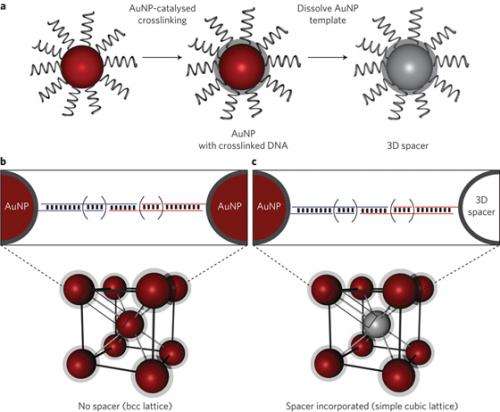
(PhysOrg.com) -- When gold vanishes from a very important location, it usually means trouble. At the nanoscale, however, it could provide more knowledge about certain types of materials. A recent discovery that enables scientists to replace gold nanoparticles with dummy "spacers" has allowed scientists to create materials with never-before-seen structures, which may lead to new properties.

In a new study, researchers led by Professor Chad A. Mirkin from Northwestern University used the high-intensity provided at beamline 5-ID of the (APS) at the U.S. Department of Energy's Argonne National Laboratory to look at "nanoparticle superlattices"—well-ordered arrangements of tiny spheres that can be manipulated to take on a number of different properties.

Superlattices have several characteristics that make them especially appealing to materials scientists, said Northwestern graduate student Evelyn Auyeung, one of the lead authors of the study. "Superlattices are defined by the fact that they maintain a well-organized structure over relatively long distances," she said. "The advantage to an ordered structure is that it gives you a better opportunity to tune or program the characteristics of the material."

In previous experiments conducted at Argonne, scientists examined the effect of using DNA as a kind of glue to reinforce the lattice structure. It had been shown that DNA is a versatile tool that directs nanoparticles into a variety of one-, two-, and three-dimensional superlattices, where the lattice parameter and symmetries depended on the length of the DNA, as well as the size and shapes of the particles used.

By incorporating the spacer particle—one that had no inorganic core—in place of the gold nanoparticle, the researchers were able to transform the structure of a body-centered cubic lattice to a simple cubic lattice. They extended this technique to other binary lattices and were able to synthesize many exotic lattices, including one which has no natural or synthetic equivalent for any known material. "Using these dummy particles gives us access to an entirely new design space," Auyeung said. "The next step is to study the kind of properties that these lattices have thanks to the different arrangement of the nanoparticles. If we can fully investigate this design space, we might be able to access some new emergent properties from these materials."

The Advanced Photon Source at Argonne National Laboratory is one of four synchrotron radiation light sources supported by the U.S. Department of Energy's Office of Science. The APS is the source of the Western Hemisphere's brightest x-ray beams for research in virtually every scientific discipline. More than 3,500 researchers representing universities, industry, and academic institutions from every U.S. state visit the APS each year to carry out both applied and basic research in support of the BES mission.

The results of the research were published in the January issue of Nature Nanotechnology.

Provided by Argonne National Laboratory search and more info website


Rank 5 /5 (4 votes)
Relevant PhysicsForums posts

More news stories

Stunning image of smallest possible five-ringed structure

Scientists have created and imaged the smallest possible five-ringed structure – about 100,000 times thinner than a human hair – and you'll probably recognise its shape.

Nanotechnology / Nanophysics

created 1 hour ago | popularity 4.5 / 5 (2) | comments 0 | with audio podcast

'Unzipped' carbon nanotubes could help energize fuel cells, batteries

Multi-walled carbon nanotubes riddled with defects and impurities on the outside could replace some of the expensive platinum catalysts used in fuel cells and metal-air batteries, according to scientists at ...

Nanotechnology / Nanomaterials

created 7 hours ago | popularity 1 / 5 (1) | comments 0 | with audio podcast

Dopant gives graphene solar cells highest efficiency yet

(Phys.org) -- By taking advantage of graphene’s favorable electrical and optical properties, and then adding an organic dopant, researchers have achieved the highest power conversion efficiency yet for ...

Nanotechnology / Nanophysics

created May 21, 2012 | popularity 5 / 5 (10) | comments 14 | with audio podcast feature

In nanorod crystal growth, nanoparticles seen as artificial atoms

In the growth of crystals, do nanoparticles act as "artificial atoms" forming molecular-type building blocks that can assemble into complex structures? This is the contention of a major but controversial theory ...

Nanotechnology / Nanophysics

created May 24, 2012 | popularity 4.8 / 5 (6) | comments 0 | with audio podcast

First direct observation of oriented attachment in nanocrystal growth

Berkeley Lab researchers have reported the first direct observation of nanoparticles undergoing oriented attachment, the critical step in biomineralization and the growth of nanocrystals. A better understanding ...

Nanotechnology / Nanophysics

created May 24, 2012 | popularity 4.7 / 5 (3) | comments 0 | with audio podcast


Change in developmental timing was crucial in the evolutionary shift from dinosaurs to birds: study

At first glance, it's hard to see how a common house sparrow and a Tyrannosaurus Rex might have anything in common. After all, one is a bird that weighs less than an ounce, and the other is a dinosaur that ...

Computer model used to pinpoint prime materials for efficient carbon capture

When power plants begin capturing their carbon emissions to reduce greenhouse gases – and to most in the electric power industry, it's a question of when, not if – it will be an expensive undertaking.

T cells 'hunt' parasites like animal predators seek prey, study shows

By pairing an intimate knowledge of immune-system function with a deep understanding of statistical physics, a cross-disciplinary team at the University of Pennsylvania has arrived at a surprising finding: T cells use a movement ...

Land and sea species differ in climate change response: study

(Phys.org) -- Marine and terrestrial species will likely differ in their responses to climate warming, new research by Simon Fraser University and Australia’s University of Tasmania has found.

Yale study concludes public apathy over climate change unrelated to science literacy

Are members of the public divided about climate change because they don't understand the science behind it? If Americans knew more basic science and were more proficient in technical reasoning, would public consensus match ...

10 million years needed to recover from mass extinction

It took some 10 million years for Earth to recover from the greatest mass extinction of all time, latest research has revealed.