New research suggests Fomalhaut B may not be a planet after all
Jan 27, 2012 By Paul Scott Anderson, Universe Today
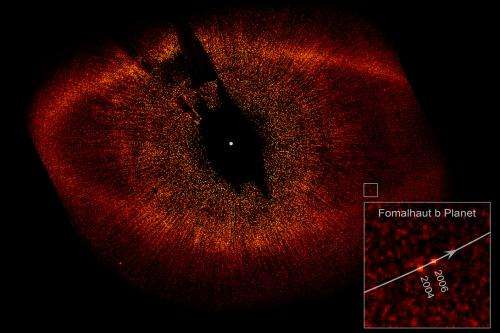
The Fomalhaut b photograph. Credit: NASA, ESA, and P. Kalas (University of California, Berkeley, USA)

When the Hubble Space Telescope photographed the apparent exoplanet Fomalhaut b in 2008, it was regarded as the first visible light image obtained of a planet orbiting another star. The breakthrough was announced by a research team led by Paul Kalas of the University of California, Berkeley. The planet was estimated to be approximately the size of Saturn, but no more than three times Jupiter’s mass, or perhaps smaller than Saturn according to some other studies, and might even have rings. It resides within a debris ring which encircles the star Fomalhaut, about 25 light-years away.

Another team at Princeton, however, has just announced that they believe the original findings are in error, and that the planet is actually a dust cloud, based on new observations by the Spitzer Space Telescope. Their paper has just been accepted by the Astrophysical Journal.

According to the abstract:

The nearby A4-type star Fomalhaut hosts a debris belt in the form of an eccentric ring, which is thought to be caused by dynamical influence from a giant planet companion. In 2008, a detection of a point-source inside the inner edge of the ring was reported and was interpreted as a direct image of the planet, named Fomalhaut b. The detection was made at ~600–800 nm, but no corresponding signatures were found in the near-infrared range, where the bulk emission of such a planet should be expected. Here we present deep observations of Fomalhaut with Spitzer/IRAC at 4.5 µm, using a novel PSF subtraction technique based on ADI and LOCI, in order to substantially improve the Spitzer contrast at small separations. The results provide more than an order of magnitude improvement in the upper flux limit of Fomalhaut b and exclude the possibility that any flux from a giant planet surface contributes to the observed flux at visible wavelengths. This renders any direct connection between the observed light source and the dynamically inferred giant planet highly unlikely. We discuss several possible interpretations of the total body of observations of the Fomalhaut system, and find that the interpretation that best matches the available data for the observed source is scattered light from transient or semi-transient dust cloud.

Kalas has responded to the new study, saying that they considered the dust cloud possibility but ruled it out for various reasons. For one thing, Spitzer lacks the light sensitivity to detect a Saturn-sized planet, and bright rings could also explain the optical characteristics observed. He says, “We welcome the new Spitzer data, but we don’t really agree with this interpretation.”

The Princeton team, interestingly, thinks that there may be a real planet orbiting Fomalhaut, but still hiding from detection. From the paper:

In particular, we find that there is almost certainly no direct flux from a planet contributing to the visible-light signature. This, in combination with the existing body of data for the Fomalhaut system, strongly implies that the dynamically inferred giant planet companion and the visible-light point source are physically unrelated. This in turn implies that the ‘real’ Fomalhaut b still hides in the system. Although we do find a tentative point source in our images that could in principle correspond to this object, its significance is too low to distinguish whether it is real or not at this point.

A resolution to the debate may come from the James Webb Space Telescope, scheduled to launch in 2018.

Of course it will be disappointing if Fomalhaut b does turn out to not be a planet after all, but let’s not forget that thousands of other ones are being discovered and confirmed. There may occasionally be hits-and-misses, but so far the planetary hunt overall has been nothing short of a home run…

The paper is available here.

Explore further: Three centaurs follow Uranus through the solar system

add to favorites email to friend print save as pdf

Related Stories

Earth's dust tail points to alien planets

Nov 15, 2010

Did you know that the Earth has a dust tail? The Spitzer Space Telescope sailed right through it a few months ago, giving researchers a clear idea of what it looks like. That could be a big help to planet ...

A green ring fit for a superhero

Jun 16, 2011

(PhysOrg.com) -- This glowing emerald nebula seen by NASA's Spitzer Space Telescope is reminiscent of the glowing ring wielded by the superhero Green Lantern. In the comic books, the diminutive Guardians of ...

Recommended for you

Three centaurs follow Uranus through the solar system

Jun 18, 2013

Astrophysicists from the Complutense University of Madrid have confirmed that Crantor, a large asteroid with a diameter of 70 km has an orbit similar to that of Uranus and takes the same amount of time to ...

Final curtain for Europe's deep-space telescope

Jun 17, 2013

The deep-space telescope Herschel took its final bow on Monday, climaxing a successful four-year mission to observe the birth of stars and galaxies, the European Space Agency (ESA) said.

Hubble spots a very bright contortionist

Jun 17, 2013

(Phys.org) —The contorted object captured by Hubble in this picture is IRAS 22491-1808, also known as the South America Galaxy. It is an ultra-luminous infrared galaxy (ULIRG) that emits a huge amount of ...

Study explains decades of black hole observations

Jun 14, 2013

(Phys.org) —A new study by astronomers at NASA, Johns Hopkins University and Rochester Institute of Technology confirms long-held suspicions about how stellar-mass black holes produce their highest-energy ...

User comments : 3

Adjust slider to filter visible comments by rank

Display comments: newest first

tadchem
2 / 5 (3) Jan 27, 2012
It is beyond debate that the evidence reveals a body in orbit around Fomalhaut. The question is whether that body is a small star or a giant planet. Given that there is also a cloud (debris?, dust?) present around the primary that overlaps the orbit, matter from the same cloud would easily be captured by the newly observed body. Given also the relative brightness of the rings of Saturn, and its recently recognized cause being freshly exposed surface from particle collisions, matter captured by the body could be much brighter than the matter in the cloud from which it came. This suggests that the brightness of the body may not be entirely due to its own properties.
mac74
not rated yet Jan 27, 2012
The models that the Princeton team used do not reflect the observed SEDs of young planets. They assume that this planet Fomalhaut b has a peak in emission at 4.5 microns. Other young planets show a deep dip in emission at this wavelength as compared to their L band flux. This is probably due to non equilibrium chemistry or strong CO absorption here. The upper limit model shown in the Janson et al paper does not take this into account, so their quoted upper limits for the planet mass are not accurate. Also, the conclusions they reach do not make sense. A saturn mass planet with rings reflecting optical light would not be detectable by Spitzer.
350
1 / 5 (1) Jan 27, 2012
Sauron's eye in space!

More news stories

Metamorphosis of moon's water ice explained

Using data gathered by NASA's Lunar Reconnaissance Orbiter (LRO) mission, scientists believe they have solved a mystery from one of the solar system's coldest regions—a permanently shadowed crater on the ...

Looking at sachet water consumption in Ghana

Many of West Africa's largest cities continue to lag in their provision of piped water to residents. Filling the service gap are plastic water sachets, which have become an important source of drinking water ...

The broken symphony of swinging metronomes

An experiment with 30 metronomes reveals chimera states which combine aspects of synchrony and of disorder. Researchers had been looking for such states for ten years.