Fermi telescope explores new energy extremes
January 10, 2012

Fermi telescope explores new energy extremes

Enlarge

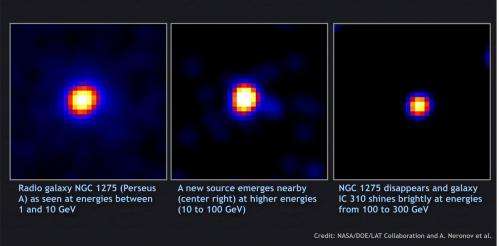
New sources emerge and old sources fade as the LAT's view extends into higher energies. Credit: NASA/DOE/Fermi LAT Collaboration and A. Neronov et al.

(PhysOrg.com) -- After more than three years in space, NASA's Fermi Gamma-ray Space Telescope is extending its view of the high-energy sky into a largely unexplored electromagnetic range. Today, the Fermi team announced its first census of energy sources in this new realm.

Fermi's Large Area Telescope (LAT) scans the entire sky every three hours, continually deepening its portrait of the sky in gamma rays, the most energetic form of light. While the energy of visible light falls between about 2 and 3 electron volts, the LAT detects gamma rays with energies ranging from 20 million to more than 300 billion (GeV).

At higher energies, gamma rays are rare. Above 10 GeV, even Fermi's LAT detects only one gamma ray every four months.

"Before Fermi, we knew of only four discrete sources above 10 GeV, all of them pulsars," said David Thompson, an at NASA's Goddard Space Flight Center in Greenbelt, Md. "With the LAT, we've found hundreds, and we're showing for the first time just how diverse the sky is at these high energies."

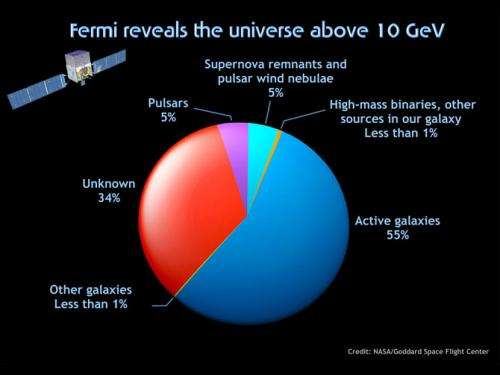
Any object producing gamma rays at these energies is undergoing extraordinary astrophysical processes. More than half of the 496 sources in the new census are active galaxies, where matter falling into a powers jets that spray out particles at nearly the speed of light.

Only about 10 percent of the known sources lie within our own galaxy. They include rapidly called pulsars, the expanding debris from supernova explosions, and in a few cases, binary systems containing .

More than a third of the sources are completely unknown, having no identified counterpart detected in other parts of the spectrum. With the new catalog, astronomers will be able to compare the behavior of different sources across a wider span of gamma-ray energies for the first time.

Just as bright infrared sources may fade to invisibility in the ultraviolet, some of the gamma-ray sources above 1 GeV vanish completely when viewed at higher, or "harder," energies.
Fermi telescope explores new energy extremes
Enlarge

More than half of the sources above 10 GeV are black-hole-powered active galaxies. More than a third of the sources are completely unknown, having no identified counterpart detected in other parts of the spectrum. Credit: NASA's Goddard Space Flight Center

One example is the well-known radio galaxy NGC 1275, which is a bright, isolated source below 10 GeV. At higher energies it fades appreciably and another nearby source begins to appear. Above 100 GeV, NGC 1275 becomes undetectable by Fermi, while the new source, the radio galaxy IC 310, shines brightly.

The Fermi hard-source list is the product of an international team led by Pascal Fortin at the Ecole Polytechnique's Laboratoire Leprince-Ringuet in Palaiseau, France, and David Paneque at the Max Planck Institute for Physics in Munich.

The catalog serves as an important roadmap for ground-based facilities called Atmospheric Cherenkov Telescopes, which have amassed about 130 gamma-ray sources with energies above 100 GeV. They include the Major Atmospheric Gamma Imaging Cherenkov telescope (MAGIC) on La Palma in the Canary Islands, the Very Energetic Radiation Imaging Telescope Array System (VERITAS) in Arizona, and the High Energy Stereoscopic System (H.E.S.S.) in Namibia.

"Our catalog will have a significant impact on ground-based facilities' work by pointing them to the most likely places to find emitting above 100 GeV," Paneque said.

Compared to Fermi's LAT, these ground-based observatories have much smaller fields of view. They also make fewer observations because they cannot operate during daytime, bad weather or a full moon.

"As Fermi's exposure constantly improves our view of hard sources, ground-based telescopes are becoming more sensitive to lower-energy , allowing us to bridge these two energy regimes," Fortin added.

Provided by NASA's Goddard Space Flight Center search and more info website

4.9 /5 (17 votes)  

Rank 4.9 /5 (17 votes)
Relevant PhysicsForums posts
  • Distance of planets from stars and revolution
    created7 hours ago
  • revamping general concept and cosmological principle
    createdMay 25, 2012
  • Transiting Exoplanet Light Curve
    createdMay 25, 2012
  • Math behind Theoretical Physics
    createdMay 24, 2012
  • Do we know whats at the center of galaxies yet?
    createdMay 23, 2012
  • Structure of the Milky Way?
    createdMay 20, 2012
  • More from Physics Forums - General Astronomy

More news stories

Land and sea species differ in climate change response: study

(Phys.org) -- Marine and terrestrial species will likely differ in their responses to climate warming, new research by Simon Fraser University and Australia’s University of Tasmania has found.

Space & Earth / Environment

created 5 hours ago | popularity 3.7 / 5 (3) | comments 5 | with audio podcast

Yale study concludes public apathy over climate change unrelated to science literacy

Are members of the public divided about climate change because they don't understand the science behind it? If Americans knew more basic science and were more proficient in technical reasoning, would public consensus match ...

Space & Earth / Environment

created 7 hours ago | popularity 4.8 / 5 (5) | comments 15 | with audio podcast

10 million years needed to recover from mass extinction

It took some 10 million years for Earth to recover from the greatest mass extinction of all time, latest research has revealed.

Space & Earth / Earth Sciences

created 7 hours ago | popularity 4 / 5 (4) | comments 1 | with audio podcast

Sophisticated simulations predict future warming

The chances of our planet being hit by a global warming of 3 degrees Celsius by 2050 is as likely as it being hit by an increase of 1.4 degrees, new research shows. Presented in the journal Nature Geoscience, the British study ...

Space & Earth / Earth Sciences

created May 22, 2012 | popularity 4.4 / 5 (9) | comments 51

Aliens don't want to eat us, says former SETI director

Alien life probably isn’t interested in having us for dinner, enslaving us or laying eggs in our bellies, according to a recent statement by former SETI director Jill Tarter.

Space & Earth / Space Exploration

created May 25, 2012 | popularity 4.4 / 5 (15) | comments 41


Stunning image of smallest possible five-ringed structure

Scientists have created and imaged the smallest possible five-ringed structure – about 100,000 times thinner than a human hair – and you'll probably recognise its shape.

'Unzipped' carbon nanotubes could help energize fuel cells, batteries

Multi-walled carbon nanotubes riddled with defects and impurities on the outside could replace some of the expensive platinum catalysts used in fuel cells and metal-air batteries, according to scientists at ...

Change in developmental timing was crucial in the evolutionary shift from dinosaurs to birds: study

At first glance, it's hard to see how a common house sparrow and a Tyrannosaurus Rex might have anything in common. After all, one is a bird that weighs less than an ounce, and the other is a dinosaur that ...

Computer model used to pinpoint prime materials for efficient carbon capture

When power plants begin capturing their carbon emissions to reduce greenhouse gases – and to most in the electric power industry, it's a question of when, not if – it will be an expensive undertaking.

T cells 'hunt' parasites like animal predators seek prey, study shows

By pairing an intimate knowledge of immune-system function with a deep understanding of statistical physics, a cross-disciplinary team at the University of Pennsylvania has arrived at a surprising finding: T cells use a movement ...

Scientists develop ultra-sensitive test that detects diseases in their earliest stages

Scientists have developed an ultra-sensitive test that should enable them to detect signs of a disease in its earliest stages, in research published today in the journal Nature Materials.