Researchers conduct experimental implementation of quantum algorithm
Jan 12, 2012 by Bob Yirka weblog
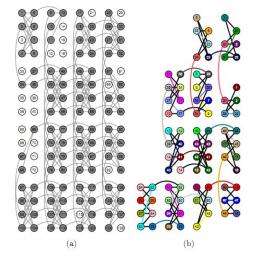
(a) Layout of qubits and couplers. (b) R(8, 2) embedding for qubit connectivity. Image: arXiv:1201.1842v2 [quant-ph]

(PhysOrg.com) -- Researchers at D-Wave Systems have carried out a calculation involving 84 qubits on an experimental quantum computer, giving some credence to the plausibility of true quantum computers being created that could vastly surpass the abilities of all those that currently rely on existing technology. Such computers would differ from traditional computers in that they would make use of quantum mechanical phenomena to perform operations on data, rather than simple binary transactions. To that end, a quantum computer would use quantum bits (qubits) rather than binary digits (bits). The team has published their results on the preprint server, arXiv.

In the research at D-Wave, those involved worked to run a just recently discovered on an actual quantum ; in this case, to solve for a two-color Ramsey number, R(m,2), where m= 4, 5, 6, 7 and 8, also known as the “Party Problem” because it’s use can be explained by posing a problem experienced by many party planners, i.e. how to invite the minimum number of guests where one group knows a certain number of others, and another group doesn’t, forcing just the right amount of mingling. Because increasing the number of different kinds of guests increases the difficulty of finding the answer, modern computers aren’t able to find R(5,5) much less anything higher. This is why researchers have turned to , because instead of simply crunching through and counting all the possible permutations, such computers should conceivably be able to take advantage of a bit of quantum mechanics that allows superconducting circuits to recognize a 1 or 0 state as current traveling in opposite directions or even when both states exist at the same time.

Quantum algorithms take advantage of such facilities and allow for the execution of “instructions” far faster than conventional computers ever could. In the demonstration by the D-Wave team, the computer solved for a R(8,2) Ramsey number in just 270 milliseconds using 84 , though just 28 of them were used in actual computation as the rest were delegated to correcting errors. Also, for those that are curious, the answer is 8.

While the fact that the team at D-Wave has managed to build and run an actual quantum computer is clearly impressive, less impressive is the fact that other than computing Ramsey numbers, the computers haven’t been found to be of much use for more practical applications. Others however, seem to think D-Wave is on to something as some big corporate names have partnered with them, and the company has even sold some of their quantum computers at $10 million a crack.

With such technology, as with many bright ideas in the past, nobody really knows whether computers of the future will all be ultra-speedy and highly efficient quantum computers, or simply faster versions of technology currently in use. We’ll all just have to wait and see how things unfold.

Explore further: A quantum simulator for magnetic materials

More information: Experimental determination of Ramsey numbers with quantum annealing, arXiv:1201.1842v2 [quant-ph] arxiv.org/abs/1201.1842

Ramsey theory is a highly active research area in mathematics that studies the emergence of order in large disordered structures. It has found applications in mathematics, theoretical computer science, information theory, and classical error correcting codes. Ramsey numbers mark the threshold at which order first appears and are notoriously difficult to calculate due to their explosive rate of growth. Recently, a quantum algorithm has been proposed that calculates the two-color Ramsey numbers $R(m,n)$. Here we present results of an experimental implementation of this algorithm based on quantum annealing and show that it correctly determines the Ramsey numbers R(3,3) and $R(m,2)$ for $4leq mleq 8$. The R(8,2) computation used 84 qubits of which 28 were computational qubits. This computation is the largest experimental implementation of a scientifically meaningful quantum algorithm that has been done to date.

via Arxiv Blog

Related Stories

New supercomputer to be unveiled

Feb 12, 2007

A Canadian firm is claiming to have taken a quantum leap in technology by producing a computer that can perform 64,000 calculations at once.

D-Wave sells first commercial quantum computer

Jun 01, 2011

(PhysOrg.com) -- Last week, Burnaby, British Columbia-based company D-Wave Systems, Inc., announced that it sold its first commercial quantum computer. Global security company Lockheed Martin, based in Bethesda, ...

'Self-correcting' gates advance quantum computing

Mar 12, 2009

(PhysOrg.com) -- Two Dartmouth researchers have found a way to develop more robust “quantum gates,” which are the elementary building blocks of quantum circuits. Quantum circuits, someday, will be used ...

Quantum Computer Science on the Internet

Jul 31, 2004

A simulated quantum computer went online on the Internet last month. With the ability to control 31 quantum bits, it is the most powerful of its type in the world. Software engineers can use it to test algorithms that might o ...

Recommended for you

A quantum simulator for magnetic materials

12 hours ago

Physicists understand perfectly well why a fridge magnet sticks to certain metallic surfaces. But there are more exotic forms of magnetism whose properties remain unclear, despite decades of intense research. ...

Researchers forward quest for quantum computing

18 hours ago

Research teams from UW-Milwaukee and the University of York investigating the properties of ultra-thin films of new materials are helping bring quantum computing one step closer to reality.

Hydrogen atoms under the magnifying glass

May 22, 2013

To describe the microscopic properties of matter and its interaction with the external world, quantum mechanics uses wave functions, whose structure and time dependence is governed by the Schrödinger equation. ...

Making quantum encryption practical

May 21, 2013

One of the many promising applications of quantum mechanics in the information sciences is quantum key distribution (QKD), in which the counterintuitive behavior of quantum particles guarantees that no one can eavesdrop on ...

Lab sets a new record for creating heralded photons

May 20, 2013

(Phys.org) —Entanglement, by general consensus of physicists, is the weirdest part of quantum science. To say that two particles, A and B, are entangled means that they are actually two parts of an inseparable ...

Competition in the quantum world

May 20, 2013

Innsbruck physicists led by Rainer Blatt and Peter Zoller experimentally gained a deep insight into the nature of quantum mechanical phase transitions. They are the first scientists that simulated the competition ...

User comments : 1

Adjust slider to filter visible comments by rank

Display comments: newest first

fmfbrestel
not rated yet Jan 13, 2012
Lot of momentum going for D-Wave right now. USC just bought one of their systems, and this here is a pretty remarkable achievement.
This computation is the largest experimental implementation of a scientifically meaningful quantum algorithm that has been done to date.


This is just a glimpse of what a true quantum computer could do, but still a remarkable first step.

More news stories

A quantum simulator for magnetic materials

Physicists understand perfectly well why a fridge magnet sticks to certain metallic surfaces. But there are more exotic forms of magnetism whose properties remain unclear, despite decades of intense research. ...

Engineers pioneer flat spray-on optical lens

A University of British Columbia engineer and a team of U.S. researchers have made a breakthrough utilizing spray-on technology that could revolutionize the way optical lenses are made and used.

Researchers forward quest for quantum computing

Research teams from UW-Milwaukee and the University of York investigating the properties of ultra-thin films of new materials are helping bring quantum computing one step closer to reality.

How do cold ions slide

Things not always run smoothly. It may happen, actually, that when an object slides on another, the advancement may occur through a 'stop and go' series in the characteristic manner which scientists call ...

Controlling mood through the motions of mitochondria

(Medical Xpress)—Regulating the distribution of power in neurons is done by a system that makes the national electric grid look simple by comparison. Each neuron has several thousand mitochondria confined ...