Earthly machine recreates star's sizzling-hot surface
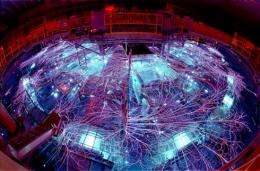
Since we can't go to the stars yet, let's bring the stars to us. In a giant X-ray-producing facility, astronomers and plasma physicists have heated a cigar-sized sample of gas to over 17,000 degrees Fahrenheit in order to replicate the surface of stars called white dwarfs.
"As an astronomer, I am used to looking at these stars from light-years away," says Don Winget of the University of Texas at Austin.
One of the primary methods astronomers use to study a distant object is to analyze its spectrum of light as it reaches Earth.
"So it was a remarkable moment the first time we took a spectrum from a distance of just 5 centimeters," said Winget.
That first time was in April 2010. Since then, the team has been refining their experiment inside the Z Machine at Sandia National Laboratories in Albuquerque, N.M. The goal is to make precision measurements of a laboratory-recreated white dwarf surface in order to improve interpretations of data from spaced-based white dwarfs. Winget described the project today at an American Astronomical Society meeting in Austin.
White dwarfs currently occupy part of the limelight in astronomical circles, as researchers recently confirmed that one of them exploded in a nearby galaxy, producing a "Type IA supernova" that astronomers use to measure the size and acceleration of the universe. Winget said that his team's work could eventually increase our understanding of these cosmic yardsticks, by providing details about what's going on in the white dwarfs before they go boom.
Stellar Fossils
White dwarfs are the burnt embers of once bright-shining stars. Our sun is expected to "retire" to a white dwarf when it runs out of nuclear fuel in roughly 7 billion years. Without the energy from nuclear fusion, the sun will shrink down to about the size of Earth due to the inward pull of its gravity.
This has already been the fate of billions of stars in our galaxy. Although no longer burning fuel, white dwarfs contain a lot of heat. Relatively young ones can be more than 180,000 degrees F on their surface. But as the heat radiates away over time, the white dwarfs tend to cool down to less than 18,000 degrees.
Because these are some of the oldest stars around, these "graybeards" can often unravel the evolutionary history of our galaxy. To estimate the age of a white dwarf, astronomers analyze the spectra of light coming from the stars. Specifically, they look at how some of the light is absorbed in the outer surface of the white dwarf. In most white dwarfs, hydrogen, the simplest of elements, absorbs this light.
"Everyone assumes we know hydrogen so well," Winget said. "As it turns out, that's not the case."
The surface of a white dwarf is largely a plasma, or electrically charged gas. In the midst of this dense plasma, hydrogen absorbs light in a slightly different way. Better understanding this behavior would help astronomers improve the accuracy of white dwarf age estimates. It would also help scientists studying exotic phenomena like the "freezing" of white dwarf cores as they cool.
"I would very much appreciate any experimental work that could help verify the models and determine the physical and chemical properties of the atmospheres of white dwarfs," said astrophysicist Piotr Kowalski, who is not a part of the project, of the Helmholtz Centre Potsdam in Germany.
From Z to X-rays
Hot hydrogen plasmas have been made before in the lab, but only in small quantities.
"We need to have a large sample in order to observe how the plasma absorbs light," said Ross Falcon, a graduate student at the University of Texas at Austin doing much of the legwork on the project.
To obtain enough plasma in the proper fashion requires an experimental facility that can generate a large amount of energy over a short time. Not many facilities can provide that, but the Z machine can. The Z was built to study nuclear weapons, but it now allots about 15 percent of its experimental time to academic research.
To replicate the conditions of a white dwarf, the team first prepares hydrogen in a gas cell that is several centimeters across. This sample is then placed a foot away from a coil of tungsten wires, which lies at the heart of the Z machine. When a switch is thrown, 26 million amps of current rush through the wires, causing them to implode. A burst of X-rays streams out, quickly ionizing the gas in the cell. Winget's team collects spectra from this "little star" using fiber-optic cables.
As the team gathers data in the coming year, it hopes to improve the understanding of white dwarf stars, Winget said.
"This has been groundbreaking research," said plasma physicist Allan Wootton, also from UT Austin. "It was an unusual experience for these astronomers, but it has opened a door to new experiments that explore the conditions inside stars and other extreme environments."
Source: Inside Science News Service


