Drought shrinks China's largest freshwater lake
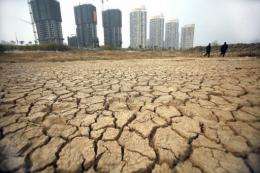
The riverbed of the Gan river, which flows into Poyang lake, during an earlier dry period in 2007. China's largest freshwater lake has shrunk to its smallest size in years due to drought, state media and officials said Thursday, endangering the ecology in the area and fishermen's livelihoods.
China's largest freshwater lake has shrunk to its smallest size in years due to drought, state media and officials said Thursday, endangering the ecology in the area and fishermen's livelihoods.
After a dry spell of more than a decade, Poyang Lake in east China's Jiangxi province is drying up fast as scant rainfall has sent water levels in the Gan River -- which feeds the lake -- to record lows, the Xinhua news agency said.
The lake's area was 183 square kilometres (73 square miles) Thursday, an official at the local hydrological bureau told AFP -- nearly half the average of 344 square kilometres recorded each year on this day since 1951.
"This year's level is very low," the official said, asking not to be named, adding there had been 65 percent less rainfall in the area since December compared to the average recorded at the same period over the past 60 years.
As large as 4,500 square kilometres when at full capacity -- more than six times the size of Singapore -- the lake is home to the migrating Siberian crane in winter and to a rare finless porpoise all year round.
The long drought has left many of the lake's 10,000 fishing boats stranded in shallow waters.
China is regularly affected by crippling dry spells. Last spring, authorities said a drought along the Yangtze river had affected more than 34 million people, leaving livestock without water and parching a major grain belt.

After a dry spell of more than a decade, Poyang Lake in east China's Jiangxi province is drying up fast as scant rainfall has sent water levels in the Gan River -- which feeds the lake -- to record lows, the Xinhua news agency said.
In December, Outlook -- an official Xinhua news agency weekly -- quoted the Yangtze Water Resources Commission as predicting an ongoing drought in the lake area and warning of a threat to the local ecology and economic development.Citing local officials, the report said low water levels and a fishing ban in March and April implemented in 2002 had reduced the fishing season to three months a year, threatening local fishermen's livelihoods.
The annual per capita income of fishermen in Poyang Lake fell to 1,000 yuan ($160) in 2011 from as much as 4,000 yuan in previous years, state media has said.
Meanwhile, dwindling fish stocks will also affect the lake's half-a-million migratory birds, which will lose their source of food, Xinhua said.
Authorities plan to try and resolve the problem by putting 165 million fry into the lake, it added.
(c) 2012 AFP
-
From lemons to lemonade: Reaction uses carbon dioxide to make carbon-based semiconductor,
32 comments
-
Thioridazine kills cancer stem cells in human while avoiding toxic side-effects of conventional cancer treatments,
3 comments
-
SpaceX private rocket blasts off for space station (Update),
42 comments
-
Climate scientists say they have solved riddle of rising sea,
31 comments
-
SpaceX capsule has 'new car' smell, astronauts say (Update),
4 comments
-
Hypothetical desert earth
21 hours ago
-
More human population = greater mass?
May 25, 2012
-
Conversion from aircraft bearing to normal degrees
May 23, 2012
-
Interpretation/Analysis of the Lab results(HEPA filter)
May 22, 2012
-
Has anyone here attended the The Urbino Summer School in Paleoclimatology?
May 22, 2012
-
Earthquakes: Mag 6 N. Italy and Mag 5.6 W. Bulgaria
May 21, 2012
- More from Physics Forums - Earth
More news stories
Land and sea species differ in climate change response: study
(Phys.org) -- Marine and terrestrial species will likely differ in their responses to climate warming, new research by Simon Fraser University and Australia’s University of Tasmania has found.
5 hours ago |
3.7 / 5 (3) |
5
|
Yale study concludes public apathy over climate change unrelated to science literacy
Are members of the public divided about climate change because they don't understand the science behind it? If Americans knew more basic science and were more proficient in technical reasoning, would public consensus match ...
7 hours ago |
4.8 / 5 (5) |
15
|
10 million years needed to recover from mass extinction
It took some 10 million years for Earth to recover from the greatest mass extinction of all time, latest research has revealed.
Space & Earth / Earth Sciences
7 hours ago |
4 / 5 (4) |
1
|
Sophisticated simulations predict future warming
The chances of our planet being hit by a global warming of 3 degrees Celsius by 2050 is as likely as it being hit by an increase of 1.4 degrees, new research shows. Presented in the journal Nature Geoscience, the British study ...
Space & Earth / Earth Sciences
May 22, 2012 |
4.4 / 5 (9) |
51
Aliens don't want to eat us, says former SETI director
Alien life probably isnt interested in having us for dinner, enslaving us or laying eggs in our bellies, according to a recent statement by former SETI director Jill Tarter.
Space & Earth / Space Exploration
May 25, 2012 |
4.4 / 5 (15) |
41
Stunning image of smallest possible five-ringed structure
Scientists have created and imaged the smallest possible five-ringed structure about 100,000 times thinner than a human hair and you'll probably recognise its shape.
'Unzipped' carbon nanotubes could help energize fuel cells, batteries
Multi-walled carbon nanotubes riddled with defects and impurities on the outside could replace some of the expensive platinum catalysts used in fuel cells and metal-air batteries, according to scientists at ...
Change in developmental timing was crucial in the evolutionary shift from dinosaurs to birds: study
At first glance, it's hard to see how a common house sparrow and a Tyrannosaurus Rex might have anything in common. After all, one is a bird that weighs less than an ounce, and the other is a dinosaur that ...
Computer model used to pinpoint prime materials for efficient carbon capture
When power plants begin capturing their carbon emissions to reduce greenhouse gases and to most in the electric power industry, it's a question of when, not if it will be an expensive undertaking.
T cells 'hunt' parasites like animal predators seek prey, study shows
By pairing an intimate knowledge of immune-system function with a deep understanding of statistical physics, a cross-disciplinary team at the University of Pennsylvania has arrived at a surprising finding: T cells use a movement ...
Scientists develop ultra-sensitive test that detects diseases in their earliest stages
Scientists have developed an ultra-sensitive test that should enable them to detect signs of a disease in its earliest stages, in research published today in the journal Nature Materials.
