Discovery of 'bioelectric' arteries opens path to heart disease treatment
January 30, 2012 By Brian Jacobsmeyer, ISNS

Discovery of 'bioelectric' arteries opens path to heart disease treatment

Enlarge

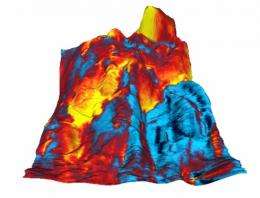
Society/Jiangyu Li et al. Electrical response overlaid on the inner aortic wall. Credit: American Physical

Bionic eyes and limbs made television's six million dollar man an icon, but new research suggests our existing biological structure already exhibits a valuable electrical property. Scientists have found that arteries react curiously to external electric fields, opening the door to minimally invasive detection and treatment of the U.S.'s number one killer -- heart disease.

The research team found for the first time that electric charge inherently builds up along the walls of the body's largest artery, the . The charge arranges itself so that an electric field points outward from the artery, and the direction of this internal field can be manipulated by external electric fields.

Together, these electrical traits make the aorta ferroelectric, a property mainly associated with such as liquid crystals used in some flat screen displays. Although the researchers used for their study, outside experts believe that these ferroelectric characteristics are likely present in humans as well.

"It's an unusual property, and we were very skeptical at the beginning," said Jiangyu Li, a mechanical engineer at the University of Washington, in Seattle, and a member of the research team. "It came to us as a big surprise, and we're very excited about it."

Having observed this property, scientists now hope to develop technology that takes advantage of it. Biomedical researchers envision new devices that could help abate the widespread problem of atherosclerosis, the buildup of fatty plaque in arteries.

Atherosclerosis occurs when excessive plaque in arterial walls blocks passageways and narrows blood's path to . Eventually, this bottlenecking can lead to heart attacks and strokes. Because electric charge builds up on plaque in a similar way to arteries, the interplay of these might contribute to fat sticking to arterial walls.

Once the phenomenon is better understood, doctors could "apply the reverse process to help gradually reduce the plaque buildup," said Katherine Zhang, a biomedical engineer at Boston University and a coauthor of the research accepted for publication in the journal Physical Review Letters.

Required surgery would be minimally invasive, but researchers need to take several steps before this treatment option becomes a reality, said George Truskey, a biomedical engineer at Duke University who was unaffiliated with the research.

In addition to new treatments, this discovery may also lead to more accurate diagnostic techniques. Different types of plaque accumulate in arteries, and distinguishing between these types can guide doctors' prescribed treatments.

"One of the issues that cardiologists are trying to address is if a person has plaque, is it something they need to worry about?" said Truskey. "This method could help in determining the type of plaque."

Although proposed treatments and diagnostic tests remain speculative, basic research into bioelectricity has led to many medical applications in the past. Competing experiments by 18th century scientists Luigi Galvani and Alessandro Volta paved the way for research on bioelectricity and the eventual development of prosthetic limbs, ears and eyes.

But scientists are limited by what they can actually see. In the past, optical microscopes proved indispensable when scientists wanted to investigate the minute interactions of nerves and neurons. For this new research, the team had to look even closer.

Li and his colleagues used a 20-nanometer-diameter conductive tip -- roughly the size of a virus -- to measure the electrical response of the tissue sample to an applied voltage. When the researchers applied a series of voltages, the charges rearranged themselves, effectively reversing the sample's electric field.

Being able to examine the arterial wall this closely may unravel some of the mystery behind and help advance the growing field of tissue engineering. Current observation techniques limit the information that researchers can extract and simultaneously sacrifice the sample in the process.

"A big challenge is being able to non-destructively get information about the function and behavior of tissues," Truskey said. "If you can keep a tissue alive and monitor it, this gives you a much more powerful technique."

Research in this area is at a very early stage, and more work needs to be done to evaluate the benefits and risks of treatments that could use the aorta's ferroelectric properties, said Li. Nonetheless, Li and his colleagues hope that their discovery will generate interest in this research area and lead to anticipated treatments, diagnostic methods and advances in tissue engineering.

This research represents a first step in an emerging area of bioelectricity research, according to Truskey.

"Technically, it's a very impressive piece of work and a proof of principle," he said. "It opens up a lot of questions."

Journal reference: Physical Review Letters search and more info website

Source: Inside Science News Service search and more info website

4.1 /5 (7 votes)  

Filter


Move the slider to adjust rank threshold, so that you can hide some of the comments.


Display comments: newest first

JIMBO
Jan 30, 2012

Rank: not rated yet
Fascinating news !! BioElectricity has a long histroy, but modern medicine has ignored it because of the `Frankenstein' connexion. 12 yrs ago, `The Body Electric' brought the subject into popsci awareness: http://www.amazon...88069711
We can only hope this research culminates in a cure for Artheriosclerosis.
HannesAlfven
Jan 30, 2012

Rank: 1 / 5 (1)
Search on "Bob Johnson water bridge pdf" for a fascinating interdisciplinary hypothesis on how red blood cells can make it through the tiniest capillaries. It's worth noting that some have claimed to observe that a chicken's blood has been observed to flow before its heart completes development. Since red blood cells exhibit an intrinsic charge to them, we'd be wise to take a closer look at these claims. Gerald Pollack's Gels, Cells and the Engines of Life can act as a useful framework for decoding these systems -- far more useful than the antiquated sodium pump hypothesis, which seems to be in the process of slowly crumbling under the weight of some very poignant criticisms.
Rank 4.1 /5 (7 votes)
Relevant PhysicsForums posts

More news stories

Is a classical electrodynamics law incompatible with special relativity?

(Phys.org) -- The laws of classical electromagnetism that were developed in the 19th century are the same laws that scientists use today. They include Maxwell’s four equations along with the Lorentz la ...

Physics / General Physics

created May 24, 2012 | popularity 4.7 / 5 (18) | comments 43 | with audio podcast feature

Landmark calculation clears the way to answering how matter is formed

(Phys.org) -- An international collaboration of scientists, including Thomas Blum, associate professor of physics, is reporting in landmark detail the decay process of a subatomic particle called a kaon – ...

Physics / General Physics

created May 25, 2012 | popularity 4.3 / 5 (22) | comments 52 | with audio podcast

Lying in wait for WIMPs: Researchers seek to dramatically increase sensitivity of Large Underground Xenon detector

Although it's invisible, dark matter accounts for at least 80 percent of the matter in the universe. No one knows what it is, but most scientists would bet on weakly interacting massive particles, or WIMPs.

Physics / General Physics

created May 23, 2012 | popularity 4 / 5 (7) | comments 18 | with audio podcast

Hawaii lab turns laser-powered bubbles into microrobots

(Phys.org) -- A team of scientists from the University of Hawaii are working on microrobots created from bubbles of air in a saline solution. The bubbles take on their title of “robots” as a laser ...

Physics / General Physics

created May 23, 2012 | popularity 5 / 5 (4) | comments 2 | with audio podcast weblog

Sound increases the efficiency of boiling

Scientists at the Georgia Institute of Technology achieved a 17-percent increase in boiling efficiency by using an acoustic field to enhance heat transfer. The acoustic field does this by efficiently removing vapor bubbles ...

Physics / Soft Matter

created May 24, 2012 | popularity 5 / 5 (2) | comments 2


Stunning image of smallest possible five-ringed structure

Scientists have created and imaged the smallest possible five-ringed structure – about 100,000 times thinner than a human hair – and you'll probably recognise its shape.

'Unzipped' carbon nanotubes could help energize fuel cells, batteries

Multi-walled carbon nanotubes riddled with defects and impurities on the outside could replace some of the expensive platinum catalysts used in fuel cells and metal-air batteries, according to scientists at ...

Change in developmental timing was crucial in the evolutionary shift from dinosaurs to birds: study

At first glance, it's hard to see how a common house sparrow and a Tyrannosaurus Rex might have anything in common. After all, one is a bird that weighs less than an ounce, and the other is a dinosaur that ...

Computer model used to pinpoint prime materials for efficient carbon capture

When power plants begin capturing their carbon emissions to reduce greenhouse gases – and to most in the electric power industry, it's a question of when, not if – it will be an expensive undertaking.

T cells 'hunt' parasites like animal predators seek prey, study shows

By pairing an intimate knowledge of immune-system function with a deep understanding of statistical physics, a cross-disciplinary team at the University of Pennsylvania has arrived at a surprising finding: T cells use a movement ...

Land and sea species differ in climate change response: study

(Phys.org) -- Marine and terrestrial species will likely differ in their responses to climate warming, new research by Simon Fraser University and Australia’s University of Tasmania has found.