Deciphering communication: learning from robots
January 6, 2012

Deciphering communication: learning from robots

Enlarge

(PhysOrg.com) -- An experiment led by Laurent Keller at the University of Lausanne (UNIL) and by Steffen Wischmann and Dario Floreano at EPFL shows that communication systems can evolve differently within the same species and even the same environment. Performed using robots, this research can enable a better understanding of communication within the animal kingdom.

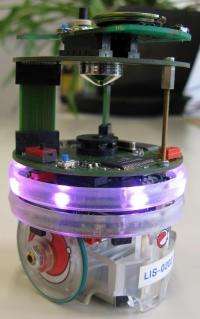
A joint research project conducted at UNIL and EPFL enabled the scientists to follow the evolution of communication in 100 groups of 20 robots over the course of 1000 generations. The robots were equipped with a camera that detected the environment, and also with wheels and a ring enabling them to emit luminous signals of different colors. Positioned in arenas, they had to locate a source of virtual food that was only visible when they came upon it. Their behavior was guided by a “neural network”, which was also controlled by genes that could evolve through mutation and selection in the course of successive generations.

This video is not supported by your browser at this time.

An initial experiment showed that the robots rapidly acquire a communication system that enables them to transmit information about the location of the food to their peers. In fact, two really distinct evolved, according to the given populations. The simplest mechanism, using a single color to indicate the location of the food, proved more effective that the system using two colors – one pointing towards the food and the other towards the remaining part of the arena.

It also became evident that a population that has evolved towards a relatively effective type of communication doesn’t subsequently change it, as it would then be necessary to simultaneously modify the way the information is transmitted, and also the way of responding. In other words, a communication system, just like a language, cannot change rapidly through generations. In addition, this research underlines the importance of random factors in evolutionary processes. The experiment performed in twenty homogenous groups (with robots of the same type) actually shows that half of them choose the simpler – one color – strategy, whereas the other half opt for the two color system.

Competition requests more complex talking

Finally, a second experiment demonstrated that, even with robots, nothing is perfect. Within a competition context, when groups of robots were confronted with robots of other populations, it was the more complex (two-color) strategy that won the day, in spite of the proven effectiveness of the single-color strategy.

Supported by the Swiss National Science Foundation, this research has been published in the magazine PNAS (Proceedings of the National Academy of Sciences of the United States). It shows that communication strategies can evolve in different ways through generations within an identical environment.

“We know that in the animal kingdom communication systems are very complex”, concludes Laurent Keller, “and this diversity evolved over a very long period of time. Our experiment shows how it occurs, and reveals that environmental factors are not the only ones involved, as one might believe. The robots shed new light on these evolutionary processes.”

Provided by Ecole Polytechnique Federale de Lausanne

Filter


Move the slider to adjust rank threshold, so that you can hide some of the comments.


Display comments: newest first

Shifty0x88
Jan 07, 2012

Rank: not rated yet
We know that in the animal kingdom communication systems are very complex, concludes Laurent Keller...


Within a competition context, when groups of robots were confronted with robots of other populations, it was the more complex (two-color) strategy that won the day, in spite of the proven effectiveness of the single-color strategy.


I wonder if they choose the more complex strategy as a result of thinking that, more complex is better, because you can convey more meaning with more words/beeps/phrases/light-colors.
rsklyar
Jan 08, 2012

Rank: not rated yet
United italian research gang from the Italian Institute of Technology (IIT) and Joint Research Centre (JRC), universities of Ferrara and Genova with a leading bandit at Northwestern University (USA) is successfully completed its sequential plagiaristic enterprise: http://issuu.com/...saivaldi
Shifty0x88
Jan 08, 2012

Rank: not rated yet
So I have been thinking about something over the past few days... what if they "killed" the robots with the more complex(2-color) behavior, and kept adding the simpler robots(1-color) into the mix. I wonder if, given enough "generations," and enough of the 1-color robots, they would switch to the simpler robot's behavior because they would "realize" that the 2-color robots are "dying" faster then the simpler 1-color robots.

I think this would be an interesting follow-up study to see what the influence of others(same species) have on a particular robot's behavior.
Rank 5 /5 (3 votes)
Relevant PhysicsForums posts

More news stories

Nvidia trumpets Tegra 3 phone design wins for 2012

(Phys.org) -- Nvidia’s competitive war paint has a name, Tegra 3. On the heels of Nvidia announcements about lowering costs of its Tegra 3 processors and Nvidia-enabled tablets running Android Ice Cream ...

Electronics / Hardware

created 15 hours ago | popularity 5 / 5 (2) | comments 1 | with audio podcast report

Dell tablet leak: 10.1-inch display, two-battery choice

(Phys.org) -- Headline after headline talks about vendors’ tablets in the wings as likely number-one contenders for the iPad. Such claims have justifiably been taken with a grain of salt, considering ...

Electronics / Consumer & Gadgets

created May 26, 2012 | popularity 4 / 5 (4) | comments 11 | with audio podcast report

Nvidia says Kai platform will turn price tide for tablets

(Phys.org) -- In March, Nvidia gave some signs that they were working to lower the cost of their Tegra 3 processors and they suggested consumers might see prices for Android tablets as low as $199. Connect ...

Electronics / Hardware

created May 24, 2012 | popularity 4.3 / 5 (4) | comments 3 | with audio podcast report

OmniVision tops up sensors for cameras, phones

(Phys.org) -- OmniVision has announced two high-resolution image sensors for the digital still and digital video camera market (DS/DVC) and higher end smartphones. In end-user language, it is a claim for superior ...

Electronics / Hardware

created May 25, 2012 | popularity 5 / 5 (6) | comments 3 | with audio podcast report

MIT researchers devise new means to synchronize a group of robots (w/ Video)

(Phys.org) -- For several years, roboticists have been working out ways to get a group of robots to perform synchronized activities as demonstrated most often in dance routines. It’s not just about trying ...

Electronics / Robotics

created May 25, 2012 | popularity 5 / 5 (1) | comments 1 | with audio podcast report


Stunning image of smallest possible five-ringed structure

Scientists have created and imaged the smallest possible five-ringed structure – about 100,000 times thinner than a human hair – and you'll probably recognise its shape.

'Unzipped' carbon nanotubes could help energize fuel cells, batteries

Multi-walled carbon nanotubes riddled with defects and impurities on the outside could replace some of the expensive platinum catalysts used in fuel cells and metal-air batteries, according to scientists at ...

Change in developmental timing was crucial in the evolutionary shift from dinosaurs to birds: study

At first glance, it's hard to see how a common house sparrow and a Tyrannosaurus Rex might have anything in common. After all, one is a bird that weighs less than an ounce, and the other is a dinosaur that ...

Computer model used to pinpoint prime materials for efficient carbon capture

When power plants begin capturing their carbon emissions to reduce greenhouse gases – and to most in the electric power industry, it's a question of when, not if – it will be an expensive undertaking.

T cells 'hunt' parasites like animal predators seek prey, study shows

By pairing an intimate knowledge of immune-system function with a deep understanding of statistical physics, a cross-disciplinary team at the University of Pennsylvania has arrived at a surprising finding: T cells use a movement ...

Land and sea species differ in climate change response: study

(Phys.org) -- Marine and terrestrial species will likely differ in their responses to climate warming, new research by Simon Fraser University and Australia’s University of Tasmania has found.