Climate change is altering mountain vegetation at large scale, European research says
Jan 08, 2012
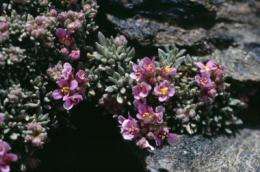
This alpine species (Nevadensia purpurea) could disappear from some European mountains in the next few decades. Credit: Harald Pauli

The decade from 2000 to 2009 was the warmest since global climate has been measured, and while localized studies have shown evidence of changes in mountain plant communities that reflect this warming trend, no study has yet taken a continental-scale view of the situation – until now.

With the publication of "Continent-wide response of mountain vegetation to climate change," scheduled for Advance Online Publication (AOP) in Nature Climate Change on 8 January, researchers from 13 countries report clear and statistically significant evidence of a continent-wide warming effect on mountain plant communities.

The findings are "clearly significant," says Ottar Michelsen, a researcher at the Norwegian University of Science and Technology and one of the article's co-authors. "You can find studies that have shown an effect locally, and where researchers try to say something more globally, but in this case, when you have so many mountains in so many regions and can show an effect, that's a big thing."

The article describes the results of a comprehensive effort to measure plant community changes in the mountains over the whole of Europe, with nearly a decade of time between the sampling efforts. Researchers looked at 60 summit sites and 867 vegetation samples from 17 mountain areas across Europe in 2001 and then revisited the mountain sample sites in 2008. In Norway, researchers studied mountain plots in the Dovre region of central Norway.

By comparing the vegetation found in the sample plots in 2001 and 2008, the researchers were able to see a clear shift in the species in the plots towards species that preferred warmer temperatures.
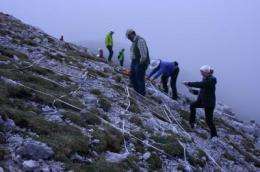
All 32 authors involved in the study used the same sampling procedures enabling pan-continental comparisons to be made for the first time, here at the Austrian Hochschwab mountains. Credit: Harald Pauli

More specifically, the researchers assigned what they called an altitudinal rank to all 764 plant species included in the study. The rank reflects the temperature at which each species has its optimum performance. And because altitude and temperature are directly correlated in each mountain area (the higher your altitude in the mountains, in general, the colder it will be) the location on the mountain where a plant is found reflects its response to the actual temperature at that location.

By summing the altitudinal ranks for the species in the plots, the researchers then used a mathematical formula to give each plot a "thermic vegetation indicator". The indicator was calculated for each plot for 2001 and 2008, and the change in the indicator over the 7 years between sample periods showed researchers whether the mix of plants in each plot had stayed the same or shifted on average to plant types that preferred either colder or warmer temperatures. They then combined the data for the 17 mountain areas for the two time periods to get a continental-scale view of what kind of change, if any, might be underway.

"The transformation of plant communities on a continental scale within less than a decade can be considered a rapid ecosystem response to ongoing climate warming," the researchers wrote. "Although the signal is not statistically significant for single mountain regions, it is clearly significant when data throughout Europe are pooled."

The finding is significant both because the shift in plant communities could be clearly detected over time, but also because it suggests that plants adapted to colder temperatures that are now found in alpine plant communities will be subject to more competition, which "may lead to declines or even local disappearance of alpine plant species," the researchers note. "In fact, declines of extreme high-altitude species at their lower range margins have recently been observed in the Alps."

Explore further: Slovenian flyer lands in France on return trip from Arctic

More information: Continent-wide response of mountain vegetation to climate change. Nature Climate Change, Jan 8, 2012 (Online ahead of print) DOI:10.1038/NCLIMATE1329

add to favorites email to friend print save as pdf

Related Stories

Desert Dust Alters Ecology of Colorado Alpine Meadows

Jun 29, 2009

(PhysOrg.com) -- Accelerated snowmelt--precipitated by desert dust blowing into the mountains--changes how alpine plants respond to seasonal climate cues that regulate their life cycles, according to results ...

Short-lived seed of alpine plants

Sep 21, 2011

Scientists from the Millennium Seed Bank Partnership have found that the seeds of alpine plants are shorter lived than their lowland relatives. This will have implications for seed conservation strategies ...

Rare alpine insect may disappear with glaciers

Apr 05, 2011

Loss of glaciers and snowpack due to climate warming in alpine regions is putting pressure on a rare aquatic insect, the meltwater stonefly, according to a study recently released in Climatic Change Letters.

Recommended for you

Century-old science helps confirm global warming

16 hours ago

(Phys.org) —Ocean measurements taken more than 135 years ago during the scientific expedition of HMS Challenger have provided further confirmation of human-produced global warming over the past century.

Be prepared for weather extremes

18 hours ago

Unsettled weather is an Iowa mainstay, and so is Inside's annual reminder of the university's severe weather safety and preparedness guidelines—for storms, extreme heat, flooding and more.

User comments : 2

Adjust slider to filter visible comments by rank

Display comments: newest first

Howhot
4.3 / 5 (6) Jan 09, 2012
"The transformation of plant communities on a continental scale within less than a decade can be considered a RAPID ECOSYSTEM RESPONSE to ongoing climate warming,"

I don't think it's just alpine systems we are seeing the response in. In the middle latitudes where plants go dormant during the seasonal winters, there are plant stresses on some varieties with earlier warming temps. I've seen dogwood blooming early and being caught by a ice/snow storm event. Has anyone else seen these odd types of events?


deepsand
3 / 5 (6) Jan 09, 2012
Such changes in seasonal events have been observed, recorded, and reported for quite some time now.

Not only are cycles of flora being displaced from their long running norms, but so too the seasonal migrations of a myriad species.

As a bird watcher, the conspicuous changes observed in Pennsylvania over the past decade include:
1) Cedar Waxwings not migrating as far South in Winter as before;
2) More Robins not migrating South in Winter; and,
3) Spring Warbler northward migration happening much earlier.

More news stories

A hidden population of exotic neutron stars

(Phys.org) —Magnetars – the dense remains of dead stars that erupt sporadically with bursts of high-energy radiation - are some of the most extreme objects known in the Universe. A major campaign using ...

Hubble reveals the ring nebula's true shape

(Phys.org) —The Ring Nebula's distinctive shape makes it a popular illustration for astronomy books. But new observations by NASA's Hubble Space Telescope of the glowing gas shroud around an old, dying, ...

NASA head views progress on asteroid lasso mission

Surrounded by engineers, NASA chief Charles Bolden inspected a prototype spacecraft engine that could power an audacious mission to lasso an asteroid and tow it closer to Earth for astronauts to explore.

Controlling mood through the motions of mitochondria

(Medical Xpress)—Regulating the distribution of power in neurons is done by a system that makes the national electric grid look simple by comparison. Each neuron has several thousand mitochondria confined ...

A quantum simulator for magnetic materials

Physicists understand perfectly well why a fridge magnet sticks to certain metallic surfaces. But there are more exotic forms of magnetism whose properties remain unclear, despite decades of intense research. ...