China launches operation to free pandas into wild
January 11, 2012

There have already been 10 unsuccesful attempts at setting pandas free over the past 30 years

Enlarge

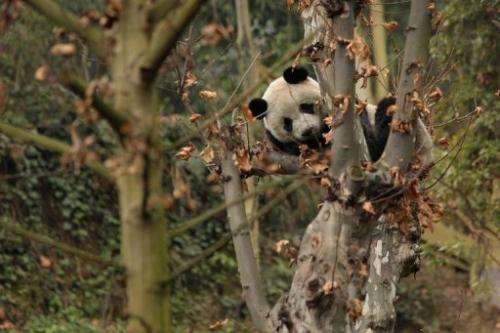
A panda climbs a tree in its new enclosure at the Chengdu Giant Panda Field Research Centre. China released six, young captive pandas into semi-wild enclosures as part of a project aimed at helping the endangered bears adapt to the wild and eventually set them free.

China on Wednesday released six young captive pandas into semi-wild enclosures as part of a project aimed at helping the endangered bears adapt to the wild and eventually go free.

Previous attempts by Chinese authorities to release pandas into the wild have proved unsuccessful. The last bear that was set free in 2006 was found dead after 10 months, apparently killed by wild pandas.

This time round, scientists are releasing the six pandas in stages in a bid to increase their chances of survival, as they try and bring the number of endangered bears in the wild up from the current 1,590.

On Wednesday, Xing Rong, Xing Ya, Gong Zai, Ying Ying, Zhi Zhi and Qi Qi -- aged between two and four -- ambled slowly into their new enclosures in the southwestern province of Sichuan to the flash of cameras.
The pandas will be left to fend for themselves to learn crucial survival skills
Enlarge

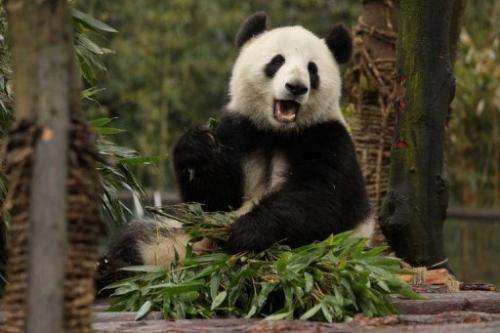
A panda eats bamboo in its new enclosure at the Chengdu Giant Panda Field Research Centre. China has released six, young captive pandas into semi-wild enclosures as part of a project aimed at helping the endangered bears adapt to the wild and eventually set them free.

They will stay in their enclosures in Dujiangyan for a minimum of two months before being let out in a much larger hillside valley nearby, which has been fenced off. Eventually, if all goes well, they will be released into the wild.

Qi Dunwu, head of at the Chengdu panda base near Dujiangyan, told AFP the valley had been kitted out with to enable vets to observe the pandas without disturbing them.

The bears will be left to fend for themselves to learn crucial survival skills, and scientists plan to gradually reduce until they can live in the wild without any assistance.

There have already been 10 attempts at setting pandas free over the past 30 years, and only two are thought to have been successful as the bears find it very hard to survive on their own, the official said.

Of the 10, Xiang Xiang -- the panda that was set free in 2006 -- was found killed, another is also believed to have died, and six of the animals were sent back to the Chengdu base after they lost too much weight, it said.

But scientists hope that releasing six strong, young together -- unlike previous attempts to release the bears individually -- will help them survive.

(c) 2012 AFP


Rank not rated yet
Relevant PhysicsForums posts

More news stories

Manufacturing genes to attack flu virus

An international research team has manufactured a new protein that can combat deadly flu epidemics.

Biology / Biotechnology

created 8 hours ago | popularity not rated yet | comments 0 | with audio podcast

Scientist: Evolution debate will soon be history

(AP) -- Richard Leakey predicts skepticism over evolution will soon be history. Not that the avowed atheist has any doubts himself.

Biology / Evolution

created May 26, 2012 | popularity 3.5 / 5 (20) | comments 96

More plant species responding to global warming than previously thought

(Phys.org) -- Far more wild plant species may be responding to global warming than previous large-scale estimates have suggested.

Biology / Ecology

created May 22, 2012 | popularity 4.6 / 5 (14) | comments 18 | with audio podcast

For monogamous sparrows, it doesn't pay to stray (but they do it anyway)

It's quite common for a female song sparrow to stray from her breeding partner and mate with the male next door, but a new study shows that sleeping around can be costly.

Biology / Plants & Animals

created May 22, 2012 | popularity 5 / 5 (2) | comments 8 | with audio podcast

Thousands of shellfish found dead in Peru

Thousands of crustaceans were found dead off the coast of Lima following the mystery mass death of dolphins and pelicans, the Peruvian Navy said Friday.

Biology / Ecology

created May 26, 2012 | popularity 4.7 / 5 (7) | comments 7


Stunning image of smallest possible five-ringed structure

Scientists have created and imaged the smallest possible five-ringed structure – about 100,000 times thinner than a human hair – and you'll probably recognise its shape.

'Unzipped' carbon nanotubes could help energize fuel cells, batteries

Multi-walled carbon nanotubes riddled with defects and impurities on the outside could replace some of the expensive platinum catalysts used in fuel cells and metal-air batteries, according to scientists at ...

Change in developmental timing was crucial in the evolutionary shift from dinosaurs to birds: study

At first glance, it's hard to see how a common house sparrow and a Tyrannosaurus Rex might have anything in common. After all, one is a bird that weighs less than an ounce, and the other is a dinosaur that ...

Computer model used to pinpoint prime materials for efficient carbon capture

When power plants begin capturing their carbon emissions to reduce greenhouse gases – and to most in the electric power industry, it's a question of when, not if – it will be an expensive undertaking.

T cells 'hunt' parasites like animal predators seek prey, study shows

By pairing an intimate knowledge of immune-system function with a deep understanding of statistical physics, a cross-disciplinary team at the University of Pennsylvania has arrived at a surprising finding: T cells use a movement ...

Land and sea species differ in climate change response: study

(Phys.org) -- Marine and terrestrial species will likely differ in their responses to climate warming, new research by Simon Fraser University and Australia’s University of Tasmania has found.