Chemistry professor developing sustainable bioplastics
January 19, 2012 By Emily Narvaes Wilmsen
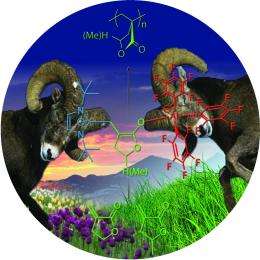
Illustration of Eugene Chen's research
(PhysOrg.com) -- A Colorado State University chemistry professor has developed several patent-pending chemical processes that would create sustainable bioplastics from renewable resources for use on everything from optical fibers and contact lenses to furniture and automobile parts.
Chemistry Professor Eugene Chen and his co-workers have invented a platform of processes to convert small molecules derived from nonedible plant biomass to bioplastics. The molecules can be transformed into different materials depending on the catalyst that is added to them. That catalyst can either be an organic compound or a metal-based compound.
Officials with CSU Ventures, the universitys technology transfer arm, are optimistic about the commercial potential of this work and have filed several provisional patent applications on Chens processes. Two related studies were published last year and this month, both in Angewandte Chemie International Edition.
Each year, the U.S. alone manufactures almost 90 billion pounds of synthetic plastics derived predominantly from fossil fuels, which are not renewable, Chen said. Theres a great deal of concern to develop sustainable polymers or materials that can displace those petrochemical polymers. Theres huge interest in academia and industry, so the largest companies such as Dow Chemical, Dupont and BASF are pursuing sustainable chemical feedstocks to make materials.
The organic process Chen created could be used to produce commodity plastics for everyday uses such as artificial glass, dental resins, automobile parts and furniture. His metal-based process would be used to produce high-performance engineering plastic materials that have superb mechanical and physical properties.
Chen has found in his laboratory that commercially available organic catalysts applied to small molecules derived from plant biomass are very active and efficient the reaction achieves completion within a minute and non-toxic. He also has developed a metal-based catalyst system that produces stereoregular polymers that exhibit superior physical and mechanical properties, meaning theyre very robust and more resistant to such factors as temperature, liquids, chemicals and scratches.
Plastic optical fibers, for example, must sustain exposure to the elements and still perform at a high level so they dont interrupt telecommunications service.
These materials require high resistance to extreme conditions including high temperature and unexpected environmental invasion, Chen said.
Chen has done previous research showing that dissolving plant biomass in green solvent ionic liquids - salts that melt at low temperatures - converts more sugars needed for biofuel more quickly than traditional methods. The discovery was an important step in the move toward the use of nonedible plant biomass as an alternative source for fuel. Most recently, Chens lab has filed a provisional patent for a new catalytic process in ionic liquids to convert plant biomass to platform chemicals.
Chen joined Colorado State in 2000 from Dow Chemical where he researched production of petroleum-based polyolefin plastics. His current research has been supported by grants from the National Science Foundation and the U.S. Department of Energy.
Yuetao Zhang, a research scientist; Yangjian Hu, a postdoctoral fellow; and Garret Miyake, a graduate student, all work with Chen and contribute to the research.
Provided by Colorado State University
-
From lemons to lemonade: Reaction uses carbon dioxide to make carbon-based semiconductor,
32 comments
-
Thioridazine kills cancer stem cells in human while avoiding toxic side-effects of conventional cancer treatments,
3 comments
-
SpaceX private rocket blasts off for space station (Update),
42 comments
-
Climate scientists say they have solved riddle of rising sea,
31 comments
-
SpaceX capsule has 'new car' smell, astronauts say (Update),
4 comments
-
How to find the concentration of nucleic acid solution using optical density?
2 hours ago
-
How do I turn sodium acetate trihydrate into sodium acetate anhydrous and vice versa?
2 hours ago
-
Calculating partial pressures Pa and Pw
5 hours ago
-
Gibbs Free Energy Change/Entropy
15 hours ago
-
What's the rule to covalent character
16 hours ago
-
Schwartz reagent-- NMR/MS/IR
May 26, 2012
- More from Physics Forums - Chemistry
More news stories
Computer model used to pinpoint prime materials for efficient carbon capture
When power plants begin capturing their carbon emissions to reduce greenhouse gases and to most in the electric power industry, it's a question of when, not if it will be an expensive undertaking.
8 hours ago |
not rated yet |
0
|
Scientists develop ultra-sensitive test that detects diseases in their earliest stages
Scientists have developed an ultra-sensitive test that should enable them to detect signs of a disease in its earliest stages, in research published today in the journal Nature Materials.
Chemistry / Analytical Chemistry
8 hours ago |
not rated yet |
0
|
New CO2-removing catalyst can take the heat
(Phys.org) -- The current method of removing the greenhouse gas carbon dioxide (CO2) from the flues of coal-fired power plants uses so much energy that no one bothers to use it. So says Roger Aines, principal ...
May 24, 2012 |
5 / 5 (9) |
11
|
High-speed method to aid search for solar energy storage catalysts
Eons ago, nature solved the problem of converting solar energy to fuels by inventing the process of photosynthesis.
May 25, 2012 |
5 / 5 (3) |
4
|
Researchers demonstrate possible primitive mechanism of chemical info self-replication
(Phys.org) -- When scientists think about the replication of information in chemistry, they usually have in mind something akin to what happens in living organisms when DNA gets copied: a double-stranded molecule ...
May 25, 2012 |
5 / 5 (4) |
2
|
Stunning image of smallest possible five-ringed structure
Scientists have created and imaged the smallest possible five-ringed structure about 100,000 times thinner than a human hair and you'll probably recognise its shape.
'Unzipped' carbon nanotubes could help energize fuel cells, batteries
Multi-walled carbon nanotubes riddled with defects and impurities on the outside could replace some of the expensive platinum catalysts used in fuel cells and metal-air batteries, according to scientists at ...
Change in developmental timing was crucial in the evolutionary shift from dinosaurs to birds: study
At first glance, it's hard to see how a common house sparrow and a Tyrannosaurus Rex might have anything in common. After all, one is a bird that weighs less than an ounce, and the other is a dinosaur that ...
T cells 'hunt' parasites like animal predators seek prey, study shows
By pairing an intimate knowledge of immune-system function with a deep understanding of statistical physics, a cross-disciplinary team at the University of Pennsylvania has arrived at a surprising finding: T cells use a movement ...
Land and sea species differ in climate change response: study
(Phys.org) -- Marine and terrestrial species will likely differ in their responses to climate warming, new research by Simon Fraser University and Australia’s University of Tasmania has found.
Yale study concludes public apathy over climate change unrelated to science literacy
Are members of the public divided about climate change because they don't understand the science behind it? If Americans knew more basic science and were more proficient in technical reasoning, would public consensus match ...