How cells dispose of their waste
January 23, 2012

How cells dispose of their waste

Enlarge

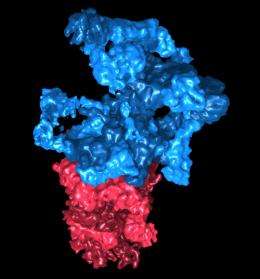
The "regulatory particle" (in blue) detects the proteins tagged with ubiquitin and prepares them for degradation. The "core particle" (in red) breaks the proteins down into their single components. Credit: Julio Ortiz / Copyright: MPI of Biochemistry

German researchers reveal the structure of cellular protein degradation machinery.

Defective proteins that are not disposed of by the body can cause diseases such as Alzheimer's or Parkinson's. Scientists at the Max Planck Institute (MPI) of Biochemistry recently succeeded in revealing the structure of the degradation machinery (26S ) by combining different methods of structural biology.

The results of collaboration with colleagues from the University of California, San Francisco and the Swiss Federal Institute of Technology Zurich (ETH Zürich) represent an important step forward in the investigation of the 26S proteasome. The findings have now been published in Proceedings of the National Academy of Sciences.

At any given point in time, may contain only the proteins that are needed at exactly this moment. Otherwise, undesirable reactions can occur which could cause cancer or other diseases. Furthermore, the proteins have to be folded correctly to fulfill their tasks. Misfolded proteins can clump into aggregates, and neurodegenerative diseases such as Alzheimer's or Parkinson's may be the consequence. In order to prevent this, several mechanisms in the body regulate the number of proteins in the cell and degrade proteins if necessary.

"Cellular waste disposal" – the 26S proteasome – plays an important role in degradation. First, misfolded and potentially dangerous proteins are tagged with molecules called ubiquitin. The 26S proteasome detects the tagged proteins and breaks them down into small fragments, which are then recycled. Scientists in the team of Wolfgang Baumeister, head of the research department "Molecular " at the MPI of Biochemistry, have now been able to reveal its structure.

Many puzzle pieces lead to one structure

"The structure of the 26S proteasome changes continuously," explained Friedrich Förster, head of the research group "Modeling of Protein Complexes" at the MPI of Biochemistry. "That is why until now it could not be explained by means of traditional approaches, such as only using X-ray crystallography. We had to combine different methods to be successful." Electron microscopy and mass spectrometry helped to reveal the general structure of the 26S proteasome. X-ray crystallography provided detailed insights into specific areas of the molecule. The researchers then used computer software to integrate the different data and generate an overall picture.

Based on these results, the researchers next want to find out how the different mechanisms of work in detail. "We have already developed a hypothesis of how exactly the 26S proteasome detects tagged proteins and processes them," said Stefan Bohn, scientist at the MPI of Biochemistry. The complete elucidation of the 26S proteasome and its underlying mechanisms could also be of medical importance: "Cellular waste disposal" is a therapeutic target for cancer und neurodegenerative diseases.

More information: Lasker, K. et al. Molecular architecture of the 26S proteasome holocomplex determined by an integrative approach. Proc. Natl. Acad. Sci., January, 24, 2012. DOI:10.1073/pnas.1120559109

Journal reference: Proceedings of the National Academy of Sciences search and more info website

Provided by Max-Planck-Gesellschaft search and more info website


Rank 5 /5 (7 votes)
Relevant PhysicsForums posts

More news stories

Manufacturing genes to attack flu virus

An international research team has manufactured a new protein that can combat deadly flu epidemics.

Biology / Biotechnology

created 8 hours ago | popularity not rated yet | comments 0 | with audio podcast

Scientist: Evolution debate will soon be history

(AP) -- Richard Leakey predicts skepticism over evolution will soon be history. Not that the avowed atheist has any doubts himself.

Biology / Evolution

created May 26, 2012 | popularity 3.5 / 5 (20) | comments 96

More plant species responding to global warming than previously thought

(Phys.org) -- Far more wild plant species may be responding to global warming than previous large-scale estimates have suggested.

Biology / Ecology

created May 22, 2012 | popularity 4.6 / 5 (14) | comments 18 | with audio podcast

For monogamous sparrows, it doesn't pay to stray (but they do it anyway)

It's quite common for a female song sparrow to stray from her breeding partner and mate with the male next door, but a new study shows that sleeping around can be costly.

Biology / Plants & Animals

created May 22, 2012 | popularity 5 / 5 (2) | comments 8 | with audio podcast

Thousands of shellfish found dead in Peru

Thousands of crustaceans were found dead off the coast of Lima following the mystery mass death of dolphins and pelicans, the Peruvian Navy said Friday.

Biology / Ecology

created May 26, 2012 | popularity 4.7 / 5 (7) | comments 7


Stunning image of smallest possible five-ringed structure

Scientists have created and imaged the smallest possible five-ringed structure – about 100,000 times thinner than a human hair – and you'll probably recognise its shape.

'Unzipped' carbon nanotubes could help energize fuel cells, batteries

Multi-walled carbon nanotubes riddled with defects and impurities on the outside could replace some of the expensive platinum catalysts used in fuel cells and metal-air batteries, according to scientists at ...

Change in developmental timing was crucial in the evolutionary shift from dinosaurs to birds: study

At first glance, it's hard to see how a common house sparrow and a Tyrannosaurus Rex might have anything in common. After all, one is a bird that weighs less than an ounce, and the other is a dinosaur that ...

Computer model used to pinpoint prime materials for efficient carbon capture

When power plants begin capturing their carbon emissions to reduce greenhouse gases – and to most in the electric power industry, it's a question of when, not if – it will be an expensive undertaking.

T cells 'hunt' parasites like animal predators seek prey, study shows

By pairing an intimate knowledge of immune-system function with a deep understanding of statistical physics, a cross-disciplinary team at the University of Pennsylvania has arrived at a surprising finding: T cells use a movement ...

Land and sea species differ in climate change response: study

(Phys.org) -- Marine and terrestrial species will likely differ in their responses to climate warming, new research by Simon Fraser University and Australia’s University of Tasmania has found.