The case of the missing gas mileage
January 4, 2012 by Peter Dizikes
Graphic: Christine Daniloff
Contrary to common perception, the major automakers have produced large increases in fuel efficiency through better technology in recent decades. Theres just one catch: All those advances have barely increased the mileage per gallon that autos actually achieve on the road.
Sound perplexing? This situation is the result of a trend newly quantified by MIT economist Christopher Knittel: Because automobiles are bigger and more powerful than they were three decades ago, major innovations in fuel efficiency have only produced minor gains in gas mileage.
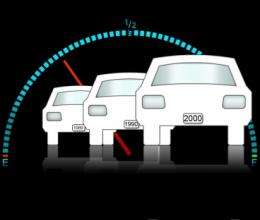
Specifically, between 1980 and 2006, the average gas mileage of vehicles sold in the United States increased by slightly more than 15 percent a relatively modest improvement. But during that time, Knittel has found, the average curb weight of those vehicles increased 26 percent, while their horsepower rose 107 percent. All factors being equal, fuel economy actually increased by 60 percent between 1980 and 2006, as Knittel shows in a new research paper, Automobiles on Steroids, just published in the American Economic Review (download PDF).
Thus if Americans today were driving cars of the same size and power that were typical in 1980, the countrys fleet of autos would have jumped from an average of about 23 miles per gallon (mpg) to roughly 37 mpg, well above the current average of around 27 mpg. Instead, Knittel says, Most of that technological progress has gone into [compensating for] weight and horsepower.
And considering that the transportation sector produces more than 30 percent of U.S. greenhouse gas emissions, turning that innovation into increased overall mileage would produce notable environmental benefits. For his part, Knittel thinks it is understandable that consumers would opt for large, powerful vehicles, and that the most logical way to reduce emissions is through an increased gas tax that leads consumers to value fuel efficiency more highly.
When it comes to climate change, leaving the market alone isnt going to lead to the efficient outcome, Knittel says. The right starting point is a gas tax.
Giving the people what they want
While auto-industry critics have long called for new types of vehicles, such as gas-electric hybrids, Knittels research underscores the many ways that conventional internal-combustion engines have improved.
Among other innovations, as Knittel notes, efficient fuel-injection systems have replaced carburetors; most vehicles now have multiple camshafts (which control the valves in an engine), rather than just one, allowing for a smoother flow of fuel, air and exhaust in and out of engines; and variable-speed transmissions have let engines better regulate their revolutions per minute, saving fuel.
To be sure, the recent introduction of hybrids is also helping fleet-wide fuel efficiency. Of the thousands of autos Knittel scrutinized, the most fuel-efficient was the 2000 Honda Insight, the first hybrid model to enter mass production, at more than 70 mpg. (The least fuel-efficient car sold in the United States that Knittel found was the 1990 Lamborghini Countach, a high-end sports car that averaged fewer than nine mpg).
To conduct his study, Knittel drew upon data from the National Highway Transportation Safety Administration, auto manufacturers and trade journals. As those numbers showed, a major reason fleet-wide mileage has only slowly increased is that so many Americans have chosen to buy bigger, less fuel-efficient vehicles. In 1980, light trucks represented about 20 percent of passenger vehicles sold in the United States. By 2004, light trucks including SUVs accounted for 51 percent of passenger-vehicle sales.
I find little fault with the auto manufacturers, because there has been no incentive to put technologies into overall fuel economy, Knittel says. Firms are going to give consumers what they want, and if gas prices are low, consumers are going to want big, fast cars. And between 1980 and 2004, gas prices dropped by 30 percent when adjusted for inflation.
The road ahead
Knittels research has impressed other scholars in the field of environmental economics. I think this is a very convincing and important paper, says Severin Borenstein, a professor at the Haas School of Business at the University of California at Berkeley. The fact that cars have muscled up rather than become more efficient in the last three decades is known, but Chris has done the most credible job of measuring that tradeoff. Adds Borenstein: This paper should get a lot of attention when policymakers are thinking about what is achievable in improved automobile fuel economy.
Indeed, Knittel asserts, given consumer preferences in autos, larger changes in fleet-wide gas mileage will occur only when policies change, too. Its the policymakers responsibility to create a structure that leads to these technologies being put toward fuel economy, he says.
Among environmental policy analysts, the notion of a surcharge on fuel is widely supported. I think 98 percent of economists would say that we need higher gas taxes, Knittel says.
Instead, the major policy advance in this area occurring under the current administration has been a mandated rise in CAFE standards, the Corporate Average Fuel Economy of cars and trucks. In July, President Barack Obama announced new standards calling for a fleet-wide average of 35.5 mpg by 2016, and 54.5 mpg by 2025.
According to Knittels calculations, the automakers could meet the new CAFE standards by simply maintaining the rate of technological innovation experienced since 1980 while reducing the weight and horsepower of the average vehicle sold by 25 percent. Alternately, Knittel notes, a shift back to the average weight and power seen in 1980, along with a continuation of the trend toward greater fuel efficiency, would lead to a fleet-wide average of 52 mpg by 2020.
That said, Knittel is skeptical that CAFE standards by themselves will have the impact a new gas tax would. Such mileage regulations, he says, end up reducing the cost of driving. If you force people to buy more fuel-efficient cars through CAFE standards, you actually get whats called rebound, and they drive more than they would have. A gas tax, he believes, would create demand for more fuel-efficient cars without as much rebound, the phenomenon through which greater efficiency leads to potentially greater consumption.
Fuel efficiency, Knittel says, has come a long way in recent decades. But when it comes to getting those advances to have an impact out on the road, there is still a long way to go.
Provided by
Massachusetts Institute of Technology
This story is republished courtesy of MIT News (http://web.mit.edu/newsoffice/), a popular site that covers news about MIT research, innovation and teaching.
-
From lemons to lemonade: Reaction uses carbon dioxide to make carbon-based semiconductor,
32 comments
-
Thioridazine kills cancer stem cells in human while avoiding toxic side-effects of conventional cancer treatments,
3 comments
-
SpaceX private rocket blasts off for space station (Update),
42 comments
-
Climate scientists say they have solved riddle of rising sea,
31 comments
-
SpaceX capsule has 'new car' smell, astronauts say (Update),
4 comments
-
Need a rigid insulation material???
23 hours ago
-
magnets or EMF in car bumpers to protect from fender bender
May 26, 2012
-
length of wire in a coil of known dimensions?
May 25, 2012
-
India Engineering Powerhouse
May 25, 2012
-
electromagnet core dereference between hard and soft iron
May 25, 2012
-
Measuring water pressure in an open tank
May 24, 2012
- More from Physics Forums - General Engineering
More news stories
Browser wars flare in mobile space
The browser wars are heating up again, but this time the fight is for dominance of the mobile Internet.
15 hours ago |
5 / 5 (2) |
3
Probability of contamination from severe nuclear reactor accidents is higher than expected: study
Catastrophic nuclear accidents such as the core meltdowns in Chernobyl and Fukushima are more likely to happen than previously assumed. Based on the operating hours of all civil nuclear reactors and the number ...
Technology / Energy & Green Tech
May 22, 2012 |
3.6 / 5 (25) |
56
|
HyperSolar shows dirty water no barrier to power world
(Phys.org) -- The Santa Barbara, California, company, HyperSolar, is set to transparently share the ups and downs of its research experiences toward the companys ultimate vision, successfully producing ...
SpotterRF debuts Radar Backpack Kit (w/ Video)
(Phys.org) -- SpotterRF has announced a special radar backpack kit designed to enhance situational awareness for soldiers on the ground. The company says its special radar is designed for warfighters as part ...
Tesla to launch electric sedan in US on June 22
Tesla Motors said Tuesday it would begin deliveries of "the world's first premium electric sedan" on June 22, slightly ahead of schedule.
Technology / Energy & Green Tech
May 22, 2012 |
4.5 / 5 (12) |
18
Stunning image of smallest possible five-ringed structure
Scientists have created and imaged the smallest possible five-ringed structure about 100,000 times thinner than a human hair and you'll probably recognise its shape.
'Unzipped' carbon nanotubes could help energize fuel cells, batteries
Multi-walled carbon nanotubes riddled with defects and impurities on the outside could replace some of the expensive platinum catalysts used in fuel cells and metal-air batteries, according to scientists at ...
Change in developmental timing was crucial in the evolutionary shift from dinosaurs to birds: study
At first glance, it's hard to see how a common house sparrow and a Tyrannosaurus Rex might have anything in common. After all, one is a bird that weighs less than an ounce, and the other is a dinosaur that ...
Computer model used to pinpoint prime materials for efficient carbon capture
When power plants begin capturing their carbon emissions to reduce greenhouse gases and to most in the electric power industry, it's a question of when, not if it will be an expensive undertaking.
T cells 'hunt' parasites like animal predators seek prey, study shows
By pairing an intimate knowledge of immune-system function with a deep understanding of statistical physics, a cross-disciplinary team at the University of Pennsylvania has arrived at a surprising finding: T cells use a movement ...
Land and sea species differ in climate change response: study
(Phys.org) -- Marine and terrestrial species will likely differ in their responses to climate warming, new research by Simon Fraser University and Australia’s University of Tasmania has found.
Jan 04, 2012
Rank: 2.3 / 5 (27)
On a totally separate note - I wonder why our children continue to produce the worst scores in the field of science.
Jan 04, 2012
Rank: 2.2 / 5 (43)
Federal involvement in the education system. The quality of education has declined in proportion to federal intrusion into the education system. The obvious solution is to eliminate the Department of Education.
Jan 04, 2012
Rank: 2.2 / 5 (43)
We do not need more taxes. We do not need more federal involvement in our daily lives. We do need to stop listening to the AGW nuts.
Jan 04, 2012
Rank: 2 / 5 (27)
I have a nice Wensleydale for that whine.
Here is a case in point describing the counter purposes Gob'mint regulators have with automobiles.
My father has always purchased Buicks (he is 86, after all). He had a '94 Park Avenue 3.8l V6 which got 32mpg on the highway at interstate speeds (70mph). He purchased a '98, same model Park Avenue 3.8l V6 which was capable of 34mpg. In 2007 he bought a Buick Lucerne 3.8l V6 (replacement for the Park Avenue). It is only capable of 27mpg. Additional "safety" equipment adds 400 lbs to the mass of the car. Crap on a stick, these government regulations.
Jan 04, 2012
Rank: 3.1 / 5 (9)
Jan 04, 2012
Rank: 2.2 / 5 (29)
Jan 04, 2012
Rank: 3.9 / 5 (12)
Jan 04, 2012
Rank: 1.8 / 5 (4)
Jan 04, 2012
Rank: 2.9 / 5 (9)
Jan 04, 2012
Rank: 3 / 5 (5)
Jan 04, 2012
Rank: 2.7 / 5 (7)
The is purely political wishful thinking. Changes in policies are unlikely to effect changes in consumer preferences - ever.
Jan 04, 2012
Rank: 2.2 / 5 (5)
Jan 04, 2012
Rank: 4.8 / 5 (14)
Motorcycle and moped ownership has risen sharply over the past two decades... perhaps this is skewing the results of the study in this article.
Regardless, climate control is one of the very few things that require government oversight because there's no inherent profit in having a clean industry. Global warming aside, one need only go to Mexico City or Beijing to see what happens locally when there are essentially no regulations on pollution
Jan 04, 2012
Rank: 4.6 / 5 (22)
Also, gotta love the knee-jerk reaction of the American commenters to taxes. In most other countries gas is not subsidized by the government. It's the absolute opposite -- gas is taxed heavily. As stated in the article and by Tadchem, policies don't change consumer preferences. Taxes do.
I pay 1.70 eur for a liter of gas, last time I checked the average price in the USA was about 0.60 eur or something. And because of that, people here want to drive efficient vehicles, not freakin' TRUCKS.
Jan 04, 2012
Rank: 5 / 5 (21)
You may be familiar with the phrase "Your freedom to swing your fists stops at my nose". If you can arrange the world so that your choice of car affects no one else, drive what you like. The more impact you have, the more you must expect others to take an interest.
If it helps, substitute slavery for environment, and see whether what you wrote still works as a moral argument: "How about if you oppose slavery YOU buy a robot instead and don't try to force your beliefs or values on everybody else." Or substitute abortion. If you are unwilling to accept the same form of argument with other topics substituted, you have no coherent position. If you are willing to accept any substitution, don't complain if you have to pay for others' externalities.
Jan 04, 2012
Rank: 2.1 / 5 (10)
The reason cars weigh more, is to make them safer.
For example, Porsche, would make tens of billions of dollars if they came out with a car that weighed only 2000lbs. So why dont they? Because it would be unsafe, and not road legal. Passengers would die when it was impacted by a truck.
Believe me, car manufacturers, and consumers, would LOVE to driver cars that weighed less. But the laws of F=ma require us to have some amount of weight to counteract obsticals we may encounter on the street.
Go ahead Mr. Knittel, get yourself a 81 GTI, put a modern direct injected turbo in it and drive it around. You'll get great gas mileage, and that GTI will wrap itself around you like tinfoil the first time it snows and you slide into a ditch.
Jan 04, 2012
Rank: 2.2 / 5 (14)
Wrong.
Neither policy nor taxes will change consumer preference, but they may coerce them to act counter to their preference.
Jan 04, 2012
Rank: 5 / 5 (3)
http://en.wikiped...d_States
Plus additional taxes by state. A big problem is that the tax isn't well advertised so many people assume it's "big oil" driving the prices up. As an american, I'm sad to say that many of my fellow citizens need big signs saying things like "the state is taxing your gas" and "you probably don't need to drive as much as you think so stop complaining about gas prices" to actually consider that gas is directly linked to market prices instead of some dark and mysterious arab figure thwarting their daily lives.
A Nobel prize winner wrote in a medical journal, roughly, that the smoking culture in America lives on because we refuse to blame ourselves for the problem. The same seems to be true of gas prices and consumerism. Big, bulky cars will be around until we're willing to take personal responsibility. Note from my earlier post that I still haven't quite done it...
Jan 04, 2012
Rank: 4.7 / 5 (11)
Jan 04, 2012
Rank: 4 / 5 (1)
Jan 04, 2012
Rank: 5 / 5 (10)
If you're going up against a 20 - 40 ton truck, whether your car weighs 1 ton or 3 makes very little difference. Meanwhile, if car drivers drove smaller cars, they'd have better economy, and the same risk from each other.
Do you define preferences as being independent of cost? If yes, why exclude that relevant factor?
Jan 04, 2012
Rank: 1.3 / 5 (12)
Your analogy fails. Other than your disagreement, his choice to buy a truck does not impact you at all, whereas the rights of the slave are clearly being violated, not yours. Disagreement with the choice of another person does not equate to your rights being violated.
Also, exaggerating the impact of something on your life so as to try and make a case of a violation of your rights won't do it either.
Jan 04, 2012
Rank: 2.6 / 5 (9)
A gas tax isn't going to decrease the miles I have to drive to work or for my kid. That's an idea that only a wealthy person can like.
Jan 04, 2012
Rank: 3.7 / 5 (11)
Sounds great as long as I can come fart in your face any time I want and force you to breathe my shit-gas, because thats what you're doing to me bitch.
I ride a bike whenever I can, the amount of acetaldehyde in the air makes me sick and I can literally feel it rising every few months or during large emission times like thanksgiving/xmas.
If you want to live in a choking atmosphere filled with pollutants that damage your brain then go do it somewhere else and get the fuck off my planet. PERIOD.
Jan 04, 2012
Rank: 3.7 / 5 (9)
Don't give me that bull argument against fairy farts and gay beam powered infrastructure.
Go suck a tailpipe and tell me gasoline is great!
I'd rather be using a horse to commute than be forced to inhale benzene, acetaldehyde and carbon monoxide for no fucking reason.
This is a science website, get a freaking brain and learn what pollution is. Or has it already lowered your IQ enough to make that futile? Pollution doesn't just make old people and children get a little sicky, it damages your fucking brain, do you even understand what that means??????
Jan 04, 2012
Rank: 1.4 / 5 (13)
I don't know if the 51% figure is accurate but the main reason beyond load capacity for driving a pickup is that it has an engine in the front and drive wheels in the back. Front wheel drive is rubbish.
@cave man
Move somewhere more third worldish, you'll enjoy it, and so will we. Win, win.
The air is cleaner today than it was 50 years ago. How did you ever survive childhood?
Jan 04, 2012
Rank: 5 / 5 (6)
Better crumple zones require better metals & computer based design, not added weight in any way.
Secondly the added weight is for comfort & luxury, more padded seats, electric motors on everything conceivable & all the other unnecessary additions.
Cars used to be a mode of transport to get from a to b but now is a home away from home.. Auto makers are appealing to our wants rather than needs to a) sell cars.
If we could go back to the basic concept of 'transport' we would save fuel (a finite resource) & reduce emissions (which effects everyone regardless if its global warming of lung problems from smog)
the problem is always the human element...
Jan 04, 2012
Rank: 3.8 / 5 (5)
you dont seem very smart here, maybe you should read up on what you are burning in your ICE these days:
http://en.wikiped...hemistry
Also see the section about carcinogenicity.
Oh and I would pay to see you try to drive a rear wheel drive car on my street during any of the 3 months of winter. It would be quite a show watching you fishtail off the downhill side and into a ravine. But, you MUST be right, front wheel drive is rubbish because you say so.
And as for third world countries? look at Brazil, they burn ethanol and even all their presidents in south america are getting cancer. But you cornhole morons keep pushing ethanol saying it's the answer to renewable fuel (and apparently the solution to anyone with an intelligent argument about anything)
Jan 04, 2012
Rank: 3.4 / 5 (5)
That starts with the assumption that everyone agrees those things are problems. There are plenty of people who would say that placing a tax on fast food is a good idea too, but that is getting into some hot debate territory.
Personally, I think the guy above has forgotten how taxation is supposed to work. As far as I know, the idea is that when the majority decide that something is needed, you figure out how much it'll cost and then you raise tax money to pay for it. Roads or the military, for example. The idea of raising a tax sheerly for the purpose of social engineering, without any clear need that demands funding, seems directionally wrong to me. Who gets this money?
How about changing the vehicle tax so that it adjusts based on vehicle weight in stead?
Jan 04, 2012
Rank: not rated yet
For comparison, the '81 gti weighed only 1800lbs, and carried four people (if cramped). Maybe a better example would be the '77 Porsche 911 which weighed 2000lbs. There is no reason in the world Porsche would have added weight to the 911, except that it was required by new safety regulations.
The current 3000lb GT3 RS is an example of a car with ALL the comfort stripped out, so as to be faster. And it is still heavy compared 80s deathtraps.
Jan 04, 2012
Rank: 1 / 5 (1)
Health statistics and mortality rate data is contrary to your fearmongering opinion. The net benefit of ICE transportation far outweighs the drawbacks. You can compare real life data between different places around the world today or look at historical data over time, and both show that you are exagerating the negatives and/or ignoring the positives.
Jan 04, 2012
Rank: 5 / 5 (3)
"Average citizen" doesn't realize that certain taxes are meant to deincentivize certain behaviors, perhaps because the overall tax code is so confusing (although that's a totally different conversation).
PS, excellent comments, GSwift. Thanks for adding to the conversation and making us think
Jan 04, 2012
Rank: 3.3 / 5 (3)
To be effective it would need to be a completely seperate tax bill, ideally. You might also want to make them pay it up front when buying the car, as opposed to letting the dealer roll it into the financing deal. The weight tax info on a given vehicle could even be printed on the window sticker, right next to the mileage info. (I'm thinking Federal, rather than State). Then you could get a double whammy by using the funds from the heavy vehicles to offer a rebate to people with light vehicles too. People in the middle would pay/receive nothing I suppose.
P.S. to the person who characterized the Buick Park Avenue as an old person's car above, I happen to drive one and I'm only 41. You're exactly right about the mileage it gets though. That 3.8 is a great engine.
Jan 04, 2012
Rank: 3.7 / 5 (3)
Jan 04, 2012
Rank: 2.8 / 5 (4)
Jan 04, 2012
Rank: 1.8 / 5 (5)
Artificial cost...
Jan 04, 2012
Rank: 1 / 5 (1)
http://wattsupwit...re-54207
I wonder how much of the Australian report is backed up by other similar studies? I haven't cross-referenced it against EPA and DoE figures yet, but I know they have some.
Jan 04, 2012
Rank: 1 / 5 (1)
Kinda makes this discussion about whether we need a huge gas tax irrelevant, since the price is going to skyrocket and cause a decline in consumption in the next 10 to 20 years anyway, doesn't it?
Jan 04, 2012
Rank: 5 / 5 (4)
That's right, but it will factor in when you buy a new car. The cost of the commute will also factor in when deciding on a job. On average, people would choose jobs that are not so far away, and drive more efficient cars.
They would also cut down on unnecessary trips, such as driving across town to save a few bucks on some purchase.
I don't like taxes either, but they really do influence behavior.
I think that, if done right, they correct a major flaw of the free market: externalities are not taken into account in prices. If pollution takes a lot of money to deal with, buying a car and driving must pay for that.
Jan 05, 2012
Rank: 5 / 5 (7)
http://en.wikiped..._paradox
Same theory applies to gas and oil. Unless a Government implement a tax society will burn up this resource faster and faster until it is all gone or priced out of existence no matter how efficient that vehicle is made. Another paradox/irony is if everyone did the right thing by others this tax would be entirely unnecessary
Jan 05, 2012
Rank: 1.6 / 5 (7)
However,
- Cave Man
It is not YOUR planet you knuckle dragging throwback and the overwhelming majority of the human species are quite happy to pollute the air for efficient transport. It is clearly YOU that should get off OUR planet.
Jan 05, 2012
Rank: 5 / 5 (1)
It's a broad category including sport utility vehicles, crossover vehicles, vans, minivans, as well as pickup trucks and commercial light delivery vehicles. Many have car underbodies and are only vaguely considered light trucks because their form factor isn't that of a sedan or hatchback.
This category is popular with Americans for the simple reason that the vehicles in it tend to be able to carry more stuff (or people).
And then there's law enforcement. Nothing says "hello" like a five-ton armored SUV with police markings. They're in the category of 'light trucks,' too.
The "light truck" category will still have a lot of appeal in the US, even if it is downsized and its mileage upgraded. I don't think that's a bad thing. Our needs and Europe's for vehicular form factors do overlap, but they aren't identical (and there is no reason they should be).
Jan 05, 2012
Rank: 3 / 5 (1)
Guys, don't believe me? Try this thought experiment: test drive a tiny, fuel efficient vehicle and bring it home, saying you just bought it, what do you think? Then note the expression from your significant other.
Jan 05, 2012
Rank: 1 / 5 (1)
Yeah, that category includes the majority of fleet vehicles for businesses. Delivery vans, etc. so it isn't really a matter of having a choice there. Most companies are already using the smallest vehicle that can handle their business needs.
We would probably get more bang for the buck if we look at heavy trucks and busses, rather than personal transportation. There's a LOT of room for improvement in heavy trucks. Look at UPS trucks for example. They still use the same basic design that they've had since I was a kid. School busses too.
A program to improve building codes and require energy efficient structures is another place where we could gain a lot for little cost, maybe even a cost saving in the long term.
The US needs jobs first and foremost though.
Jan 05, 2012
Rank: 2.3 / 5 (6)
It's called the free market. It's what happens when you don't have any regulation like some idiots want.
Jan 05, 2012
Rank: 5 / 5 (5)
If you make the additional assumption that responsibility sufficiently diluted is zero, you are right. To illustrate, imagine I invested in a company, knowing that its profits depend on slave labour. I am a small investor, so I make no difference to the behaviour of the company, yet if no one invested, it would not exist. If you were one of the slaves, would you argue I bear no responsibility for your situation?
If yes, you say that if there is a significant problem that does depend on many individual decisions, yet each individual has negligible impact, then no one has any responsibility at all.
I argue that car driving is one example of significant negative cumulative impact, even though each individual has little influence. I don't agree that absolves people from responsibility.
Jan 05, 2012
Rank: 5 / 5 (2)
Kinda makes this discussion about whether we need a huge gas tax irrelevant, since the price is going to skyrocket and cause a decline in consumption in the next 10 to 20 years anyway, doesn't it?
Indeed! But then again, the common folk in every great civilization were always led to beleive that their way of life was going to be eternal and was superior to all others...
Then there's this guy......
Ya gotta love the "It's better to burn out than fade away" outlook on life....put your philosophy to the test by having some kids and let them do what they want without regulating their behaviour....jackass.
Jan 05, 2012
Rank: not rated yet
Of course it's a diesel and not made in the US.
Jan 06, 2012
Rank: 1.6 / 5 (7)
I speak from personal experience as I do actually own one of these cars and it doesn't use an environmentally unsound battery either.
Jan 07, 2012
Rank: not rated yet
Ever notice how we look to Economics for all our scientific breakthroughs these days?
Well, except for those we get from transportation engineers.
Jan 08, 2012
Rank: 1 / 5 (3)
The only thing this article shows is that some people should not get a higher education.
Reduce the price of electricity so that it becomes insignificant and the cheapest form of consumer energy use and solve the whole environmental issue about any impact that individual consumers can have on the environment.
Jan 08, 2012
Rank: 1 / 5 (1)
Jan 08, 2012
Rank: 3.7 / 5 (3)
Jan 08, 2012
Rank: 3.5 / 5 (2)
let's go after the other 70%, as it is probably connected to industrial, energy production, and manufacturing processes.
Thus, it will be more standardized, in level/effect/localization/area(location) and easier to achieve via technology and application, than any 1000 different gasoline engine designs and applications.
Concentrating on the automotive manufacturers is a bassackward way of achieving anything in the realm of reduction of airborne pollutants.
This last point clarifies the record with regard to corporations and governments working together--against the will of the people.
There is a word for that, you know....
Jan 08, 2012
Rank: 3.7 / 5 (6)
And you are proud of such colossal waste?
Gasoline will cost over $8.00 (constant dollars) a gallon by 2030.
Jan 08, 2012
Rank: 3 / 5 (6)
Figure 2 shows a plot of energy consumption per unit of GDP. On this graph, GDP is not measured in constant dollars.
http://205.254.13..._img.png
http://eco-efficiency-action-project.com/wp-content/uploads/2010/06/Picture31.png
http://www.energy...hina.jpg
http://t3.gstatic...qHuoQj4w
As shown above, the real energy intensity of the U.S. has fallen by 20 percent since 1980. But the author of the article on the Global warming Denialist website "Whatts up with that" shows U.S. energy intensity falling by 80 percent.
Yet another lie from Anthony Whatts.
Jan 08, 2012
Rank: 2.6 / 5 (5)
Horses have an entirely different set of externalities with respect to transportation.
Have you been a non-thinker all of your life?
"Extending the theory to the logical extreme - if we all rode horses we would be more environmental. " - CsyGuy
Jan 08, 2012
Rank: 3 / 5 (2)
(in my defense I've had that car for 3 years and I only have about 7000 miles on it. Just because you own a gas guzzler doesn't mean you drive it)
Jan 09, 2012
Rank: not rated yet
Jan 09, 2012
Rank: 1 / 5 (3)
Jan 09, 2012
Rank: 1 / 5 (1)
Actually, the figure on Watt's site is based on adjusted dollars of GDP, just like yours. The difference between your graph and the one I linked to is that they are not measuring the same thing.
Your graph is BTU/GDP for total energy use (independent of fuel, so that includes ethenol, hydroelectric, solar, wind, etc..).
The graph I linked to is barrels of oil/GDP (oil consumption only, and that's mostly automobile fuel, which is what we're talking about here).
As usual, you are all smoke and mirrors. You either don't understand what you read or you are misleading people on purpose. And you have the nerve to call someone else a liar?
Jan 09, 2012
Rank: 1 / 5 (1)
lol. They would just nag you to ride a smaller horse.
Jan 10, 2012
Rank: 1 / 5 (1)