Battery, heal thyself: Inventing self-repairing batteries
January 11, 2012 By Louise Lerner
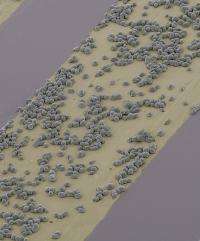
These microcapsules, filled with liquid metal, sit on a gold conductive layer. If the circuit is mechanically damaged, the capsules burst to restore the conductive pathway. Each is just 10 microns across; 10 could fit side by side in a human hair. Image by Amanda Jones and Ben Blaiszik.
(PhysOrg.com) -- Imagine dropping your phone on the hard concrete sidewalkbut when you pick it up, you find its battery has already healed itself.
A team of researchers from the University of Illinois at Urbana-Champaign (UIUC) and the U.S. Department of Energy's (DOE) Argonne National Laboratory are exploring ways to design batteries that heal themselves when damaged.
"This would help electronics survive daily useboth the long-term damage caused by charging over and over again, and also the inevitable physical damage of everyday life," said Jeff Moore, a UIUC scientist on the team.
Scientists think that loss of electrical conductivity is what causes a battery to fade and die. Theories abound on the specific molecular failures; perhaps chemicals build up on electrodes, or the electrodes themselves pull away. Perhaps it's simply the inevitable stress fractures in materials forced to expand and contract repeatedly as the battery is charged and used.
In any case, the battery's storage capacity drops due to loss of electrical conductivity. This is what the team wants to address.
The idea is to station a team of "emergency repairmen" already contained in the battery. These are tiny microspheres, each smaller than a single red blood cell, and containing liquid metal inside. Added along with the battery components, they lie dormant for most of the battery's lifetime.
But if the battery is damaged, the capsules burst open and release their liquid metal into the battery. The metal fills in the gaps in the electrical circuit, connecting the broken lines, and power is restored.
Capsules could be designed to be triggered by different eventssome that respond to physical damage and others that respond to overheating, for example. This would allow scientists to tailor the contents of the different capsules to repair specific situations.
This video is not supported by your browser at this time.
Microcapsules have been manufactured in large scale since the 1950s. When you press your pencil down on carbonless copy paper, microcapsules full of ink burst open to leave an imprint on the paper layers beneath. Microcapsules full of perfume burst when you rub a scratch-and-stiff sticker."We hope that using microcapsules, which are a well-known technology, could make this technology easy to scale up for commercial use," Moore said.
The team's first step was to test the system in a simple system, connecting an electrode with a wire to see if the capsules could "heal" the circuit if cut. (Watch a demonstration of this in the video above).
"Our new self-healing materials can completely repair the circuit in less than a millisecond," Moore said.
The next step, which the researchers are beginning, is to test the capsules in a prototype battery. Argonne materials scientist and battery expert Khalil Amine is helping the team adapt the capsules for lithium-ion batteries. Other collaborators are UIUC scientists Nancy Sottos and Scott White.
The work is funded through the Center for Electrical Energy Storage (CEES), one of three Argonne-led Energy Frontier Research Centers (EFRCs). Established in 2009 by a special block grant from DOE, the EFRCs are five-year interdisciplinary programs focused around specific scientific challenges that are believed to be key to breakthroughs in energy technology.
The CEES is addressing the problems that limit electrochemical energy storage technologiessuch as batteries and supercapacitorsfor transportation, residential and commercial use.
The results have been published in a paper, "Autonomic Restoration of Electrical Conductivity", in the journal Advanced Materials. Moore's co-authors on the paper are Benjamin Blaiszik, Sharlotte Kramer, Martha Grady, David McIlroy, Nancy Sottos and Scott White.
Provided by
Argonne National Laboratory
-
From lemons to lemonade: Reaction uses carbon dioxide to make carbon-based semiconductor,
32 comments
-
Thioridazine kills cancer stem cells in human while avoiding toxic side-effects of conventional cancer treatments,
3 comments
-
SpaceX private rocket blasts off for space station (Update),
42 comments
-
Climate scientists say they have solved riddle of rising sea,
31 comments
-
SpaceX capsule has 'new car' smell, astronauts say (Update),
4 comments
-
Laser noise spectrum
8 hours ago
-
Transparency of molten substances?
May 25, 2012
-
saturated paramagnetic and ferromagnetic
May 24, 2012
-
How to calculate the bandstructure of Twisted Bilayer Graphene
May 23, 2012
-
vast computational richness from swapping one proton
May 22, 2012
-
Oscillator strength of mixed LH- and HH-excitons
May 22, 2012
- More from Physics Forums - Atomic, Solid State, Comp. Physics
More news stories
Is a classical electrodynamics law incompatible with special relativity?
(Phys.org) -- The laws of classical electromagnetism that were developed in the 19th century are the same laws that scientists use today. They include Maxwell’s four equations along with the Lorentz la ...
Landmark calculation clears the way to answering how matter is formed
(Phys.org) -- An international collaboration of scientists, including Thomas Blum, associate professor of physics, is reporting in landmark detail the decay process of a subatomic particle called a kaon ...
May 25, 2012 |
4.3 / 5 (22) |
52
|
Lying in wait for WIMPs: Researchers seek to dramatically increase sensitivity of Large Underground Xenon detector
Although it's invisible, dark matter accounts for at least 80 percent of the matter in the universe. No one knows what it is, but most scientists would bet on weakly interacting massive particles, or WIMPs.
May 23, 2012 |
4 / 5 (7) |
18
|
Hawaii lab turns laser-powered bubbles into microrobots
(Phys.org) -- A team of scientists from the University of Hawaii are working on microrobots created from bubbles of air in a saline solution. The bubbles take on their title of robots as a laser ...
Sound increases the efficiency of boiling
Scientists at the Georgia Institute of Technology achieved a 17-percent increase in boiling efficiency by using an acoustic field to enhance heat transfer. The acoustic field does this by efficiently removing vapor bubbles ...
May 24, 2012 |
5 / 5 (2) |
2
Stunning image of smallest possible five-ringed structure
Scientists have created and imaged the smallest possible five-ringed structure about 100,000 times thinner than a human hair and you'll probably recognise its shape.
'Unzipped' carbon nanotubes could help energize fuel cells, batteries
Multi-walled carbon nanotubes riddled with defects and impurities on the outside could replace some of the expensive platinum catalysts used in fuel cells and metal-air batteries, according to scientists at ...
Change in developmental timing was crucial in the evolutionary shift from dinosaurs to birds: study
At first glance, it's hard to see how a common house sparrow and a Tyrannosaurus Rex might have anything in common. After all, one is a bird that weighs less than an ounce, and the other is a dinosaur that ...
Computer model used to pinpoint prime materials for efficient carbon capture
When power plants begin capturing their carbon emissions to reduce greenhouse gases and to most in the electric power industry, it's a question of when, not if it will be an expensive undertaking.
T cells 'hunt' parasites like animal predators seek prey, study shows
By pairing an intimate knowledge of immune-system function with a deep understanding of statistical physics, a cross-disciplinary team at the University of Pennsylvania has arrived at a surprising finding: T cells use a movement ...
Land and sea species differ in climate change response: study
(Phys.org) -- Marine and terrestrial species will likely differ in their responses to climate warming, new research by Simon Fraser University and Australia’s University of Tasmania has found.
Jan 11, 2012
Rank: 3 / 5 (6)
Jan 11, 2012
Rank: 1.6 / 5 (7)
Jan 11, 2012
Rank: 2.3 / 5 (3)
Jan 11, 2012
Rank: 5 / 5 (2)
Jan 11, 2012
Rank: 5 / 5 (1)
Jan 12, 2012
Rank: not rated yet
Jan 12, 2012
Rank: not rated yet
Feb 19, 2012
Rank: not rated yet