Automakers embrace high-tech in safety drive
Jan 11, 2012 by Charlotte Raab
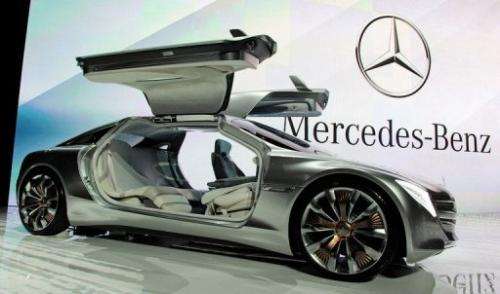
Germany's Mercedes-Benz is among those pursuing what is known as "active security" to build a car that would have a "less than one percent chance of getting into a crash," outside of a driver being drunk, a spokesman said.

Automakers displaying the latest technology at the Consumer Electronics Show (CES) are relying on sensors, digital cameras and connectivity in a drive towards a common goal -- eliminating accidents.

Germany's Mercedes-Benz is among those pursuing what is known as "active security" to build a car that would have a "less than one percent chance of getting into a crash," outside of a driver being drunk, a spokesman said.

Doug Newcomb of auto industry experts Edmunds.com said that while they don't want to admit it too openly, are even working on "autonomous" cars like the celebrated self-driving vehicles tested by .

"It's very controversial," Newcomb said, but the Google experience, which saw just a single accident -- and that due to human error -- tends to show that "cars are smarter than many drivers."

Don't expect to turn over the anytime soon, but experts say the improved auto on display at the CES gadgets fair here in Las Vegas and in research labs are leading to a "semi-autonomous" car.

In some luxury models, onboard computers can already take control of the brakes or the steering wheel.

Ford currently offers a lane-keeping system which features a mounted on the windshield that is focused on the lane markings ahead as a car drives down the road.
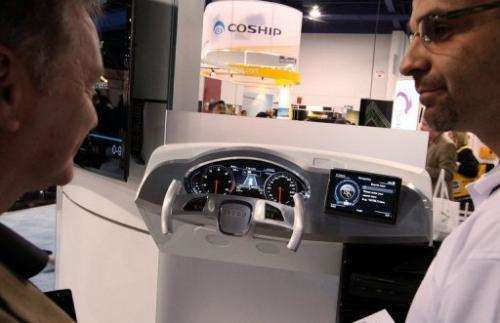
Automakers displaying the latest technology at the Consumer Electronics Show (CES) are relying on sensors, digital cameras and connectivity in a drive towards a common goal -- eliminating accidents.

"If you drift off your lane, there will be an audible warning and a shake of the steering wheel," said Wes Sherwood, a Ford spokesman.

"It will steer you back" in the event of repeated incursions, he said.

Restricted for now to high-end models, the lane-keeping aid will be extended for the first time this year to mid-range vehicles like the Ford Explorer and the .

"Consumers really question how much control they want the car to take," Sherwood said. "(But) in general, people like it. It's very subtle."

Ford has sold 300,000 vehicles equipped with the system since 2009.

Mercedes has a similar lane-keeping system and another for blind spot monitoring to detect the presence of an unseen car to the side.

Radar-like sensors are also being used to make sure drivers keep a safe distance from cars in front of them and can brake automatically in the event of a sudden deceleration.

The increased connectivity in cars will also help keep a driver better informed, leading to greater safety.

"A connected car is proactive," Dieter Zetsche, the chairman of Daimler and head of Mercedes-Benz cars, said during a CES keynote address.

Mercedes-Benz's telematics system, mbrace2, is capable of scouring the Web for information on safety hazards, such as ice, in order to alert a driver.

Newcomb of Edmunds.com said he believes the connectivity in a vehicle will increasingly come via the omnipresent smartphone, which automakers are already synching with the LCD screens on dashboards.

Over time, the device seen as a leading cause of many accidents could help to prevent them.

Explore further: Inventor creates Card Beams with 3D printer

add to favorites email to friend print save as pdf

Related Stories

Ford sets the stage for Fusion 2013 in Detroit

Jan 10, 2012

(PhysOrg.com) -- Ford is to cars like Apple and Microsoft are to computers; the public knows they are being marketed to the hilt but that does not stem public curiosity year after year to see the newest models ...

New car tech: Not just crash protection, but prevention

Jan 28, 2009

A car that can brake itself to avoid a fender-bender during the morning commute might seem far into the future. Except it goes on sale in March. That's when City Safety, a low-speed collision-avoidance technology becomes ...

With human behind wheel, Google's self-driving car crashes

Aug 07, 2011

Google Inc.'s quest to popularize cars that drive themselves seemed to hit a roadblock Friday when news emerged that one of the automated vehicles was in an accident. But in an ironic twist, the company is saying that the ...

Recommended for you

Inventor creates Card Beams with 3D printer

May 23, 2013

What are card beams, you may ask? They are the building toy that allows you to build gravity-defying houses of cards with the help of friction, gravity, and two types of beams - the cap and the connector.

With high-tech guns, users could disable remotely

May 21, 2013

A high-tech startup is wading into the gun control debate with a cellphone controller that would allow gun owners to know when their weapon is being moved—and disable it remotely.

Game system castAR debuts at Maker Faire

May 21, 2013

(Phys.org) —Two tech talents, formerly employees at video game publisher Valve, have been working on their own vision in the form of game-ready glasses. Their company, Technical Illusions, will seek to ...

China police billions spell profit opportunity

May 19, 2013

Mannequins in riot gear, armoured cars and drones line a police equipment and "anti-terrorism technology" trade fair in Beijing as vendors seek to profit from China's huge internal security budget.

User comments : 1

Adjust slider to filter visible comments by rank

Display comments: newest first

Vendicar_Decarian
not rated yet Jan 12, 2012
The safety solution is lower driving speeds.

40 Mph highway, max.

As gasoline goes trends to $10.00 a gallon over the next 20 years, highway speeds will drop to that value.

More news stories

Google eyes emerging markets networks

Google has become deeply involved in a series of projects to build and operate wireless networks in emerging markets including sub-Saharan Africa and Southeast Asia, a report said Friday.

Facial-recognition technology proves its mettle

(Phys.org) —In a study that evaluated some of the latest in automatic facial recognition technology, researchers at Michigan State University were able to quickly identify one of the Boston Marathon bombing ...

Drones may violate international law

(Phys.org) —As President Obama gives a speech on national security—including defending U.S. use of drones to combat terrorism—Leila Sadat, JD, international law expert and professor of law at Washington University in ...

Galaxies fed by funnels of fuel

(Phys.org) —Computer simulations of galaxies growing over billions of years have revealed a likely scenario for how they feed: a cosmic version of swirly straws.