Asteroid to make closest approach since 1975
Jan 30, 2012 by Jason Major, Universe Today
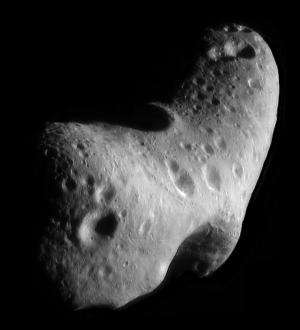
Asteroid 433 Eros as seen by NASA's NEAR spacecraft on Feb. 29, 2000. Credit: NASA/JPL/JHUAPL

On Tuesday, January 31, asteroid 433 Eros will come closer to Earth than it has in 37 years, traveling across the night sky in the constellations Leo, Sextans and Hydra. At its closest pass of 16.6 million miles (26.7 million km) the relatively bright 21-mile (34-km) -wide asteroid will be visible with even modest backyard telescopes, approaching magnitude 8, possibly even 7. It hasn’t come this close since 1975, and won’t do so again until 2056!

433 Eros is an S-type asteroid, signifying a composition of magnesium silicates and iron. S-types make up about 17 percent of known asteroids and are some of the brightest, with albedos (reflectivity) in the range of 0.10 – 0.22. S-type asteroids are most common in the inner asteroid belt and, as in the case of Eros, can even pass within the of Mars.

Occasionally Eros’ orbit brings it close enough to Earth that it can be spotted with amateur telescopes. 2012 will be one of those times.

Eros was discovered on August 13, 1898, by astronomers Carl Gustav Witt in Berlin and Auguste Charlois in Nice. When Eros’ orbit was calculated it was seen to be an elongated oval that brought it within the orbit of Mars. This allowed for good observations of the bright asteroid, and eventually led to more accurate estimates of the distance from Earth to the Sun.
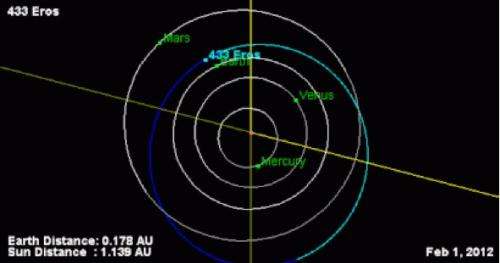
Orbit of 433 Eros for Jan. 31, 2012

In February 2000 NASA’s NEAR Shoemaker spacecraft approached Eros, established orbit and made a soft landing on its surface, the first mission ever to do so. While in orbit NEAR took over 160,000 images of Eros’ surface, identifying over 100,000 craters, a million house-sized boulders (give or take a few) and helped researchers conclude that the cashew-shaped Eros is a solid object rather than a “rubble pile” held together by gravity.

View NEAR images of Eros’ surface.

Studying pristine objects like Eros gives insight into the earliest days of our solar system, and also allows scientists to better understand compositions… which is invaluable information when deciding how best to avoid any potential future impacts.

Although Eros will be making a “close” approach to Earth on Jan. 31/Feb. 1, there is no danger of a collision. It will still remain at a very respectable distance of about 16.6 million miles (26.7 million km), or 0.178 AU. This is over 80 times the distance of the much smaller 2005 YU55, which safely passed within a lunar orbit radius on November 8, 2011.

If you do want to try viewing 433 Eros as it passes, you can find a diagram charting its path from Sky and here. According to the Sydney Observatory’s website “the coordinates on 31 January (from the BAA 2012 Handbook) are 10 hours 33 minutes 19.0 seconds RA and -4° 48’ 23” declination. On 10 February the RA is 10 hours 20 minutes 27.6 seconds and the declination is -14° 38’ 49 seconds.”

Also there’s an updated chart on Heavens Above showing Eros’ current position.

Eros should remain visible up until Feb. 10.

Explore further: Communications satellite launched into space

add to favorites email to friend print save as pdf

Related Stories

A New Twist to Dating an Asteroid

Aug 02, 2005

It turns out you can’t judge an asteroid by its cover, according to a recent study in the journal Nature. Or at least you can’t accurately date a certain asteroid called 433 Eros by counting the impact craters on its ...

8-meter-wide asteroid will pass close to Earth today

Jan 27, 2012

A small asteroid will pass extremely close to Earth tomorrow (January 27, 2012). Named 2012 BX34, this 11 meter- (36 feet-) wide 8 meter- (26-foot-) space rock (astronomers have updated their estimates of the ...

New horseshoe orbit Earth-companion asteroid discovered

Apr 06, 2011

(PhysOrg.com) -- Apostolos Christou and David Asher from the Armagh Observatory in Northern Ireland announced the discovery of an asteroid near Earth called Asteroid 2010 SO16 and their findings were published ...

Recommended for you

Dark, massive asteroid to fly by Earth on May 31

19 hours ago

It's 1.7 miles long. Its surface is covered in a sticky black substance similar to the gunk at the bottom of a barbecue. If it impacted Earth it would probably result in global extinction. Good thing it is ...

Research team explains 'Lazarus' comets

23 hours ago

Astronomers from the University of Antioquia have discovered a graveyard of comets. These once-dormant comets, dubbed by astronomers as "The Lazarus comets," are now rejuvenated.

NASA ships sensors for seafaring satellite to France

23 hours ago

(Phys.org) —Three NASA-built instruments that are integral components of the next in a series of U.S./European ocean altimetry satellites have arrived in France for integration with their spacecraft in ...

Trip into space with DiCaprio costs $1.55m

May 24, 2013

Leonardo DiCaprio is going to get closer to stars of a different kind as he heads into space aboard the Virgin Galactic, and a well-heeled bidder at the Cannes Film Festival has paid 1.2 million euros (1.5 million) to be ...

User comments : 5

Adjust slider to filter visible comments by rank

Display comments: newest first

antialias_physorg
3 / 5 (1) Jan 30, 2012
We really should use such a close encounter one of these days to try out various ways of altering an asteroid's path in a (relatively) inexpensive way. It would provide excellent possibilities for measuring the results, since we could bring all of (near)Earth's observational capabilities to bear.

It would have been interesting to try nuking it and/or hitting it with an impactor at some point shortly after flyby to see if that is feasible and produces any significant result at all. (I think for such an experiment we could waive the "no nukes in space" law if all countries contribute/consent)
LariAnn
3 / 5 (3) Jan 30, 2012
Since NEAR made a soft landing on the surface of 430 Eros, where are the pictures taken from the asteroid's surface? Seems we get to see only photos taken many miles away from the surfaces of moons and asteroids - why is that?
antialias_physorg
5 / 5 (2) Jan 30, 2012
'Soft' landing just means that part of it continued to operate afterwards for some time (namely the gamma spctrometer and the communications equipment) It wasn't designd to land but to 'slow crash' at 4mph. There was no provsision for extending an arm and panning a camera around, since the crash was though to destroy the craft with high probability (the camera probably ended up pointing into the dust if it survived the crash at all)

But you can get pictures like these
http://near.jhuapl.edu/
Which is from an altitude of down to 120 meters (shot during the descent).

If I read the mission profile correctly then the rendevouz was also at about 2AU distance (which means that there is only a quarter of the light available than on Earth - consequently they needed to up the exposition time to get better pictures.)
deatopmg
2 / 5 (2) Jan 30, 2012
"If I read the mission profile correctly then the rendevouz was also at about 2AU distance (which means that there is only a quarter of the light available than on Earth - consequently they needed to up the exposition time to get better pictures.)"

C'mon, that's only 2 f-stops and the albedo is high.
antialias_physorg
5 / 5 (2) Jan 30, 2012
Eros' albedo is 0.25.

That's a third less than Earth (0.36). So total light is 16% of what you get from Earth (if they approached with the sun directly at their backs ...but from the pics it looks like they approached at an angle to the sun)

CCDs are more attuned to the infrared spectrum (I'm not at all sure the pictures on the NASA website are visible light pics). Albedo is over the entire range of radiation...Eros probably has a different spectral distribution from Earth, so the number might be even lower for the radiation the CCD is sensitive to (or it might be higher).

Add to that that they wanted the pics to be sent before the craft hit (because they couldn't be sure that it would continue working afterwards)...and the number of pics you can send becomes severly limited during the last stages of 'landing' - because the bandwith over interplanetary distances is rather low.

More news stories

Galaxies fed by funnels of fuel

(Phys.org) —Computer simulations of galaxies growing over billions of years have revealed a likely scenario for how they feed: a cosmic version of swirly straws.

Source of life running out: water scientists

The majority of people on Earth people will face severe water shortages within a generation or two if pollution and waste continues unabated, scientists warned at a conference in Bonn Friday.

Dark, massive asteroid to fly by Earth on May 31

It's 1.7 miles long. Its surface is covered in a sticky black substance similar to the gunk at the bottom of a barbecue. If it impacted Earth it would probably result in global extinction. Good thing it is ...

Yahoo, pay-TV operators among Hulu bidders

Online video site Hulu is again up for sale, with Yahoo and pay TV operators DirecTV and Time Warner Cable among the seven bidders, according to a person with direct knowledge of the matter.

Radiation leak at Japan lab; small impact expected

An atomic research lab in northern Japan has reported a radiation leak that may have affected about 50 people, though none were hospitalized and no impact was expected outside the facility, the lab's operator ...

Heart failure accelerates male 'menopause'

Heart failure accelerates the aging process and brings on early andropausal syndrome (AS), according to research presented today at the Heart Failure Congress 2013. AS, also referred to as male 'menopause', was four times ...