World's smallest frogs discovered in New Guinea
December 12, 2011

World's smallest frogs discovered in New Guinea

Enlarge

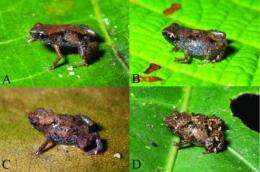
These are images of specimens of Paedophryne dekot (A) and (B), and P. verrucosa (C), and (D). Credit: Photos by Fred Kraus

Field work by researcher Fred Kraus from Bishop Museum, Honolulu has found the world's smallest frogs in southeastern New Guinea. This also makes them the world's smallest tetrapods (non-fish vertebrates). The frogs belong to the genus Paedophryne, all of whose species are extremely small, with adults of the two new species - named Paedophryne dekot and Paedophryne verrucosa - only 8-9 mm in length. The study was published in the open access journal ZooKeys.

Previous research had led to the discovery of Paedophryne by Kraus in 2002 from nearby areas in , but the genus was not formally described until last year (Kraus 2010, also in Zookeys). The two species described earlier were larger, attaining sizes of 10-11 mm, but the genus still represents the most miniaturized group of tetrapods in the world.

"Miniaturization occurs in many frog genera around the world," said the author, "but New Guinea seems particularly well represented, with species in seven genera exhibiting the phenomenon. Although most frog genera have only a few diminutive representatives mixed among larger relatives, Paedophryne is unique in that all species are minute." The four known species all inhabit small ranges in the mountains of southeastern New Guinea or adjacent, offshore islands. Their closest relatives remain unclear.

The members of this have reduced digit sizes that would not allow them to climb well; all inhabit , and their reduced digits may be a corollary of a reduced body size required for inhabiting leaf litter and moss. Habitation in leaf litter and moss is common in miniaturized frogs and may reflect their exploitation of novel in that habitat. The frogs' small body sizes have also reduced the egg complements that females carry to only two, although it is not yet known whether both eggs are laid simultaneously or at staged intervals.

More information: Kraus F (2011) At the lower size limit for tetrapods, two new species of the miniaturized frog genus Paedophryne (Anura, Microhylidae). ZooKeys 154: 71-88. doi: 10.3897/zookeys.154.1963

Kraus, F. (2010) New genus of diminutive microhylid frogs from Papua New Guinea. ZooKeys 48 (2010) : 39-59. doi: 10.3897/zookeys.48.446

Provided by Pensoft Publishers


Rank 5 /5 (1 vote)
Relevant PhysicsForums posts

More news stories

Manufacturing genes to attack flu virus

An international research team has manufactured a new protein that can combat deadly flu epidemics.

Biology / Biotechnology

created 8 hours ago | popularity not rated yet | comments 0 | with audio podcast

Scientist: Evolution debate will soon be history

(AP) -- Richard Leakey predicts skepticism over evolution will soon be history. Not that the avowed atheist has any doubts himself.

Biology / Evolution

created May 26, 2012 | popularity 3.4 / 5 (21) | comments 97

More plant species responding to global warming than previously thought

(Phys.org) -- Far more wild plant species may be responding to global warming than previous large-scale estimates have suggested.

Biology / Ecology

created May 22, 2012 | popularity 4.6 / 5 (14) | comments 18 | with audio podcast

For monogamous sparrows, it doesn't pay to stray (but they do it anyway)

It's quite common for a female song sparrow to stray from her breeding partner and mate with the male next door, but a new study shows that sleeping around can be costly.

Biology / Plants & Animals

created May 22, 2012 | popularity 5 / 5 (2) | comments 8 | with audio podcast

Thousands of shellfish found dead in Peru

Thousands of crustaceans were found dead off the coast of Lima following the mystery mass death of dolphins and pelicans, the Peruvian Navy said Friday.

Biology / Ecology

created May 26, 2012 | popularity 4.7 / 5 (7) | comments 7


Stunning image of smallest possible five-ringed structure

Scientists have created and imaged the smallest possible five-ringed structure – about 100,000 times thinner than a human hair – and you'll probably recognise its shape.

'Unzipped' carbon nanotubes could help energize fuel cells, batteries

Multi-walled carbon nanotubes riddled with defects and impurities on the outside could replace some of the expensive platinum catalysts used in fuel cells and metal-air batteries, according to scientists at ...

Change in developmental timing was crucial in the evolutionary shift from dinosaurs to birds: study

At first glance, it's hard to see how a common house sparrow and a Tyrannosaurus Rex might have anything in common. After all, one is a bird that weighs less than an ounce, and the other is a dinosaur that ...

Computer model used to pinpoint prime materials for efficient carbon capture

When power plants begin capturing their carbon emissions to reduce greenhouse gases – and to most in the electric power industry, it's a question of when, not if – it will be an expensive undertaking.

T cells 'hunt' parasites like animal predators seek prey, study shows

By pairing an intimate knowledge of immune-system function with a deep understanding of statistical physics, a cross-disciplinary team at the University of Pennsylvania has arrived at a surprising finding: T cells use a movement ...

Land and sea species differ in climate change response: study

(Phys.org) -- Marine and terrestrial species will likely differ in their responses to climate warming, new research by Simon Fraser University and Australia’s University of Tasmania has found.