A 'wild card' in your genes
December 7, 2011

A 'wild card' in your genes

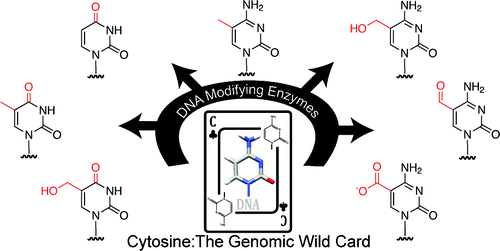
The human genome and the endowments of genes in other animals and plants are like a deck of poker cards containing a "wild card" that in a genetic sense introduces an element of variety and surprise that has a key role in life. That's what scientists are describing in a review of more than 100 studies on the topic that appears in ACS Chemical Biology.

Rahul Kohli and colleagues focus on , one of the four chemical "bases" that comprise the alphabet that the DNA uses to spell out everything from hair and eye color to risk of certain diseases. But far from just storing information, cytosine has acquired a number of other functions that give it a claim to being the genome's wild card. "In poker, the rules of the game can occasionally change," they note in the article. "Adding a 'wild card' to the mix introduces a new degree of variety and presents opportunities for a skilled player to steal the pot. Given that evolution is governed by the same principles of risk and reward that are common to a poker game, it is perhaps not surprising that a genomic 'wild card' has an integral role in biology."

They discuss the many faces of cytosine that make it such a game-changer and the biological processes that help to change its identity. Removing something called an amine group from cytosine, for instance, allows the immune system to recognize and destroy foreign invaders such as viruses. Adding so-called "" on cytosines acts as on/off switches for genes. The authors say that these many faces of cytosine allow it to play various roles and give it true "wild card" status.

More information: The Curious Chemical Biology of Cytosine: Deamination, Methylation,and Oxidation as Modulators of Genomic Potential, ACS Chem. Biol., Article ASAP. DOI: 10.1021/cb2002895

Abstract
A multitude of functions have evolved around cytosine within DNA, endowing the base with physiological significance beyond simple information storage. This versatility arises from enzymes that chemically modify cytosine to expand the potential of the genome. Some modifications alter coding sequences, such as deamination of cytosine by AID/APOBEC enzymes to generate immunologic or virologic diversity. Other modifications are critical to epigenetic control, altering gene expression or cellular identity. Of these, cytosine methylation is well understood, in contrast to recently discovered modifications, such as oxidation by TET enzymes to 5-hydroxymethylcytosine. Further complexity results from cytosine demethylation, an enigmatic process that impacts cellular pluripotency. Recent insights help us to propose an integrated DNA demethylation model, accounting for contributions from cytosine oxidation, deamination, and base excision repair. Taken together, this rich medley of alterations renders cytosine a genomic “wild card”, whose context-dependent functions make the base far more than a static letter in the code of life.

Provided by American Chemical Society search and more info website

Filter


Move the slider to adjust rank threshold, so that you can hide some of the comments.


Display comments: newest first

that_guy
Dec 07, 2011

Rank: not rated yet
Surprise! You have three legs! You win!
Rank not rated yet
Relevant PhysicsForums posts

More news stories

Computer model used to pinpoint prime materials for efficient carbon capture

When power plants begin capturing their carbon emissions to reduce greenhouse gases – and to most in the electric power industry, it's a question of when, not if – it will be an expensive undertaking.

Chemistry / Materials Science

created 8 hours ago | popularity not rated yet | comments 0 | with audio podcast

Scientists develop ultra-sensitive test that detects diseases in their earliest stages

Scientists have developed an ultra-sensitive test that should enable them to detect signs of a disease in its earliest stages, in research published today in the journal Nature Materials.

Chemistry / Analytical Chemistry

created 8 hours ago | popularity not rated yet | comments 0 | with audio podcast

New CO2-removing catalyst can take the heat

(Phys.org) -- The current method of removing the greenhouse gas carbon dioxide (CO2) from the flues of coal-fired power plants uses so much energy that no one bothers to use it. So says Roger Aines, principal ...

Chemistry / Materials Science

created May 24, 2012 | popularity 5 / 5 (9) | comments 11 | with audio podcast

High-speed method to aid search for solar energy storage catalysts

Eons ago, nature solved the problem of converting solar energy to fuels by inventing the process of photosynthesis.

Chemistry / Materials Science

created May 25, 2012 | popularity 5 / 5 (3) | comments 4 | with audio podcast

Researchers demonstrate possible primitive mechanism of chemical info self-replication

(Phys.org) -- When scientists think about the replication of information in chemistry, they usually have in mind something akin to what happens in living organisms when DNA gets copied: a double-stranded molecule ...

Chemistry / Materials Science

created May 25, 2012 | popularity 5 / 5 (4) | comments 2 | with audio podcast


Stunning image of smallest possible five-ringed structure

Scientists have created and imaged the smallest possible five-ringed structure – about 100,000 times thinner than a human hair – and you'll probably recognise its shape.

'Unzipped' carbon nanotubes could help energize fuel cells, batteries

Multi-walled carbon nanotubes riddled with defects and impurities on the outside could replace some of the expensive platinum catalysts used in fuel cells and metal-air batteries, according to scientists at ...

Change in developmental timing was crucial in the evolutionary shift from dinosaurs to birds: study

At first glance, it's hard to see how a common house sparrow and a Tyrannosaurus Rex might have anything in common. After all, one is a bird that weighs less than an ounce, and the other is a dinosaur that ...

T cells 'hunt' parasites like animal predators seek prey, study shows

By pairing an intimate knowledge of immune-system function with a deep understanding of statistical physics, a cross-disciplinary team at the University of Pennsylvania has arrived at a surprising finding: T cells use a movement ...

Land and sea species differ in climate change response: study

(Phys.org) -- Marine and terrestrial species will likely differ in their responses to climate warming, new research by Simon Fraser University and Australia’s University of Tasmania has found.

Yale study concludes public apathy over climate change unrelated to science literacy

Are members of the public divided about climate change because they don't understand the science behind it? If Americans knew more basic science and were more proficient in technical reasoning, would public consensus match ...