Websites downed in Russia poll 'hack attack'
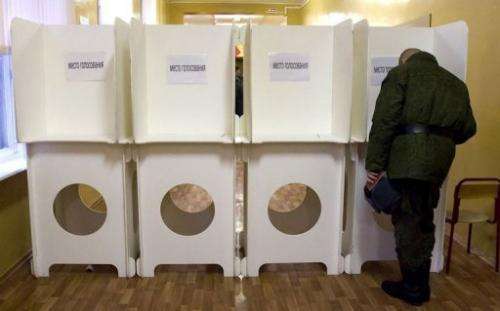
Websites which revealed violations in Russia's legislative polls were inaccessible Sunday after a hacking attack their operators said was aimed at preventing the exposure of mass election fraud.
Popular Russian radio station Moscow Echo and election monitoring group Golos said their websites were the victims of massive cyber attacks, while several opposition news sites were inaccessible.
"The attack on the website on election day is clearly an attempt to inhibit publication of information about violations," Moscow Echo editor-in-chief Alexei Venediktov wrote on Twitter.
Golos said it was the victim of a similar "distributed denial of service" (DDoS) attack, while several other opposition news sites were down. The Moscow Echo is popular among the liberal opposition although it is owned by state gas giant Gazprom.
Prime Minister Vladimir Putin, whose United Russia party is expected to win Sunday's polls but with a reduced majority, has denounced non-governmental organisations like Golos, comparing them to the disciple Judas who betrayed Jesus.
Russia has seen an upsurge in Internet penetration since the last elections in 2007, and analysts have said the explosion of critical material on the web poses one of the biggest challenges to United Russia's grip on power.
Golos said on Twitter that its main website as well as the "Map of Violations" site detailing claims of fraud across Russia were under "massive DDoS attacks".
Golos head Liliya Shibanova said the authorities seemed especially angry at their Map of Violations project, where people could upload any information or evidence of election violations.
"It's a very expensive operation," Shibanova said of the attacks. "It's a big organisation with plenty of means that must have done it."
Shibanova, who was held for nearly 12 hours Saturday by customs officials who also confiscated her computer, said the attack consisted of 50,000 hits per second by computers attempting to access the Golos website.
The website of opposition weekly New Times, known to publish investigative reports about government officials and feature columns by jailed oil tycoon Mikhail Khodorkovsky, was also down, along with news website slon.ru, which reported a DDoS attack.
Both have extensively covered the elections campaign and published opinion pieces on voting tactics in what opposition commentators have called a sham election with pre-determined results.
Bolshoi Gorod, a Moscow weekly magazine popular with the hipster youth, was also attacked at noon on Sunday, and business daily Kommersant was not working for the fourth consecutive day after it was hacked on Thursday. Hackers switched its IP address.
Moscow Echo filed a complaint to the Central Election Committee demanding to open a criminal case into the attacks, and editor Venediktov said he complained directly to the spokespeople of Putin and President Dmitry Medvedev.
The radio station is popular with the liberal opposition, though it is owned by the media arm of state-controlled Russian gas giant Gazprom.
"Any hacker attack on any resource leads to financial losses, which is essentially the same as stealing," said the chairman of Moscow Echo's board of directors Nikolai Senkevich, adding that Gazprom's media holding "fully supports" the station's concern.
Pro-Kremlin youth activists also complained on Twitter that the opposition ordered an attack on their website chronicling violations by the opposition parties, although the website was fully accessible.
Russian bloggers also complained of their inability to access their accounts on popular blogging platform Livejournal.com. The website has been a victim of repeated DDoS attacks throughout the week and worked intermittently.
"The goal of the attackers is clear," Anton Nossik, the media director of Livejournal owner SUP, wrote on his blog, alleging that the perpetrators are a "group of criminals" who are "probably fattened by the federal budget."
(c) 2011 AFP


