Vibration rocks for entangled diamonds

December 16, 2011 by Pete Wilton
double diamond illustration
(PhysOrg.com) -- Diamonds are celebrated for their enduring beauty and hardness but they can also be a physicists best friend.
In Nature Photonics and Science an international team of scientists report that a strange quantum state called entanglement has been achieved in two 3mm-wide diamond crystals, spaced 15cm apart, at room temperature.
One of the weird effects well known from atomic-scale systems is the possibility of superposition - the ability of an object to be in two places at once, explains Ian Walmsley of Oxford Universitys Department of Physics, a member of the team behind the research.
We show that you can take two diamonds - not quite everyday objects, but at least simple and recognizable - and put them in such a state: in particular a superposition of a state of one diamond vibrating and the other not, and vice versa.
This special type of superposition is called "entangled" and is of a kind that may be used for applications of quantum physics to new technologies, especially in communications and computing.
Because it is so easily disturbed by its surroundings entanglement can only normally be observed in isolated systems cooled to temperatures close to absolute zero.
But the structure of diamond makes it different: Exciting a vibrational motion in diamond requires a temperature of about 2000 degrees Celsius, comments Joshua Nunn of Oxford Universitys Department of Physics, also a member of the research team.
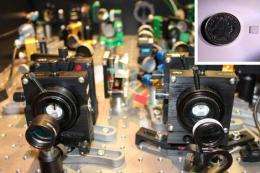
Laser equipment used for the experiment. Inset: one of the diamond samples used.
So at room temperature the vibrations are non-existent. The system behaves in that sense like a very cold cloud of atoms.The researchers, from Oxford University, National University of Singapore, and National Research Council of Canada, also sought to exploit another property of diamond: it tends to scatter light in such a way that a photon striking it can be converted to a lower energy photon, with the remaining energy being converted into a vibration.
This vibration or ringing in the diamond crystal can be detected using a laser.
We sent bursts of laser light through both diamonds, Ian tells me. Most of the time the light would travel straight through the crystals but sometimes the light would dump some energy in one of the crystals, setting it ringing, and the light would then emerge with less energy - a lower frequency.
The light is combined after the crystals so that when a low frequency pulse is detected, it is possible for scientists to know that one diamond is vibrating, but not which one.
In fact, the universe doesn't know which diamond is vibrating! Joshua explains. The diamonds are entangled, with one vibration shared between them, even though they are separated in space. We could use a similar technique to measure the diamonds and determine that this was the case.
The fact that entanglement is occurring inside everyday objects is not a surprise, but up until now most people would have thought that it would be impossible to observe: being washed out or otherwise disturbed by noise from the environment.
Joshua suggests that their approach might encourage scientists to look for strange quantum effects in places where previously they wouldnt have expected to be able to spot them.
Whilst any practical applications for the work are a long way off, the Nature Photonics paper does describe how it might be possible to build a diamond quantum memory for photonic quantum computing.
Ian comments: Several groups around the world have built different elements of a nanophotonic processor, and a vibrational quantum memory for photons could be incorporated into these.
Another possibility is explored in a related piece of work using these diamonds that makes use of the quantum character of "nothingness". It exploits this possibility to generate truly random numbers: something that could help to improve the security of electronic communications and transactions.
Provided by
Oxford University
-
From lemons to lemonade: Reaction uses carbon dioxide to make carbon-based semiconductor,
32 comments
-
Thioridazine kills cancer stem cells in human while avoiding toxic side-effects of conventional cancer treatments,
3 comments
-
SpaceX private rocket blasts off for space station (Update),
42 comments
-
Climate scientists say they have solved riddle of rising sea,
31 comments
-
SpaceX capsule has 'new car' smell, astronauts say (Update),
4 comments
-
Why does a boiled egg rotates while a raw egg doesn't?
3 hours ago
-
Lightning strike in mindair
3 hours ago
-
Why does light move?
5 hours ago
-
How to calculate the repulsion force between a permanent and an electromagnet?
7 hours ago
-
Why does light allow us to see things?
7 hours ago
-
Room temperature superconductivity
7 hours ago
- More from Physics Forums - General Physics
More news stories
Is a classical electrodynamics law incompatible with special relativity?
(Phys.org) -- The laws of classical electromagnetism that were developed in the 19th century are the same laws that scientists use today. They include Maxwell’s four equations along with the Lorentz la ...
Landmark calculation clears the way to answering how matter is formed
(Phys.org) -- An international collaboration of scientists, including Thomas Blum, associate professor of physics, is reporting in landmark detail the decay process of a subatomic particle called a kaon ...
May 25, 2012 |
4.3 / 5 (22) |
52
|
Lying in wait for WIMPs: Researchers seek to dramatically increase sensitivity of Large Underground Xenon detector
Although it's invisible, dark matter accounts for at least 80 percent of the matter in the universe. No one knows what it is, but most scientists would bet on weakly interacting massive particles, or WIMPs.
May 23, 2012 |
4 / 5 (7) |
18
|
Hawaii lab turns laser-powered bubbles into microrobots
(Phys.org) -- A team of scientists from the University of Hawaii are working on microrobots created from bubbles of air in a saline solution. The bubbles take on their title of robots as a laser ...
Sound increases the efficiency of boiling
Scientists at the Georgia Institute of Technology achieved a 17-percent increase in boiling efficiency by using an acoustic field to enhance heat transfer. The acoustic field does this by efficiently removing vapor bubbles ...
May 24, 2012 |
5 / 5 (2) |
2
Stunning image of smallest possible five-ringed structure
Scientists have created and imaged the smallest possible five-ringed structure about 100,000 times thinner than a human hair and you'll probably recognise its shape.
'Unzipped' carbon nanotubes could help energize fuel cells, batteries
Multi-walled carbon nanotubes riddled with defects and impurities on the outside could replace some of the expensive platinum catalysts used in fuel cells and metal-air batteries, according to scientists at ...
Change in developmental timing was crucial in the evolutionary shift from dinosaurs to birds: study
At first glance, it's hard to see how a common house sparrow and a Tyrannosaurus Rex might have anything in common. After all, one is a bird that weighs less than an ounce, and the other is a dinosaur that ...
Computer model used to pinpoint prime materials for efficient carbon capture
When power plants begin capturing their carbon emissions to reduce greenhouse gases and to most in the electric power industry, it's a question of when, not if it will be an expensive undertaking.
T cells 'hunt' parasites like animal predators seek prey, study shows
By pairing an intimate knowledge of immune-system function with a deep understanding of statistical physics, a cross-disciplinary team at the University of Pennsylvania has arrived at a surprising finding: T cells use a movement ...
Land and sea species differ in climate change response: study
(Phys.org) -- Marine and terrestrial species will likely differ in their responses to climate warming, new research by Simon Fraser University and Australia’s University of Tasmania has found.

Dec 16, 2011
Rank: 4 / 5 (4)
Dec 16, 2011
Rank: 5 / 5 (3)
Dec 16, 2011
Rank: 5 / 5 (3)
You would be correct in that.
Dec 16, 2011
Rank: 2 / 5 (4)
http://www.aether...glow.jpg
http://www.aether...ancy.gif
IMO entanglement could be explained with charge coupling of excited atoms at the case of diamonds (excited electrons resonate at phase inside of both pieces).
Dec 16, 2011
Rank: not rated yet
I'm pretty sure since you haven't seen it you wouldn't know what I'm talking about. There's plenty of maths, it's a series of lectures for physics students.
Dec 16, 2011
Rank: 2 / 5 (3)
Dec 16, 2011
Rank: 1 / 5 (1)
Dec 16, 2011
Rank: not rated yet
Dec 16, 2011
Rank: 1 / 5 (1)
http://physics.wm...tes1.pdf
http://www.nd.edu...001.html
Why these two concepts should open our insights right now and not before fifty years or after another thirty years?
Dec 16, 2011
Rank: 2.8 / 5 (4)
The reason I quote Deutsch is because his earth-shattering ideas are also put to practical use toward his instrumental work with quantum computers. He is highly respected , controversial, and bound to upset and threaten those who were educated in schools teaching dated information.
Dec 17, 2011
Rank: 4.3 / 5 (6)
Actually, the language and the philosophical argument came first and is still foremost. It is far more universal to the human condition than the math. The math is only as correct as the philosopher who brought the idea and potential theory to the table.
The reason the human condition is far more correct is that the human must interpret it. The philosophical argument is the foundational cornerstone to the conceptual aspects of reality, thus all vital to the human..the human...who is the only thing the argument is relevant to. Descartian logical supposition.
You may argue that the math is all important but to get there you had to pass through the philosophical mental membrane of human observational conditionals.
Math is a human tool. It's foundation is philosophy. Math has no innate capacity to leave that context.
Dec 17, 2011
Rank: 1 / 5 (1)
Philosophy, in communicative and expressive language -can and does describe more than math. Inherently so. Yet math cannot leave the area of confined expression that it is within.
Humans and their philosophy can expand well beyond that area and arena.
Thus one cannot say that nothing is real, until math expresses it. Such an argument is logically invalid on all fronts.
Paradoxically and ironically...the very idea of Godel's Incompleteness theorems express this fallacy rather nicely.
Mathematics stares at itself..and finds itself wanting.
Dec 17, 2011
Rank: not rated yet
That would be some pricey memory..
Dec 17, 2011
Rank: 2 / 5 (1)
For me personally, following the philosophical paths that led to the formulation of QM has been very important, that leads to an understanding of the theories, _then_ comes math, but we can't just go straight to the numbers without knowing how or why they are derived.
All science is based _first_ and foremost in philosophy.
Btw, here's the links to the series I'm watching this week, if anybody's interested..from Madras, India :)
QM, first lecture
http://www.youtub...GYe39XG0
At least he doesn't put me to sleep like Susskind, lol.
Dec 17, 2011
Rank: 3 / 5 (2)
Philosophy is an old, almost useless method of trying to explain what goes on around us. Philosophy cannot prove anything at all other than what your brain tells you it thinks it proves. Math on the other hand has a physical basis that supersedes whatever you think may be happening philosophically.
Eventually, when our understanding of reality is great enough, there will be no need at all for philosophy as there will be math to represent it. Neuroscience is a prime example of the failure of philosophy where evidence/math makes philosophical arguments obsolete.
But hey, I'm just an undergrad and have a lot left to learn, but this is just how I see it.
Dec 17, 2011
Rank: 3 / 5 (2)
Eventually, when our understanding of reality is great enough, there will be no need at all for philosophy as there will be math to represent it. Neuroscience is a prime example of the failure of philosophy where evidence/math makes philosophical arguments obsolete.
But hey, I'm just an undergrad and have a lot left to learn, but this is just how I see it.
That's an interesting philosophy you've got there, kid.
Dec 19, 2011
Rank: 1 / 5 (1)
Dec 21, 2011
Rank: 1 / 5 (1)
In fact, the universe doesn't know which diamond is vibrating! Joshua explains. The diamonds are entangled, with one vibration shared between them, even though they are separated in space. We could use a similar technique to measure the diamonds and determine that this was the case.
Fools. Don't combine the light and you can tell which one is vibrating. What the heck does this have to do with entanglement. One of the two would have to vibrate at all times, so how would you ever detect a change if you combined the light.