Twin probes to circle moon to study gravity field
December 26, 2011 By ALICIA CHANG , AP Science Writer

Twin probes to circle moon to study gravity field (AP)

Enlarge

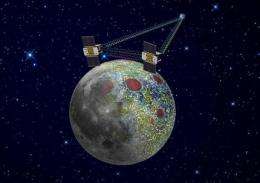
This undated artist rendering provided by NASA on Dec. 21,2011 shows the twin Grail spacecraft mapping the lunar gravity field. The two probes are scheduled to enter orbit around the moon over New Year's weekend. (AP Photo/NASA, Jet Propulsion Laboratory)

The moon has come a long way since Galileo first peered at it through a telescope. Unmanned probes have circled around it and landed on its surface. Twelve American astronauts have walked on it. And lunar rocks and soil have been hauled back from it.

Despite being well studied, Earth's closest neighbor remains an enigma.

Over the New Year's weekend, a pair of spacecraft the size of washing machines are set to enter orbit around it in the latest . Their job is to measure the uneven and determine what lies beneath - straight down to the core.

Since rocketing from the Florida coast in September, the near-identical Grail spacecraft have been independently traveling to their destination and will arrive 24 hours apart. Their paths are right on target that engineers recently decided not to tweak their positions.

"Both spacecraft have performed essentially flawlessly since , but one can never take anything for granted in this business," said mission chief scientist Maria Zuber of the Massachusetts Institute of Technology.

The nail-biting part is yet to come. On New Year's Eve, one of the Grail probes - short for Gravity Recovery and Interior Laboratory - will fire its engine to slow down so that it could be captured into orbit. This move will be repeated by the other the following day.

Engineers said the chances of the probes overshooting are slim since their trajectories have been precise. Getting struck by a may prevent the completion of the engine burn and they won't get boosted into the right orbit.

"I know I'm going to be nervous. I'm definitely a worrywart," said project manager David Lehman of NASA's Jet Propulsion Laboratory, which manages the $496 million, three-month mission.

Once in orbit, the spacecraft will spend the next two months flying in formation and chasing one another around the moon until they are about 35 miles above the surface with an average separation of 124 miles. Data collection won't begin until March.

Previous missions have attempted to measure lunar gravity with mixed success. Grail is the first mission dedicated to this goal.

As the probes circle the moon, regional changes in the lunar gravity field will cause them to speed up or slow down. This in turn will change the distance between them. Radio signals transmitted by the spacecraft will measure the slight distance gaps, allowing researchers to map the underlying gravity field.

Using the gravity information, scientists can deduce what's below or at the lunar surface such as mountains and craters and may help explain why the far side of the moon is more rugged than the side that faces Earth.

The probes are officially known as Grail-A and Grail-B. Several months ago, hosted a contest inviting schools and students to submit new names. The probes will be christened with the winning names after the second orbit insertion, Zuber said.

Besides the one instrument on board, each spacecraft also carries a camera for educational purposes. Run by a company founded by Sally Ride, the first American woman in space, middle school students from participating schools can choose their own lunar targets to image during the mission.

A trip to the moon is typically relatively quick. It took Apollo astronauts three days to get there. Since Grail was launched from a relatively small rocket to save on costs, the journey took 3 1/2 months.

Scientists expect the mission to yield a bounty of new information about the , but don't count on the U.S. sending astronauts back anytime soon. The Constellation program was canceled last year by President Barack Obama, who favors landing on an asteroid as a stepping stone to Mars.

More information: Mission details: http://www.nasa.gov/mission-pages/grail/news/index.html

©2011 The Associated Press. All rights reserved. This material may not be published, broadcast, rewritten or redistributed.

3.6 /5 (11 votes)  

Filter


Move the slider to adjust rank threshold, so that you can hide some of the comments.


Display comments: newest first

Nanobanano
Dec 26, 2011

Rank: 2.9 / 5 (18)
may help explain why the far side of the moon is more rugged than the side that faces Earth


Pretty obvious, geniuses.

The near side of the moon would be shielded from "some" meteors by the Earth since it is gravitationally locked, therefore mostly smooth.

Can I have your salary now?
QuantumPundit
Dec 26, 2011

Rank: 3.4 / 5 (19)
Sorry Nanobananobrain the Earth is too far away from the Moon to have any significant effect on blocking or deflecting meteors or asteroids, the latter of are thought to cause most of the ruggedness, not meteors. Keep your job and salary at Burger King....
Nanobanano
Dec 26, 2011

Rank: 1.4 / 5 (19)
Sorry Nanobananobrain the Earth is too far away from the Moon to have any significant effect on blocking or deflecting meteors or asteroids, the latter of are thought to cause most of the ruggedness, not meteors. Keep your job and salary at Burger King....


"Meteors" and "asteroids" are the same thing, idiot.

Well, put this way, a "meteoroid" is any "asteroid" or "comet" that actually hits something.

But you're wrong anyway,.

Earth's gravity is 6 times more than the moon, and it's cross section is 13 times more than the moon.

An Lunar eclipse proves you wrong, since the shadow of the Earth entirely blocks the sun light on the Moon, proving that the Earth would block all "straight line" ballistic objects from hitting the moon, AND having much stronger gravity, it will even capture "some" of the objects that would have come in on slightly arcing paths.

Lunar eclipse proves you wrong.
Nanobanano
Dec 26, 2011

Rank: 1.9 / 5 (17)
So, since the moon is tidally locked, when the meteors come from a Moon-side direction, they naturally hit the far side of the moon, cratering it up badly.

When the meteors come from the Earth-side, then they hit the Earth, many burning up in the atmosphere, and so the near-side of the moon is not hit as often.

This isn't rocket science, it's obvious to anyone who can think for themself.

Oh yeah, if you're too slow to figure out the Earth could shield some ballistics, go get some balls and place them at distances, and try to hit the second one by throwing a rock THROUGH the first one.

You think a tree need be as big as the horizon to stop a bullet? No, not at all.

Same principle.

Earth shields the near side of the moon, and the far side of the moon shields Earth.
Nanobanano
Dec 26, 2011

Rank: 1.4 / 5 (19)
This is what's wrong with "science" in the world today.

These bozos can't even figure out stuff that's piss easy.

I thought everyone knew this kind of baby stuff, because it's pathetically obvious.
theapc
Dec 26, 2011

Rank: 4.7 / 5 (14)
"Meteors" and "asteroids" are the same thing, idiot.

Well, put this way, a "meteoroid" is any "asteroid" or "comet" that actually hits something.


a meteor is a non-terrestrial object that has entered earth's atmosphere. on successful impact it is a meteorite.

does the rather narrow field of interference in nearly straight-line object trajectories account for the differences found between the near-side and far-side? I don't know, but I doubt it. perhaps, nanobanano, you should dial down the arrogance and do the math. load your mind before you shoot your mouth, idiot.
Ronan
Dec 26, 2011

Rank: 4.7 / 5 (6)
Very interesting! I'm puzzled by the necessity of using two satellites rather than just one, like GOCE here on Earth. As far as I know GOCE has worked admirably, and with the thinner lunar atmosphere drag should be even less of a problem than it is for GOCE. Perhaps this is just the less expensive/more robust option?
LEDman
Dec 26, 2011

Rank: 4.6 / 5 (18)
Nano - Pathetically obvious unless you do the math. Learn about solid angles and see how well the earth "shields" the moon.

Here is the quick math (some approximations)
Distance earth to moon = 250,000 miles
earth diameter = 8,000 miles

Angle of the earth as seen from the moon = 1.833 degrees
Solid angle of the earth as seen from the moon = 0.003215 Sr
Since a sphere (the entire sky around the moon) is 12.566 Sr (4pi), the earth "shields" 0.003215/12.566 = 0.0256% of the sky as seen from the moon.

Yes the earth can shield some, but even if you want to allow for gravitational effects and say the math is off by a factor of 10, you are talking about 0.25%

Some bozos can't even do the basic math and troll around on science sites. Pathetically obvious that you have no concept of basic geometry or the distances involved in astronomy.
Ronan
Dec 26, 2011

Rank: 4.7 / 5 (15)
This is what's wrong with "science" in the world today.

These bozos can't even figure out stuff that's piss easy.

I thought everyone knew this kind of baby stuff, because it's pathetically obvious.

It's also pathetically obvious that heavier objects fall faster than lighter ones, that the pressure exerted by a column of liquid depends on both its height and its diameter, that all dinosaurs were lumbering cold-blooded beasts, that an object in motion will eventually come to rest, and that if you accelerate long enough you'll eventually go faster than light. Rationalism's a nice first step, but it just doesn't work as a way of figuring out the universe. You have to employ empiricism to stand a chance of figuring anything out, and that's what these researchers are doing. Deciding that something is "pathetically obvious" and coming to a halt right there won't cut it.
omatumr
Dec 26, 2011

Rank: 1.3 / 5 (15)
a pair of spacecraft the size of washing machines are set to measure the Moon's uneven gravity field and determine what lies beneath - straight down to the core.


Thanks, Alicia, for this report on measurements to determine what lies beneath the Moon's surface - "straight down to the core."

That type of measurement on the Sun could show if a pulsar core causes CMEs (coronal mass ejections) - like those approaching Earth now

http://spaceweather.com/

Or if the Sun is a stable heat source and man-made CO2 (AGW) causes climate change.

See the discussion on Professor Curry's blog:

http://judithcurr...t-152465

Best wishes for the Holidays!
Oliver K. Manuel
http://myprofile....anuelo09
Tseihta
Dec 26, 2011

Rank: 1 / 5 (1)
Very interesting! I'm puzzled by the necessity of using two satellites rather than just one, like GOCE here on Earth. As far as I know GOCE has worked admirably, and with the thinner lunar atmosphere drag should be even less of a problem than it is for GOCE. Perhaps this is just the less expensive/more robust option?


I believe you're right about it being the more cost effective option. Here is a link on GRACE.

http://www.csr.ut...iew.html

antialias_physorg
Dec 27, 2011

Rank: 4.2 / 5 (5)
The near side of the moon would be shielded from "some" meteors by the Earth since it is gravitationally locked, therefore mostly smooth.

The Earth only shields a miniscule part of the sky of the near side. This cannot account for the vast difference in landscape.

The gravity effect also does not account for a difference in the number of impacting objects.
E.g. Not long ago it was thought that Jupiter (and to a lesser extent Saturn) would 'protect' the Earth by gravitationally pulling in comets and the like. But simulations show that their gravity fields steer as many towards us as they deflects or catch.
Similarly Earth gravitational field will cause as many incoming objects to hit the Moon as it would deflect away (only the tiny part that are really on a straight line between Earth and Moon will be caught in excess of this)
antialias_physorg
Dec 27, 2011

Rank: 3 / 5 (2)
I'm puzzled by the necessity of using two satellites rather than just one, like GOCE here on Earth.

It's a different setup. GOCE has about ten times the mass of each of these sattelites, so it would probably have been too expensve to get something like it to the Moon.

GRAIL has the advantage of being able to fly in very low orbit, though (about 50km high) which should give excellent data.
Callippo
Dec 27, 2011

Rank: 3.7 / 5 (3)
The near side of the moon would be shielded from "some" meteors by the Earth since it is gravitationally locked, therefore mostly smooth
It looks naturally, but there are another explanations. For example, the Moon was hit with large body, which melted portion of its surface. http://www.viewsi...-reports The gravity field spaceprobes could help distinguish between these two models.
flyboy2112
Dec 27, 2011

Rank: 2.3 / 5 (3)
The probes were launched in September and they're just getting there now? It took the Apollo missions four days. Why is it taking so much longer for these probes?
antialias_physorg
Dec 27, 2011

Rank: 4.2 / 5 (5)
Why is it taking so much longer for these probes?

Because they were on a low fuel trajectory via L1.
It's not like we have to get these things there as fast as possible. Saving fuel (and thereby increasing payload) is better than getting there a few days earlier.

With the Apollo missions time was precious. A low fuel approach would have saved some weight - but that would have been more than eaten up (literally) by the additional food, water and air (and fuel for heating) they would have to have taken with them. So getting them there on a more direct route was preferrable.
omatumr
Dec 27, 2011

Rank: 1 / 5 (9)
could show if a pulsar core causes CMEs - like

http://spaceweather.com/


Neutron repulsion is shown in the Cradle of the Nuclides on the front cover of this symposium organized by Glenn T. Seaborg (Element #106 is Seaborgium in his honor)

www.amazon.com/Or...06465620

Since E = mc^2 and every nucleus is composed of positive
(+) charged protons (P) and (A-Z) uncharged neutrons (N):

1. Attractive forces between N and P
__ reduce the rest mass when Z /A ~0.5

2. Repulsive forces between N and N
__ increase the rest mass for Z/A <0.5

3. Repulsive forces between P and P
__ increase the rest mass for Z/A >0.5

That explains the ~265 Bohr-Wheeler mass parabolas.

http://arxiv.org/...2.1499v1

Individual mass data points provide this holiday message of peace:

https://dl-web.dr...8949abdc
henry_rivera
Dec 27, 2011

Rank: 3 / 5 (1)
Maybe the public will finally get some high res pics of the lunar surface from these cameras. Anyone know the resolution or specs of the cameras?
MrGrynch
Dec 27, 2011

Rank: 1 / 5 (4)
The difference in topography between the hemispheres of the moon is indeed because of shielding from the Earth, but not from meteorites or asteroids, but rather from electrical discharge machining. The earth/moon system are essentially locked, and their electrical dipoles have long since reached a state of equilibrium with each other. It is this relationship with the rest of the solar system that is responsible for the increased cratering on the far side, as well as anomalous heat signatures at the poles of nearly all solar bodies. This is where the birkeland currents connect. Plasma cosmology folks. It is gaining in acceptance and can explain much
CHollman82
Dec 27, 2011

Rank: 4.1 / 5 (9)
Nano - Pathetically obvious unless you do the math. Learn about solid angles and see how well the earth "shields" the moon.

Here is the quick math (some approximations)
Distance earth to moon = 250,000 miles
earth diameter = 8,000 miles

Angle of the earth as seen from the moon = 1.833 degrees
Solid angle of the earth as seen from the moon = 0.003215 Sr
Since a sphere (the entire sky around the moon) is 12.566 Sr (4pi), the earth "shields" 0.003215/12.566 = 0.0256% of the sky as seen from the moon.

Yes the earth can shield some, but even if you want to allow for gravitational effects and say the math is off by a factor of 10, you are talking about 0.25%

Some bozos can't even do the basic math and troll around on science sites. Pathetically obvious that you have no concept of basic geometry or the distances involved in astronomy.


Nanobanano is an idiot, well done taking the time to show him.
antialias_physorg
Dec 27, 2011

Rank: 3.8 / 5 (4)
Maybe the public will finally get some high res pics of the lunar surface from these cameras.

From the size of them (and the types of pictures they provide) I think they will not deliver higher resolution images than what is already available (though I couldn't find any detailed specs). They're aimed at student/classroom participation.
Husky
Dec 27, 2011

Rank: 5 / 5 (6)
i still cant decide if nano is the walter of science, the o'reilly factor of science or the two grumpy old muppetmen of science?

A typical nanoposting goes like this:

1. DUH!
2. Obvious...
3. I can do that
4. Idiots/Bozos
Repeat.
jsdarkdestruction
Dec 28, 2011

Rank: 3.4 / 5 (5)
Neutron repulsion doesnt exist anymore than santa claus does oliver. It's a fantasy thats outlived its time. Just give it up already, you wasted your career.(and integrity and honor with what you did in your personal life)
antialias_physorg
Dec 29, 2011

Rank: 5 / 5 (8)
A typical nanoposting goes like this:

1. DUH!
2. Obvious...
3. I can do that
4. Idiots/Bozos


And just imagine what it would be like if he actually tried to reproduce this

1. Oh
2. This is more tricky than I thought
3. Oh boy. That requires years of additional study. I give up.
4. Dunning Kruger Effect - Now I understand how it applies to me.

http://en.wikiped...r_effect
bluehigh
Jan 01, 2012

Rank: 1 / 5 (4)
Selenologists, as those who study the moon call themselves, have kicked around many theories to explain the differences between the moons two faces:
1. Earth partly shielding the moon from meteoritic impacts;
2. uneven heating from beneath;
3. the collision that excavated a 2,500km-wide crater at the lunar south pole, one of the biggest in the solar system.

Children learn that Earth shielding is the cause ..

The far side of the Moon has lots of craters because it faces open space. The side of the Moon facing Earth has fewer craters. Thats because our planet protects it from falling space debris.
http://www.globio...rt_id=38
Rank 3.6 /5 (11 votes)
Relevant PhysicsForums posts
  • Distance of planets from stars and revolution
    created8 hours ago
  • revamping general concept and cosmological principle
    createdMay 25, 2012
  • Transiting Exoplanet Light Curve
    createdMay 25, 2012
  • Math behind Theoretical Physics
    createdMay 24, 2012
  • Do we know whats at the center of galaxies yet?
    createdMay 23, 2012
  • Structure of the Milky Way?
    createdMay 20, 2012
  • More from Physics Forums - General Astronomy

More news stories

Land and sea species differ in climate change response: study

(Phys.org) -- Marine and terrestrial species will likely differ in their responses to climate warming, new research by Simon Fraser University and Australia’s University of Tasmania has found.

Space & Earth / Environment

created 6 hours ago | popularity 3.8 / 5 (4) | comments 5 | with audio podcast

Yale study concludes public apathy over climate change unrelated to science literacy

Are members of the public divided about climate change because they don't understand the science behind it? If Americans knew more basic science and were more proficient in technical reasoning, would public consensus match ...

Space & Earth / Environment

created 8 hours ago | popularity 4.8 / 5 (5) | comments 20 | with audio podcast

10 million years needed to recover from mass extinction

It took some 10 million years for Earth to recover from the greatest mass extinction of all time, latest research has revealed.

Space & Earth / Earth Sciences

created 8 hours ago | popularity 4 / 5 (4) | comments 1 | with audio podcast

Sophisticated simulations predict future warming

The chances of our planet being hit by a global warming of 3 degrees Celsius by 2050 is as likely as it being hit by an increase of 1.4 degrees, new research shows. Presented in the journal Nature Geoscience, the British study ...

Space & Earth / Earth Sciences

created May 22, 2012 | popularity 4.1 / 5 (10) | comments 51

Aliens don't want to eat us, says former SETI director

Alien life probably isn’t interested in having us for dinner, enslaving us or laying eggs in our bellies, according to a recent statement by former SETI director Jill Tarter.

Space & Earth / Space Exploration

created May 25, 2012 | popularity 4.4 / 5 (15) | comments 41


Stunning image of smallest possible five-ringed structure

Scientists have created and imaged the smallest possible five-ringed structure – about 100,000 times thinner than a human hair – and you'll probably recognise its shape.

'Unzipped' carbon nanotubes could help energize fuel cells, batteries

Multi-walled carbon nanotubes riddled with defects and impurities on the outside could replace some of the expensive platinum catalysts used in fuel cells and metal-air batteries, according to scientists at ...

Change in developmental timing was crucial in the evolutionary shift from dinosaurs to birds: study

At first glance, it's hard to see how a common house sparrow and a Tyrannosaurus Rex might have anything in common. After all, one is a bird that weighs less than an ounce, and the other is a dinosaur that ...

Computer model used to pinpoint prime materials for efficient carbon capture

When power plants begin capturing their carbon emissions to reduce greenhouse gases – and to most in the electric power industry, it's a question of when, not if – it will be an expensive undertaking.

T cells 'hunt' parasites like animal predators seek prey, study shows

By pairing an intimate knowledge of immune-system function with a deep understanding of statistical physics, a cross-disciplinary team at the University of Pennsylvania has arrived at a surprising finding: T cells use a movement ...

Scientists develop ultra-sensitive test that detects diseases in their earliest stages

Scientists have developed an ultra-sensitive test that should enable them to detect signs of a disease in its earliest stages, in research published today in the journal Nature Materials.