Tiny solar cell could make a big difference
December 15, 2011 by Bill Scanlon

Tiny solar cell could make a big difference

Enlarge

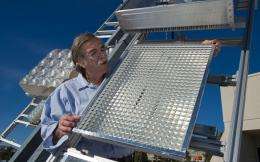
NREL scientist Keith Emery examines a Semprius solar module at the laboratory's Outdoor Test Facility. NREL helped Semprius characterize and test its tiny solar cells, which are the diameter of a dot made by a ballpoint pen. Credit: Dennis Schroeder

How small can a solar cell be and still be a powerhouse? How about six hundred microns wide — about the diameter of a dot made by a ballpoint pen?

The U.S. Department of Energy's National Renewable Energy Laboratory recently validated greater than 41 percent efficiency at a concentration of 1,000 suns for tiny cells made by Semprius — one of the highest efficiencies recorded at this concentration. The energy conversion efficiency of a solar cell is the percentage of sunlight converted by the cell into electricity.

Seed money from DOE, together with the experts at the NREL-based SunShot Incubator Program, lifted Semprius from a small electronics start-up with a novel idea to a real difference-maker in the solar cell world.

Semprius' triple-junction cells are made of gallium arsenide. Low-cost lenses concentrate the sun light onto the tiny cells 1,100 times. Their tiny size means they occupy only one-one thousandth of the entire solar module area, reducing the module cost. In addition, the use of a large number of small cells helps to distribute unwanted heat over the cell's structure, so there's no need for expensive thermal management hardware such as heat fins.

Semprius engineers use the company's patented micro-transfer printing process to allow the micro-cells to be transferred from the growth substrate to a wafer. In a massive parallel process, thousands of cells are transferred simultaneously. This allows the original substrate to be used again and again, dramatically cutting costs. It also provides a way to handle very small cells.

This low-cost approach, which Semprius executives say can cut manufacturing expense by 50 percent, caught the eye of energy giant Siemens, which this year took a 16 percent stake in Semprius, as part of a $20 million investment from venture capitalists.

Sunshot Incubator Program Spurs Private Investment

Since 2007, DOE has invested $50 million for 35 solar start-ups to participate in the PV Incubator program — now the SunShot Incubator — at NREL. Private investment in those firms now totals more than $1.3 billion, a 25-to-1 multiple.

DOE and NREL selected Semprius to be one of their PV Incubator companies in 2010. Incubator companies get $1 million to $3 million to develop their concepts into actual working prototypes or pilot projects. And they also get the expertise of NREL scientists to help overcome obstacles and test for reliability and validity.

Transfer Printing Technology Evolves to Innovative Solar-Cell Use

Semprius' back story, though, begins at the University of Illinois where Professor John Rogers and his team developed the transfer-printing process initially intended for flexible electronics.

Soon, Rogers realized that applying the technology to a concentrated photovoltaic (CPV) design could be much more lucrative.

Semprius grows a temporary layer on the original gallium-arsenide substrate, and then grows the multi-junction solar cell structure on top of that layer. Then, after the wafer is processed, the transfer printing process is used to remove the cells from the gallium-arsenide substrate and transfer them to an interposer wafer.
Tiny solar cell could make a big difference
Enlarge

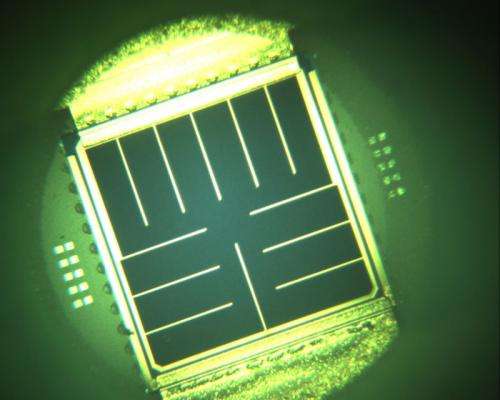
NREL's state-of-the-art testing and characterization instruments scrutinize the quality and efficiency of solar cells, such as on this module made by Semprius. Credit: NREL staff

"We're using a completely different approach to what has been practiced," said Kanchan Ghosal, CPV Applications Engineering Manager and the principal investigator for Semprius' PV Incubator Award. "This approach uses micro-cells and transfer printing to significantly reduce the use of materials in highly concentrated PV modules. And it provides a highly parallel method to manufacture the module, based on established microelectronics processes and equipment."

Demand for Concentrated PV Expected to Double Each Year

Semprius broke ground on a manufacturing plant in Henderson, N.C., this year. The state of North Carolina and local agencies kicked in $7.9 million for the 50,000-square foot plant, which is expected to employ 256 people at full build-out.

North Carolina Gov. Bev Perdue cited her state's "investments in education and job training" as the reason the company chose to locate there. The plant is expected to start operating next year, with an initial capacity of 5 megawatts, eventually growing to 35 megawatts.

The available market for highly-concentrated photovoltaics is expected to double or more each year over the next nine years, reaching greater than 10 gigawatts of power by 2020, according to Semprius CEO Joe Carr.

Partnership with DOE and NREL Proves Fruitful

Semprius first looked at using its micro-transfer printing for in 2007, with the help of a "Next-Gen" grant from DOE's Office of Energy Efficiency and Renewable Energy.

In 2010, Semprius earned one of four spots in what is now the SunShot Incubator, which is funded by DOE and run out of NREL.
Tiny solar cell could make a big difference
Enlarge

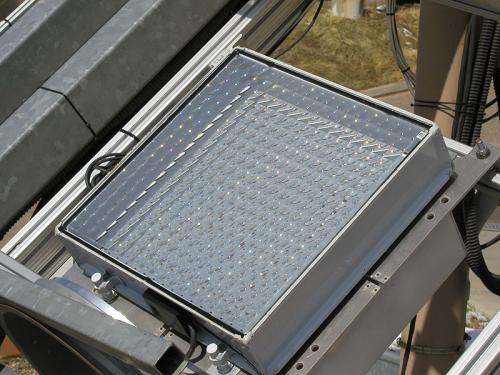
This solar cell module made by Semprius is being tested at NREL's Outdoor Test Facility. Credit: NREL staff

Ghosal laughs when he remembers the frantic moments finishing the application for the PV Incubator.

"We barely met the criteria," Ghosal said. "The rules said that you had to have a module ready to be eligible, but we only had small squares with a couple of cells, not a real module."

So, the Semprius engineers "worked feverishly day and night to make our first module."

"Two days before the deadline, we were able to get good results from that first module," Ghosal said. "We applied for the Incubator grant with the results from this module and a scale-up plan."

When Ghosal asked the company's engineers about whether they could meet the hard deadlines and aggressive goals laid down by NREL, "I was met with a lot of apprehension," he recalled. "NREL was asking for a lot of deliverables that had not been done before."

But it all worked out, and Semprius became the latest Incubator company to achieve more than it thought it could via the strict dictates of the NREL contract.

"It looked like a tall order, but we met all our goals," Ghosal said.

Kaitlyn VanSant, NREL's technical monitor for Semprius, said the company is being too modest.

"They actually met the goals a lot faster than originally anticipated," VanSant said. "The goals were definitely aggressive, but they accomplished them quicker than the timeline."

The modules to be made in the North Carolina plant starting next year will be 24 inches by 18 inches, and about 2 and a half inches deep, have a concentration of more than 1,100 suns and an efficiency of more than 31 percent. These modules would be cost competitive with fossil fuel technology at high volume.

NREL's role was critical, Ghosal said.

"A lot of the early benefits were from the testing NREL could do. NREL has an internationally recognized testing program," Ghosal said. "It's one thing to claim a particular output, but something different to say that it was validated at NREL. It gives that stamp of credibility.

"Also, we learned from NREL how vigorous we had to be in terms of the materials we are using," Ghosal said. "We got an understanding of how it would perform in the field and got some important pointers of what to watch for."

Provided by National Renewable Energy Laboratory

Filter


Move the slider to adjust rank threshold, so that you can hide some of the comments.


Display comments: newest first

CapitalismPrevails
Dec 15, 2011

Rank: not rated yet
What's the $ per kWh?
that_guy
Dec 15, 2011

Rank: not rated yet
What's the $ per kWh?

Why don't you read up on solar panels technology. That's not a valid question as you asked it.

The cost per KWh is dependent on where you put it, among other factors.

Unfortunately they did not give us any averages other than competitive with fossil fuel at volume, and 50% less than other cells of this type of technology.

From what it sounds like, even if we conservatively estimate, that it will really be 20-25% percent more than fossil fuel, we can assume that it will be a great deal for consumers - There is a fair amount of markup between power generation from the power company and the consumer getting the electricity, due to line maintenance, transmission, and other factors.

I like everything in this article, from the hard goal requirement for seed money, to the innovative ways this company designs and produces their modules to save money/increase efficiency.

Like burning ants with a magnifying glass.
Callippo
Dec 15, 2011

Rank: 4 / 5 (1)
These cells are apparently very sensitive to their orientation toward Sun. The area of lenses can use only 60% of solar cell area, thus compensating the increased efficiency of gallium arsenide cells.
chip_engineer
Dec 15, 2011

Rank: not rated yet
What's the $ per kWh?

Fair question, better stated as $/W nameplate, anyone can add the COP factor for their location.

I always liked CSP but I fear the time has come and gone. GAs and this packaging and the tracking will kill it.

For the Long Island plant I keep jabbering about, they get $65/W on a $300M project that delivers 32MW nameplate (COP 7) for 4.5MW continuous to only 4500 homes. It uses 160,000 static 200W vanilla panels (nameplate). With Mitts money, I can buy from Senelec the same for $32M using $1/W panels. The other $270M covers inverters and standing hardware. Even if the panels were free, it would still be $270M or $58/W. We should add on the cost to the grid of the gas plant to back it up too.

Change that to tracking and go way south, the system costs are still going to be in the same ballpark but maybe 1/3 of the acreage. I think the financing of this will be all funny accounting with subsidies, mandates and reqs.

Sorry but my money is still on Thorium LFTR.
xpst
Dec 30, 2011

Rank: not rated yet
The tiny cell sizes mean that the light must be tightly focused, meaning that the panels will not respond to diffuse sunlight--need clear skies, making deployment in places like Germany unattractive.

Conventional PV doesn't work so great in high ambient temps. This new tech could be especially valuable in places like Saudi Arabia.

The 2D tracker requirement is a big disadvantage, both in terms of initial capital and maintenance. Might be better to use conventional fixed PV, and use the money saved to just buy more panels. Definitely should take that into account in figuring $/W.

Rank 5 /5 (12 votes)
Relevant PhysicsForums posts

More news stories

Browser wars flare in mobile space

The browser wars are heating up again, but this time the fight is for dominance of the mobile Internet.

Technology / Software

created 15 hours ago | popularity 5 / 5 (2) | comments 3

Probability of contamination from severe nuclear reactor accidents is higher than expected: study

Catastrophic nuclear accidents such as the core meltdowns in Chernobyl and Fukushima are more likely to happen than previously assumed. Based on the operating hours of all civil nuclear reactors and the number ...

Technology / Energy & Green Tech

created May 22, 2012 | popularity 3.6 / 5 (25) | comments 56 | with audio podcast

HyperSolar shows dirty water no barrier to power world

(Phys.org) -- The Santa Barbara, California, company, HyperSolar, is set to transparently share the ups and downs of its research experiences toward the company’s ultimate vision, successfully producing ...

Technology / Energy & Green Tech

created May 24, 2012 | popularity 4.8 / 5 (16) | comments 17 | with audio podcast report

SpotterRF debuts Radar Backpack Kit (w/ Video)

(Phys.org) -- SpotterRF has announced a special radar backpack kit designed to enhance situational awareness for soldiers on the ground. The company says its special radar is designed for warfighters as part ...

Technology / Hi Tech & Innovation

created May 26, 2012 | popularity 5 / 5 (5) | comments 13 | with audio podcast report

Tesla to launch electric sedan in US on June 22

Tesla Motors said Tuesday it would begin deliveries of "the world's first premium electric sedan" on June 22, slightly ahead of schedule.

Technology / Energy & Green Tech

created May 22, 2012 | popularity 4.5 / 5 (12) | comments 18


Stunning image of smallest possible five-ringed structure

Scientists have created and imaged the smallest possible five-ringed structure – about 100,000 times thinner than a human hair – and you'll probably recognise its shape.

'Unzipped' carbon nanotubes could help energize fuel cells, batteries

Multi-walled carbon nanotubes riddled with defects and impurities on the outside could replace some of the expensive platinum catalysts used in fuel cells and metal-air batteries, according to scientists at ...

Change in developmental timing was crucial in the evolutionary shift from dinosaurs to birds: study

At first glance, it's hard to see how a common house sparrow and a Tyrannosaurus Rex might have anything in common. After all, one is a bird that weighs less than an ounce, and the other is a dinosaur that ...

Computer model used to pinpoint prime materials for efficient carbon capture

When power plants begin capturing their carbon emissions to reduce greenhouse gases – and to most in the electric power industry, it's a question of when, not if – it will be an expensive undertaking.

T cells 'hunt' parasites like animal predators seek prey, study shows

By pairing an intimate knowledge of immune-system function with a deep understanding of statistical physics, a cross-disciplinary team at the University of Pennsylvania has arrived at a surprising finding: T cells use a movement ...

Land and sea species differ in climate change response: study

(Phys.org) -- Marine and terrestrial species will likely differ in their responses to climate warming, new research by Simon Fraser University and Australia’s University of Tasmania has found.