How supermassive black holes came into existence shortly after the Big Bang
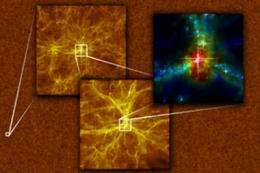
Pictured is the large scale cosmological mass distribution in the the MassiveBlack simulation. The projected gas density over the whole volume ("unwrapped" into 2-D) is shown in the background image. The two images on top show two close-ups of the regions where the most massive black hole is formed. The black hole is at the center of the image and is being fed by cold gas streams. Credit: Yu Feng
(PhysOrg.com) -- Researchers at Carnegie Mellon University's Bruce and Astrid McWilliams Center for Cosmology have discovered what caused the rapid growth of early supermassive black holes a steady diet of cold, fast food.
Computer simulations, completed using supercomputers at the National Institute for Computational Sciences and the Pittsburgh Supercomputing Center, and viewed using CMU's GigaPan technology, show that thin streams of cold gas flow uncontrolled into the center of the first black holes, causing them to grow faster than anything else in the universe. The findings will be published in the Astrophysical Journal Letters.
In the early days of the universe, a mere 700 to 800 million years after the Big Bang, most things were small. The first stars and galaxies were just beginning to form and grow in isolated parts of the universe. According to astrophysical theory, black holes found during this era also should be small in proportion with the galaxies in which they reside. However, recent observations from the Sloan Digital Sky Survey (SDSS) have shown that this isn't the case enormous supermassive black holes existed as early as 700 million years after the Big Bang.
"The Sloan Digital Sky Survey found supermassive black holes at less than 1 billion years. They were the same size as today's most massive black holes, which are 13.6 billion years old," said Tiziana Di Matteo, associate professor of physics at Carnegie Mellon. "It was a puzzle. Why do some black holes form so early when it takes the whole age of the universe for others to reach the same mass?"
Supermassive black holes are the largest black holes, with masses billions of times larger than that of the sun. Typical black holes have masses only up to 30 times larger than the sun's. Astrophysicists have determined that supermassive black holes can form when two galaxies collide and their two black holes merge into one. These galaxy collisions happened in the later years of the universe, but not in the early days. In the first few millions of years after the Big Bang, galaxies were too few and too far apart to merge.
"If you write the equations for how galaxies and black holes form, it doesn't seem possible that these huge masses could form that early," said Rupert Croft, an associate professor of physics at Carnegie Mellon. "But we look to the sky and there they are."
To find out exactly how these supermassive black holes came to be, Di Matteo, Croft and Carnegie Mellon post-doctoral researcher Nishikanta Khandai created the largest cosmological simulation to date. Called MassiveBlack, the simulation focused on recreating the first billion years after the Big Bang.
"This simulation is truly gigantic. It's the largest in terms of the level of physics and the actual volume. We did that because we were interested in looking at rare things in the universe, like the first black holes. Because they are so rare, you need to search over a large volume of space," Di Matteo said.
They began by running the simulation under conditions set under the standard model of cosmology the accepted theories and laws of modern day physics governing the formation and growth of the universe.
"We didn't put anything crazy in. There's no magic physics, no extra stuff. It's the same physics that forms galaxies in simulations of the later universe," Croft said. "But magically, these early quasars, just as had been observed, appear. We didn't know they were going to show up. It was amazing to measure their masses and go 'Wow! These are the exact right size and show up exactly at the right point in time.' It's a success story for the modern theory of cosmology."
Their simulation data was incorporated into a new technology developed by Carnegie Mellon computer scientists called GigaPan Time Machine. The technology allowed the researchers to view their simulation as if it was a video with extremely high resolution. This enabled them to easily pan across the simulated universe as it formed and move back and forth through time as necessary. They could then zoom in on events that looked interesting, viewing them in greater detail than could be seen using a telescope.
As they zoomed in to the creation of the first supermassive black holes, they saw something unexpected. Normally, when cold gas flows toward a black hole it collides with other gas in the surrounding galaxy. This causes the cold gas to heat up and then cool back down before it enters the black hole. This process, called shock heating, would stop black holes in the early universe from growing fast enough to reach the masses we see. Instead, Di Matteo and Croft saw in their simulation thin streams of cold dense gas flowing along the filaments that give structure to the universe and straight into the center of the black holes at breakneck speed, making for cold, fast food for the black holes. This uncontrolled consumption caused the black holes to grow exponentially faster than the galaxies in which they reside.
And since a galaxy forms when a black hole forms, the results could also shed light on how the first galaxies formed, giving more clues to how the universe came to be. Di Matteo and Croft hope to push the limits of their simulation a bit more, creating even bigger simulations that cover more space and time.
Journal reference:
Astrophysical Journal Letters
Provided by
Carnegie Mellon University
-
From lemons to lemonade: Reaction uses carbon dioxide to make carbon-based semiconductor,
32 comments
-
Thioridazine kills cancer stem cells in human while avoiding toxic side-effects of conventional cancer treatments,
3 comments
-
SpaceX private rocket blasts off for space station (Update),
42 comments
-
Climate scientists say they have solved riddle of rising sea,
31 comments
-
SpaceX capsule has 'new car' smell, astronauts say (Update),
4 comments
-
Distance of planets from stars and revolution
8 hours ago
-
revamping general concept and cosmological principle
May 25, 2012
-
Transiting Exoplanet Light Curve
May 25, 2012
-
Math behind Theoretical Physics
May 24, 2012
-
Do we know whats at the center of galaxies yet?
May 23, 2012
-
Structure of the Milky Way?
May 20, 2012
- More from Physics Forums - General Astronomy
More news stories
Land and sea species differ in climate change response: study
(Phys.org) -- Marine and terrestrial species will likely differ in their responses to climate warming, new research by Simon Fraser University and Australia’s University of Tasmania has found.
6 hours ago |
3.8 / 5 (4) |
5
|
Yale study concludes public apathy over climate change unrelated to science literacy
Are members of the public divided about climate change because they don't understand the science behind it? If Americans knew more basic science and were more proficient in technical reasoning, would public consensus match ...
8 hours ago |
4.8 / 5 (5) |
20
|
10 million years needed to recover from mass extinction
It took some 10 million years for Earth to recover from the greatest mass extinction of all time, latest research has revealed.
Space & Earth / Earth Sciences
8 hours ago |
4 / 5 (4) |
1
|
Sophisticated simulations predict future warming
The chances of our planet being hit by a global warming of 3 degrees Celsius by 2050 is as likely as it being hit by an increase of 1.4 degrees, new research shows. Presented in the journal Nature Geoscience, the British study ...
Space & Earth / Earth Sciences
May 22, 2012 |
4.1 / 5 (10) |
51
Aliens don't want to eat us, says former SETI director
Alien life probably isnt interested in having us for dinner, enslaving us or laying eggs in our bellies, according to a recent statement by former SETI director Jill Tarter.
Space & Earth / Space Exploration
May 25, 2012 |
4.4 / 5 (15) |
41
Stunning image of smallest possible five-ringed structure
Scientists have created and imaged the smallest possible five-ringed structure about 100,000 times thinner than a human hair and you'll probably recognise its shape.
'Unzipped' carbon nanotubes could help energize fuel cells, batteries
Multi-walled carbon nanotubes riddled with defects and impurities on the outside could replace some of the expensive platinum catalysts used in fuel cells and metal-air batteries, according to scientists at ...
Change in developmental timing was crucial in the evolutionary shift from dinosaurs to birds: study
At first glance, it's hard to see how a common house sparrow and a Tyrannosaurus Rex might have anything in common. After all, one is a bird that weighs less than an ounce, and the other is a dinosaur that ...
Computer model used to pinpoint prime materials for efficient carbon capture
When power plants begin capturing their carbon emissions to reduce greenhouse gases and to most in the electric power industry, it's a question of when, not if it will be an expensive undertaking.
T cells 'hunt' parasites like animal predators seek prey, study shows
By pairing an intimate knowledge of immune-system function with a deep understanding of statistical physics, a cross-disciplinary team at the University of Pennsylvania has arrived at a surprising finding: T cells use a movement ...
Scientists develop ultra-sensitive test that detects diseases in their earliest stages
Scientists have developed an ultra-sensitive test that should enable them to detect signs of a disease in its earliest stages, in research published today in the journal Nature Materials.
Dec 12, 2011
Rank: 2 / 5 (4)
Dec 12, 2011
Rank: 1.3 / 5 (3)
Perhaps there is a lot more in common between plasma and cold uncharged matter.
I mean that charged particles acting under the influence of magnetic or electrical influence may be exactly the same as neutral particles acting under the influence of gravity.
The only problem I have with the similarity is that magnetic fields and electric fields have right angle field lines to maintain the track. How does gravity simulate that.
Dec 12, 2011
Rank: 1 / 5 (9)
But still no spiral galaxies I see.
http://www.presto...ndex.htm
Dec 12, 2011
Rank: 1 / 5 (14)
http://www.aether...sity.gif
http://www.aether...aac1.gif
http://www.aether...apse.gif
Dec 12, 2011
Rank: 1.3 / 5 (14)
In general, I don't believe the Universe as a whole is formed with black hole, but at smaller distance scales the behavior of dark matter can be really modeled with processes inside of collapsing stars and we can even get some testable predictions from it. At the general scale all models will vanish mutually into one random mixture, no matter, how pretty may appear.
Dec 12, 2011
Rank: 1.3 / 5 (13)
http://www.physor...795.html
http://www.aether...tter.jpg
It means, even the plasma model can bring some insights here, but these insights must be generalized with caution.
Dec 12, 2011
Rank: 1 / 5 (10)
I'm saying it because the laymans will face increasing number of observations and theories in future and therefore it's important to have some general guidelines for their judging. Or they will get lost in increasing amount of data.
Dec 12, 2011
Rank: 1 / 5 (9)
http://en.wikiped...c_string
IMO the dark matter fibers are actually just these cosmic strings. They appear a much more thicker and fuzzy, than the string theorists expect, because we are observing these hyperdimensional objects from our low dimensional perspective. This is just another example of phenomena, which string theorists predicted successfully, but they didn't recognize them in existing artifacts, because their theory is too schematic and difficult/complex enough to imagine in practical details. The ability to predict some phenomena is therefore one thing, the actual finding it is another one. If string theorists could balance the formal and nonformal aspects of their theory better, they would be a much more successful in promotion of their theory already.
Dec 12, 2011
Rank: 1 / 5 (8)
Of course, this is just my opinion; I could be wrong.
Dec 12, 2011
Rank: 1 / 5 (11)
But dense aether model is agnostic regarding the Steady state or Big bang models - it just says, all cosmological theories will converge into random model of Universe at the sufficiently distant perspective. One problem of both Steady state Universe, both Big Bang theory is, the observable Universe is not completely homogeneous because of Doppler shift of CMBR. This Doppler shift can be explained with insintric parity violation during observation of large random object with one of its fluctuations, but it may indicate too, even our portion of Universe isn't quite stable. For example famous astronomer Laura Mersini believes, our Universe appears like gigantic quantum wave, which travels from place to place and ignites galaxies there. Why not, after all.
Dec 12, 2011
Rank: 1 / 5 (12)
You're actually half right anyway.
The truth is, the Big Bang theory does not work.
That's why they invented the patches of inflationary theory, and "symetry breaking" in which the laws of the universe truly mean nothing!
Haven't you ever heard of GUTS? Grand Unified Theory? The laws of physics change, according to the physicists anyway...
They admit this. I didn't make it up. It's always been that way.
But I digress, the hypocrissy of trying to "post-dict" an event that could only exist if the laws of physics are not constant...it's insanity.
Dec 12, 2011
Rank: 1 / 5 (9)
Dec 12, 2011
Rank: 1 / 5 (2)
Dec 12, 2011
Rank: 1 / 5 (4)
Doesn't that sound like our universe "functions" in the multiverse as progenitor of galaxy formation? Meaning, rather than having no rhyme or reason to exist, our universe plays a part in some grand cosmic scheme , much more vast than we could have ever imagined, .
Dec 12, 2011
Rank: 1 / 5 (5)
Dec 12, 2011
Rank: 1 / 5 (1)
Dec 13, 2011
Rank: 4.5 / 5 (16)
Ethelred
Dec 13, 2011
Rank: 1 / 5 (12)
It is expanding now because of neutron emission and neutron decay.
When the neutron stars have evaporated away, it will collapse and start over.
References:
1. "Is the Universe Expanding?" The Journal of Cosmology 13, 4187-4190 (2011)
http://journalofc...102.html
2. "Neutron Repulsion", The APEIRON Journal, in press (2011)
http://arxiv.org/...2.1499v1
With kind regards,
Oliver K. Manuel
http://myprofile....anuelo09
Dec 13, 2011
Rank: 2 / 5 (8)
http://www.presto...ndex.htm
Dec 13, 2011
Rank: 4.3 / 5 (12)
There is no evidence to support that.
There is no evidence of N-N repulsion beyond the Pauli-Exclusion Principle. Interesting you evaded the latest article showing this.
http://www.physor...ons.html
Stayed right away from that one even after your name was mentioned. Evasion of reality is your real specialty.
No evidence to support that. Massive evidence that neutrons do not repel at more than nuclear ranges and there they attract via the strong force.
Ethelred
Dec 13, 2011
Rank: 2.5 / 5 (8)
So far no one has bothered to post spam of items for sale from their website. Come on you advertisers looking for free space, I'm a guy in sad need of a bikini & I haven't yet seen the new holiday specials which would make a heck of a lot more sense than the "infinity" nonsense I'm reading here.
Our astronomy club comes to this site for astronomy news only, to put up with the duress of other people talking about how brilliant other people are who say nothing intellible.
Dec 13, 2011
Rank: 4.1 / 5 (9)
However, if you really want pain from infinity I recommend looking into higher order infinities like the Irrational Numbers vs the Rational Numbers. Both are infinite groups but there is an infinite number of irrationals for each rational despite what you were told about there being nothing bigger than infinity.
The explanation for this made my brain hurt.
Still now I know that when Buzz Lightyear says 'To infinity and beyond' he isn't actually wrong as there is something bigger than infinity.
Ethelred
Dec 13, 2011
Rank: 1 / 5 (8)
1. Ordinary citizens struggle for housing and food
2. Cosmologists, nuclear, particle and solar physicists report
a) Supermassive black holes appeared from nothing
www.physorg.com/n...rse.html
b) The "God particle" may be found today
www.quantumdiarie...-exists/
c) Our climate is immune to Earth's heat source - the Sun, but sensitive to trace levels of CO2 in an insulating layer of air
http://noconsensu...nt-62303
http://judithcurr...t-149143
One of the most pressing issues facing us today: Can arrogance be reduced so politicians and scientists again serve society?
With kind regards,
Oliver K. Manuel
www.omatumr.com/
http://myprofile....anuelo09
Dec 13, 2011
Rank: 3.9 / 5 (8)
And speaking of moral collapse how much longer til you get off parole.
I don't know about the politicians but your arrogance is right up there with Newton. Which is the only thing the two of you have in common.
Ethelred
Dec 13, 2011
Rank: 5 / 5 (2)
Dec 13, 2011
Rank: 5 / 5 (1)
It took me a moment, but I think you were trying to say "intelligible".
Dec 18, 2011
Rank: 1 / 5 (1)
Sei proprio cretino.
Mais quel con nom de dieu de putain de sa mère.
and Omatumr...
TimESimmons...
maffanculo Freaks
Greetings from Europe
Dec 19, 2011
Rank: 1 / 5 (2)
demostrar que estoy equivocado
http://www.presto...ndex.htm
Jan 03, 2012
Rank: not rated yet
Mass of the world : 10 ^ 55 kg
Supermassive black hole density 1.8 x 10 ^8 kg / litre
Volume of the kernel should be : 5,6 x 10 ^ 46 litre = 5,6 x 10 ^ 43 m3 = 5,6 x 10 ^ 16 km 3
Volume of a sphere is V = 4/3 x Pi * r ^3
r^3= (3V/ 4 Pi)
r= 210 thousand km
I suppose such a big black hole would be unstable
Shwartzchild radius:
~3 * M / M sun
3 * 10^55 / 10 ^30 = 3 * 10 ^ 25 km
It would swallow anything within this distance.
Could the energy released during such a collision or "absorption" process cause to explode the kernel?
This is my hypothesis.
Jan 03, 2012
Rank: not rated yet