How granular material becomes solid: Stress causes clogs in coffee and coal
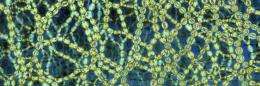
Photoelastic grains under shear. Photo: Behringer Group, Duke University
It's easy to get in a jam. But it's much harder to explain exactly how or when it started.
Scientists still aren't sure what causes clogs in flowing macroscopic particles, like corn, coffee beans and coal chunks. But new experiments by Duke physicist Robert Behringer and his colleagues suggest that when particles undergo a force called shear strain, they jam sooner than expected. The results appear in the Dec. 15 issue of Nature.
Shear strain is sort of like cupping sand between your hands, and then, without changing the width between them, moving one hand forward and the other hand backward, Behringer said. Not much sand flows between your hands with a force like this.
Many flows, including those of nuts, coffee and coal, inherently produce this type of movement among grains, but the design and engineering for hoppers and other dispensers that don't account for it won't work well, Behringer said.
The new work "points out the deficiencies in our current theoretical framework for when granular materials jam," said Corey O'Hern, an expert in granular media at Yale University who was not involved in the new study.
A deeper understanding of this point will lead to the design of new composite granular matter and also to the development of advanced materials that could counter weapons of mass destruction, including amplifiers and other countermeasures for deflecting blast waves, he said.
In past studies, physicists calculating how grains flow estimated their jamming point without accounting for friction forces among individual particles. Eliminating friction makes jamming easier to explain mathematically. It also suggested that just an increase in density would cause granular materials to jam.
"It's been an uphill battle to convince the scientific community that friction is important, and that shear causes jamming where it was not expected. No other experimentalists have really looked at what's happening with both friction and shear," Behringer said.
In his new experiments, Behringer and his team controlled the number of discs placed in a box designed to produce a shear strain. The researchers applied the shearing strain while allowing the discs to flow where they wanted.
The discs had distinct properties that allowed the team to measure the force each one experienced due to friction and shearing. The team also took pictures showing how those forces developed into branched chains, which spread through many discs and ultimately block their flow. The images and experiments show that because of friction forces and shear strain, the discs jammed when they were much farther apart, or at a lower density, than what had been previously predicted.
It's not just the number of particles that put them in a jam, it's also the strain and the real-world forces, like friction, that cause the back-up, Behringer said. The discovery could change the design of coal and grain silos and even the bulk dispensers at Whole Foods.
Friction and shear reveal the richness of possible states of granular matter, pointing scientists down a road paved with new discoveries, said Daryl Hess, program director for condensed matter and materials theory at NSF. Studying these new states of granular matter may also expose deeper connections between jamming and seemingly unrelated phenomena, from earthquakes to transformations occurring in other kinds of matter, like water to ice, he said.
More information: "Jamming by Shear," Bi, D. Zhang, J., Chakraborty, B., and Behringer, R. Nature. 480:7377, 355-358. DOI: 10.1038/nature10667
Provided by
Duke University
-
From lemons to lemonade: Reaction uses carbon dioxide to make carbon-based semiconductor,
32 comments
-
Thioridazine kills cancer stem cells in human while avoiding toxic side-effects of conventional cancer treatments,
3 comments
-
SpaceX private rocket blasts off for space station (Update),
42 comments
-
Climate scientists say they have solved riddle of rising sea,
31 comments
-
SpaceX capsule has 'new car' smell, astronauts say (Update),
4 comments
-
Why does a boiled egg rotates while a raw egg doesn't?
3 hours ago
-
Lightning strike in mindair
3 hours ago
-
Why does light move?
5 hours ago
-
How to calculate the repulsion force between a permanent and an electromagnet?
6 hours ago
-
Why does light allow us to see things?
6 hours ago
-
Room temperature superconductivity
6 hours ago
- More from Physics Forums - General Physics
More news stories
Is a classical electrodynamics law incompatible with special relativity?
(Phys.org) -- The laws of classical electromagnetism that were developed in the 19th century are the same laws that scientists use today. They include Maxwell’s four equations along with the Lorentz la ...
Landmark calculation clears the way to answering how matter is formed
(Phys.org) -- An international collaboration of scientists, including Thomas Blum, associate professor of physics, is reporting in landmark detail the decay process of a subatomic particle called a kaon ...
May 25, 2012 |
4.3 / 5 (22) |
52
|
Lying in wait for WIMPs: Researchers seek to dramatically increase sensitivity of Large Underground Xenon detector
Although it's invisible, dark matter accounts for at least 80 percent of the matter in the universe. No one knows what it is, but most scientists would bet on weakly interacting massive particles, or WIMPs.
May 23, 2012 |
4 / 5 (7) |
18
|
Hawaii lab turns laser-powered bubbles into microrobots
(Phys.org) -- A team of scientists from the University of Hawaii are working on microrobots created from bubbles of air in a saline solution. The bubbles take on their title of robots as a laser ...
Sound increases the efficiency of boiling
Scientists at the Georgia Institute of Technology achieved a 17-percent increase in boiling efficiency by using an acoustic field to enhance heat transfer. The acoustic field does this by efficiently removing vapor bubbles ...
May 24, 2012 |
5 / 5 (2) |
2
Stunning image of smallest possible five-ringed structure
Scientists have created and imaged the smallest possible five-ringed structure about 100,000 times thinner than a human hair and you'll probably recognise its shape.
'Unzipped' carbon nanotubes could help energize fuel cells, batteries
Multi-walled carbon nanotubes riddled with defects and impurities on the outside could replace some of the expensive platinum catalysts used in fuel cells and metal-air batteries, according to scientists at ...
Change in developmental timing was crucial in the evolutionary shift from dinosaurs to birds: study
At first glance, it's hard to see how a common house sparrow and a Tyrannosaurus Rex might have anything in common. After all, one is a bird that weighs less than an ounce, and the other is a dinosaur that ...
Computer model used to pinpoint prime materials for efficient carbon capture
When power plants begin capturing their carbon emissions to reduce greenhouse gases and to most in the electric power industry, it's a question of when, not if it will be an expensive undertaking.
T cells 'hunt' parasites like animal predators seek prey, study shows
By pairing an intimate knowledge of immune-system function with a deep understanding of statistical physics, a cross-disciplinary team at the University of Pennsylvania has arrived at a surprising finding: T cells use a movement ...
Land and sea species differ in climate change response: study
(Phys.org) -- Marine and terrestrial species will likely differ in their responses to climate warming, new research by Simon Fraser University and Australia’s University of Tasmania has found.
Dec 15, 2011
Rank: not rated yet
O:
Dec 15, 2011
Rank: 1 / 5 (1)
http://www.youtub...cjPSZeAg
In dense aether model the foamy streaks of dark matter can be interpreted in the same way: like jams of granular material forming the vacuum.
http://www.davidd...tion.jpg
Dec 15, 2011
Rank: 1 / 5 (1)
Dec 15, 2011
Rank: not rated yet
No sir, that gives you what's called the Brazil nut effect, which can be very useful in itself, but not for what I am doing.