SOFIA peers in to the heart of the Orion nebula
Dec 20, 2011 By Nicholas A. Veronico and Beth Hagenauer
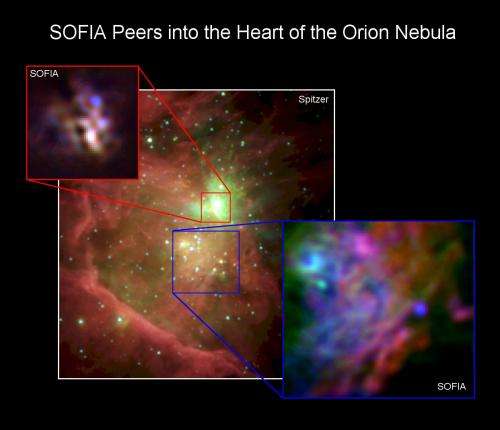
This graphical representation from the SOFIA Science Center compares two infrared images of the heart of the Orion nebula captured by the FORCAST camera on the SOFIA airborne observatory's telescope with a wider image of the same area from the Spitzer space telescope. (SOFIA image -- James De Buizer / NASA / DLR / USRA / DSI / FORCAST; Spitzer image -- NASA/JPL)

(PhysOrg.com) -- A new image from NASA’s Stratospheric Observatory for Infrared Astronomy (SOFIA) shows a complex distribution of interstellar dust and stars in the Orion nebula. Interstellar dust, composed mostly of silicon, carbon and other heavy elements astronomers refer to generically as “metals,” plus some ice and organic molecules, is part of the raw material from which new stars and planets are forming.

The two insets display mid-infrared images showing portions of the star-forming region, also known as Messier 42 (M42). The SOFIA images were produced by SOFIA staff scientist James De Buizer and his collaborators from data obtained in May-June 2011 during SOFIA’s Basic Science program. The observations were made using the FORCAST (Faint Object Infrared Camera for the SOFIA Telescope) instrument (Principal Investigator Terry Herter, Cornell University). Those observations are subjects of scientific papers to be submitted to The Astrophysical Journal.

SOFIA’s large telescope is able to resolve many individual protostars and young stars as well as knots of dust and gas that could be starting the process of gravitational contraction to become stars. The massive protostar known famously as the BN (Becklin-Neugebauer) Object stands out as the individual blue source in the red inset box. The BN/KL region of Orion gets its name from the initials of pioneering infrared astronomers Eric Becklin, Gerry Neugebauer, Doug Kleinmann, and Frank Low who mapped it in the late 1960s and early 1970s using some of the first astronomical infrared detectors. In this image, infrared light with wavelengths of 20, 31, and 37 μm, symbolized respectively by blue, green, and red, is seen coming from relatively cool with temperatures of approximately 100—200 Kelvin.

The SOFIA image in the blue inset box shows the Ney-Allen Nebula, a region of intense infrared emission that was discovered surrounding the luminous Trapezium stars by astronomers Ed Ney and David Allen. Some of the compact features shown here are disks of dust and gas around young solar-mass stars that could be planetary systems in the process of formation. In this image, blue, green, and red respectively symbolize infrared light with wavelengths of 8, 20, and 37 μm, coming from material as warm as 500 Kelvin (450°F).

The large background image is a composite of data from the Spitzer Space Telescope in which light with wavelengths of 7.9, 4.5, and 3.6 μm (represented respectively by red, green, and blue) is emitted from hot dust and gas heated by embedded stars, and from the stars themselves. The BN/KL region is so bright as to be over-exposed in the Spitzer image.

The two SOFIA images were made at combinations of wavelengths and angular resolutions unavailable to any other observatory on the ground or in space. The SOFIA and Spitzer images of Orion together provide a comprehensive view of stages of star formation from cold interstellar clouds to fully-fledged .

The SOFIA airborne observatory incorporates a 17-ton reflecting telescope with an effective diameter of 2.5 meters (100 inches) mounted inside an extensively modified Boeing 747SP. The SOFIA aircraft flies at altitudes as high as 45,000 feet (14 km), above more than 99 percent of the water vapor in Earth’s atmosphere that blocks most infrared radiation from celestial sources.

Explore further: South Africa's new radio telescope reveals giant outbursts from binary star system

Related Stories

SOFIA opens new window on star formation in Orion

Jan 12, 2011

A mid-infrared mosaic image from the Stratospheric Observatory for Infrared Astronomy, or SOFIA, offers new information about processes of star formation in and around the nebula Messier 42 in the constellation ...

Space image: Through the looking glass

Jun 15, 2011

The NASA logo on Bldg. 703 at the Dryden Aircraft Operations Facility in Palmdale, Calif., is reflected in the 2.5-meter primary mirror of the SOFIA observatory's telescope.

Spitzer Reveals New Wonders in the Familiar Orion Nebula

Aug 15, 2006

The Orion nebula is one of the most famous and easily viewed deep-sky sights. Located in the sword of Orion the Hunter, this distant cloud of gas and dust holds hundreds of young stars. At its center, a cluster ...

Space Image: North American Nebula

Oct 19, 2011

This swirling landscape of stars is known as the North America Nebula. In visible light, the region resembles North America, but in this image infrared view from NASA's Spitzer Space Telescope, the continent ...

CU telescope debuts on NASA flying observatory

May 25, 2010

(PhysOrg.com) -- SOFIA, the Stratospheric Observatory for Infrared Astronomy, will take flight May 25 along with the Cornell-built FORCAST (the Faint Object InfraRed Camera for the SOFIA Telescope).

Recommended for you

4C+29.30: Black hole powered jets plow into galaxy

May 15, 2013

(Phys.org) —This composite image of a galaxy illustrates how the intense gravity of a supermassive black hole can be tapped to generate immense power. The image contains X-ray data from NASA's Chandra X-ray ...

A space-time magnifying glass

May 15, 2013

(Phys.org) —Bright arcs are smeared around the heart of galaxy cluster Abell S1077 in this image taken by the NASA/ESA Hubble space telescope. The arcs are stretched images of distant galaxies distorted ...

Orion's hidden fiery ribbon

May 15, 2013

(Phys.org) —This dramatic new image of cosmic clouds in the constellation of Orion reveals what seems to be a fiery ribbon in the sky. This orange glow represents faint light coming from grains of cold ...

User comments : 0

More news stories

Alaska volcano shoots ash 15,000 feet into the air

(AP)—One of Alaska's most restless volcanoes has shot an ash cloud 15,000 feet into the air in an ongoing eruption that has drawn attention from a nearby community but isn't expected to threaten air traffic.

Chinese, Indian airlines face EU pollution fines

Eight Chinese and two Indian airlines face fines of up to several million euros for not paying for their greenhouse gas emissions during flights within the bloc, the European Commission said on Friday.

Bright explosion on the Moon

For the past 8 years, NASA astronomers have been monitoring the Moon for signs of explosions caused by meteoroids hitting the lunar surface. "Lunar meteor showers" have turned out to be more common than anyone ...

US seizes Bitcoin operator accounts

US authorities seized the accounts of a Bitcoin digital currency exchange operator, claiming it was functioning as an "unlicensed money service business," court documents showed Friday.