'Smart Connector' could save millions in lost revenue
December 15, 2011

'Smart Connector' could save millions in lost revenue

Enlarge

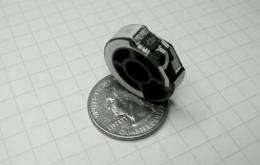
The Smart Connector, a new sensor device, is installed in the connecting units of coaxial cables to provide real-time information about primary failure modes in radio-frequency cables. Researchers in RIT’s Kate Gleason College of Engineering and PPC, a Syracuse-based telecommunications connector equipment company, developed the device. Credit: Provided by Robert Bowman

Deterioration and damage to cellular telecommunications cables cost organizations and customers millions in lost revenue and services in the always-on digital economy. A new sensor device, smaller than a quarter, might alleviate some of the impact.

Researchers at Rochester Institute of Technology and PPC Corp. have developed the Smart Connector, a new sensor that once installed in the connecting units of coaxial cables can provide information about equipment damage and pinpoint the exact location through self-diagnosing technologies—some of the most advanced in the field today.

The sensor is one outcome of corporate research and development initiatives established at RIT that have grown over the past few years. The university and PPC Corp. signed a licensing agreement in June. Both parties are in the process of final testing and technology transfer, says Robert Bowman, professor of electrical and microelectronic engineering in RIT's Kate Gleason College of Engineering.

The university demonstrated the feasibility of the technology and is working with PPC to further test the manufactured product, Bowman explains. "It's one thing to conduct laboratory testing and demonstrate viability, it's another thing to get it into a product. PPC worked very closely with us during this research effort, and we'll work with them as they try to integrate this technology into their product line."

Bowman and his research group worked with Noah Montena, principal engineer at PPC, a Syracuse-based telecommunications radio-frequency, or RF, connector equipment company, to design the sensor-disc system. The system monitors the primary failure modes in RF cables. Each sensor-disc contains a unique site identifier, monitors critical conditions and reports the sensor status using a technique called back scatter telemetry. Each smart connector is capable of activating or powering-down its energy capacity by extracting miniscule amounts of radio frequency energy from the coaxial cables.

"This technology is really exciting, and the impact it could have on the industry is only just becoming apparent," says Montena. "Up until now, connector and equipment failures could be detected only after tower capacity had been diminished, and only pinpointed on-site with the system shut down."

The sensors have been designed from the beginning with simplicity, robustness and cost-effectiveness in mind, and one of the advantages of collaborating on the research has been the communication of manufacturing considerations as design decisions get made, Montena adds. "Beyond cellular connectors, it is easy to imagine this finding a place in other high value, or 'can't fail' applications such as communications or internal networks in spacecraft or aircraft. I look forward to uncovering all the possibilities."

Provided by Rochester Institute of Technology search and more info website

4.2 /5 (6 votes)  

Filter


Move the slider to adjust rank threshold, so that you can hide some of the comments.


Display comments: newest first

that_guy
Dec 15, 2011

Rank: not rated yet
Step one - develop the smart connector.
Step two - retrofit existing technology applications to use this connector.

and, the missed part is step three. Integrate this technology into existing and new technology designs so that you don't need to add a connector to everything.
nkalanaga
Dec 15, 2011

Rank: 5 / 5 (1)
They need the connectors anyway. Every place a piece of coax connects to another device, or a second piece of coax, there's a connector. Integrating these sensors into the devices wouldn't serve any practical purpose, and would increase the cost of the devices.
Shifty0x88
Dec 15, 2011

Rank: not rated yet
I believe this is there target market:

"...it is easy to imagine this technology finding a place in other high value, or 'can't fail' applications..."

IE: We have a lot of money to spend on connectors! =D
Rank 4.2 /5 (6 votes)
Relevant PhysicsForums posts

More news stories

Browser wars flare in mobile space

The browser wars are heating up again, but this time the fight is for dominance of the mobile Internet.

Technology / Software

created 13 hours ago | popularity 5 / 5 (2) | comments 3

Probability of contamination from severe nuclear reactor accidents is higher than expected: study

Catastrophic nuclear accidents such as the core meltdowns in Chernobyl and Fukushima are more likely to happen than previously assumed. Based on the operating hours of all civil nuclear reactors and the number ...

Technology / Energy & Green Tech

created May 22, 2012 | popularity 3.7 / 5 (23) | comments 56 | with audio podcast

HyperSolar shows dirty water no barrier to power world

(Phys.org) -- The Santa Barbara, California, company, HyperSolar, is set to transparently share the ups and downs of its research experiences toward the company’s ultimate vision, successfully producing ...

Technology / Energy & Green Tech

created May 24, 2012 | popularity 4.8 / 5 (16) | comments 17 | with audio podcast report

SpotterRF debuts Radar Backpack Kit (w/ Video)

(Phys.org) -- SpotterRF has announced a special radar backpack kit designed to enhance situational awareness for soldiers on the ground. The company says its special radar is designed for warfighters as part ...

Technology / Hi Tech & Innovation

created May 26, 2012 | popularity 5 / 5 (5) | comments 13 | with audio podcast report

Tesla to launch electric sedan in US on June 22

Tesla Motors said Tuesday it would begin deliveries of "the world's first premium electric sedan" on June 22, slightly ahead of schedule.

Technology / Energy & Green Tech

created May 22, 2012 | popularity 4.5 / 5 (12) | comments 18


'Unzipped' carbon nanotubes could help energize fuel cells, batteries

Multi-walled carbon nanotubes riddled with defects and impurities on the outside could replace some of the expensive platinum catalysts used in fuel cells and metal-air batteries, according to scientists at ...

Change in developmental timing was crucial in the evolutionary shift from dinosaurs to birds: study

At first glance, it's hard to see how a common house sparrow and a Tyrannosaurus Rex might have anything in common. After all, one is a bird that weighs less than an ounce, and the other is a dinosaur that ...

Computer model used to pinpoint prime materials for efficient carbon capture

When power plants begin capturing their carbon emissions to reduce greenhouse gases – and to most in the electric power industry, it's a question of when, not if – it will be an expensive undertaking.

T cells 'hunt' parasites like animal predators seek prey, study shows

By pairing an intimate knowledge of immune-system function with a deep understanding of statistical physics, a cross-disciplinary team at the University of Pennsylvania has arrived at a surprising finding: T cells use a movement ...

Land and sea species differ in climate change response: study

(Phys.org) -- Marine and terrestrial species will likely differ in their responses to climate warming, new research by Simon Fraser University and Australia’s University of Tasmania has found.

Yale study concludes public apathy over climate change unrelated to science literacy

Are members of the public divided about climate change because they don't understand the science behind it? If Americans knew more basic science and were more proficient in technical reasoning, would public consensus match ...