Small reactors could figure into US energy future
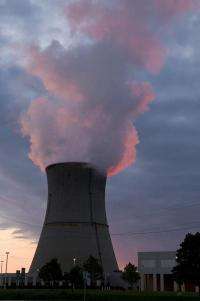
The Davis-Besse Nuclear Power Station at Oak Harbor, Ohio, on the shore of Lake Erie, is a megawatt-scale reactor. Small modular reactors may prove to be a feasible alternative to such reactors in the future, according to a new study released by the Energy Policy Institute at the University of Chicago (EPIC). Credit: Lloyd DeGrane
A newly released study from the Energy Policy Institute at the University of Chicago (EPIC) concludes that small modular reactors may hold the key to the future of U.S. nuclear power generation.
"Clearly, a robust commercial SMR industry is highly advantageous to many sectors in the United States," concluded the study, led by Robert Rosner, institute director and the William Wrather Distinguished Service Professor in Astronomy & Astrophysics.
"It would be a huge stimulus for high-valued job growth, restore U.S. leadership in nuclear reactor technology and, most importantly, strengthen U.S. leadership in a post-Fukushima world, on matters of nuclear safety, nuclear security, nonproliferation, and nuclear waste management," the report said.
The SMR report was one of two that Rosner rolled out this month at the Center for Strategic and International Studies in Washington, D.C. Through his work as former chief scientist and former director of Argonne National Laboratory, Rosner became involved in a variety of national policy issues, including nuclear and renewable energy technology development.
The reports assessed the economic feasibility of classical, gigawatt-scale reactors and the possible new generation of modular reactors. The latter would have a generating capacity of 600 megawatts or less, would be factory-built as modular components, and then shipped to their desired location for assembly.
The U.S. Department of Energy funded the reports through Argonne, which is operated by UChicago Argonne LLC. The principal authors of the report were Rosner and Stephen Goldberg, special assistant to Argonne's director.
The reports followed up a 2004 UChicago study on the economic future of nuclear energy. The 2004 study concluded that the nuclear energy industry would need financial incentives from the federal government in order to build new plants that could compete with coal- and gas-fired plants.
The first report, "Analysis of GW-scale Overnight Costs," updates the overnight cost estimates of the 2004 report. Overnight costs are the estimated costs if you were to build a new large reactor 'overnight,' that is, using current input prices and excluding the cost of financing.
It would now cost $4,210 per kilowatt to build a new gigawatt-scale reactor, according to the new report. This cost is approximately $2,210 per kilowatt higher than the 2004 estimate because of commodity price changes and other factors.
Struggling restart
At the Center for Strategic and International Studies event on Dec. 1, CSIS president and CEO John Hamre said that economic issues have hindered the construction of new large-scale reactors in the United States. The key challenge facing the industry is the seven-to-nine-year gap between making a commitment to build a nuclear plant and revenue generation.
Few companies can afford to wait that long to see a return on the $10 billion investment that a large-scale nuclear plant would require. "This is a real problem," Hamre said, but the advent of the small modular reactor "offers the promise of factory construction efficiencies and a much shorter timeline."
Natural gas would be the chief competitor of nuclear power generated by small modular reactors, but predicting the future of the energy market a decade from now is a risky proposition, Rosner said. "We're talking about natural-gas prices not today but 10, 15 years from now when these kinds of reactors could actually hit the market."
The economic viability of small modular reactors will depend partly on how quickly manufacturers can learn to build them efficiently. "The faster you learn, the better off you are in the long term because you get to the point where you actually start making money faster," Rosner noted.
Small modular reactors could be especially appealing for markets that could not easily accommodate gigawatt-scale plants, such as those currently served by aging, 200- to 400-megawatt coal plants, which are likely to be phased out during the next decade, Rosner said. An unknown factor that will affect the future of these plants would be the terms of any new clean-air regulations that might be enacted in the next year.
An important safety aspect of small modular reactors is that they are designed to eliminate the need for human intervention during an emergency. In some of the designs, Rosner explained, "the entire heat load at full power can be carried passively by thermal convection. There's no need for pumps."
Getting the first modular reactors built will probably require the federal government to step in as the first customer. That is a policy issue, though, that awaits further consideration. "It's a case that has to be argued out and thought carefully about," Rosner said. "There's a long distance between what we're doing right now and actually implementing national policy."
Provided by
University of Chicago
-
From lemons to lemonade: Reaction uses carbon dioxide to make carbon-based semiconductor,
32 comments
-
Thioridazine kills cancer stem cells in human while avoiding toxic side-effects of conventional cancer treatments,
3 comments
-
SpaceX private rocket blasts off for space station (Update),
42 comments
-
Climate scientists say they have solved riddle of rising sea,
31 comments
-
SpaceX capsule has 'new car' smell, astronauts say (Update),
4 comments
-
Need a rigid insulation material???
20 hours ago
-
magnets or EMF in car bumpers to protect from fender bender
May 26, 2012
-
length of wire in a coil of known dimensions?
May 25, 2012
-
India Engineering Powerhouse
May 25, 2012
-
electromagnet core dereference between hard and soft iron
May 25, 2012
-
Measuring water pressure in an open tank
May 24, 2012
- More from Physics Forums - General Engineering
More news stories
Browser wars flare in mobile space
The browser wars are heating up again, but this time the fight is for dominance of the mobile Internet.
13 hours ago |
5 / 5 (2) |
3
Probability of contamination from severe nuclear reactor accidents is higher than expected: study
Catastrophic nuclear accidents such as the core meltdowns in Chernobyl and Fukushima are more likely to happen than previously assumed. Based on the operating hours of all civil nuclear reactors and the number ...
Technology / Energy & Green Tech
May 22, 2012 |
3.7 / 5 (23) |
56
|
HyperSolar shows dirty water no barrier to power world
(Phys.org) -- The Santa Barbara, California, company, HyperSolar, is set to transparently share the ups and downs of its research experiences toward the companys ultimate vision, successfully producing ...
SpotterRF debuts Radar Backpack Kit (w/ Video)
(Phys.org) -- SpotterRF has announced a special radar backpack kit designed to enhance situational awareness for soldiers on the ground. The company says its special radar is designed for warfighters as part ...
Tesla to launch electric sedan in US on June 22
Tesla Motors said Tuesday it would begin deliveries of "the world's first premium electric sedan" on June 22, slightly ahead of schedule.
Technology / Energy & Green Tech
May 22, 2012 |
4.5 / 5 (12) |
18
'Unzipped' carbon nanotubes could help energize fuel cells, batteries
Multi-walled carbon nanotubes riddled with defects and impurities on the outside could replace some of the expensive platinum catalysts used in fuel cells and metal-air batteries, according to scientists at ...
Change in developmental timing was crucial in the evolutionary shift from dinosaurs to birds: study
At first glance, it's hard to see how a common house sparrow and a Tyrannosaurus Rex might have anything in common. After all, one is a bird that weighs less than an ounce, and the other is a dinosaur that ...
Computer model used to pinpoint prime materials for efficient carbon capture
When power plants begin capturing their carbon emissions to reduce greenhouse gases and to most in the electric power industry, it's a question of when, not if it will be an expensive undertaking.
T cells 'hunt' parasites like animal predators seek prey, study shows
By pairing an intimate knowledge of immune-system function with a deep understanding of statistical physics, a cross-disciplinary team at the University of Pennsylvania has arrived at a surprising finding: T cells use a movement ...
Land and sea species differ in climate change response: study
(Phys.org) -- Marine and terrestrial species will likely differ in their responses to climate warming, new research by Simon Fraser University and Australia’s University of Tasmania has found.
Yale study concludes public apathy over climate change unrelated to science literacy
Are members of the public divided about climate change because they don't understand the science behind it? If Americans knew more basic science and were more proficient in technical reasoning, would public consensus match ...
Dec 13, 2011
Rank: 4.5 / 5 (2)
1) I've always been lead to believe that larger means more efficient, in terms of power per cost, excluding loss of efficiency from longer distance transmission of power.
2) How modular can they go, when each cooling/water system will need to be unique to the physical landscape of the installation? Cooling infrastructure is rather important.
Dec 13, 2011
Rank: 5 / 5 (1)
Dec 13, 2011
Rank: 1 / 5 (4)
Dec 13, 2011
Rank: 2 / 5 (1)
http://en.wikiped..._reactor
Dec 13, 2011
Rank: not rated yet
Smaller reactor requires smaller cooling infrastructure. It can even utilise fully passive cooling (depending on the design), thus significantly lowering cost, and simultaneously increasing safety. From the article:
An important safety aspect of small modular reactors is that they are designed to eliminate the need for human intervention during an emergency. In some of the designs, Rosner explained, "the entire heat load at full power can be carried passively by thermal convection. There's no need for pumps."
Dec 13, 2011
Rank: 5 / 5 (2)
Small country towns could then have a nuclear power plant trucked in and dropped of instead of a gas power plant.
E.g. Smelting operations.
Dec 13, 2011
Rank: not rated yet
if this industry is going to make a comeback, and i would guess scale down high volume could be a good model, are we or are we not talking about gen iv breeder reactors?
Dec 13, 2011
Rank: 5 / 5 (6)
Dec 13, 2011
Rank: 3 / 5 (2)
"The Toshiba 4S has been described in some promotional articles as a nuclear battery, but as attractive as the plant is, that is too simplistic a description. The plant is a small, sodium cooled fast reactor with a rather technologically advanced, compact steam turbine secondary system. "
http://atomicinsi...ska.html
Dec 13, 2011
Rank: 5 / 5 (2)
We don't need that lesson taught to us. The lesson we need taught is how to produce safe, inexpensive reactors with a range of production capacities to meet varying needs. That's an engineering question, mainly, and it's a question the US isn't taking at all seriously.
Uranium and plutonium reactors are expensive, higher-risk than we'd prefer, and leave a nasty, unsolved clean-up problem. Thorium reactors might not fix all of those problems completely, but they should be cheaper, smaller for a given output, better suited to fail safely, no water is required, there won't be any hydrogen explosions or runaway core meltdowns. So why aren't we working on them?
Dec 13, 2011
Rank: 1.5 / 5 (6)
Since you're for the use of nuclear reactors; what say we dump the nuclear waste in your back yard? Then you can come to appreciate just how 'safe' this technology is. After all, the nuclear waste will be safe in about a million years or so... you can deal with that, right? Or are you one of these "Not in MY back yard" sorts, that think it's OK to dump toxic waste anywhere but near where YOU live?
Dec 13, 2011
Rank: 1.3 / 5 (6)
Q - How long before there is so much waste there is no safe place to put it?
A - there is already too much; and much debate on how to deal with it.
Dec 13, 2011
Rank: 1.4 / 5 (5)
Atleast not until I get my radiation suit on and lead walls up.
Insanity is alive and well. Cheers !
Dec 13, 2011
Rank: 2.3 / 5 (3)
Every nuclear power plant in the US stores its high level waste in pools on site.
I did a rough calculation of the volume of this high level waste. It would cover a US football field ~4 feet deep.
The Finns are working on a very interesting nuke dump bored into their local bedrock.
http://www.comsol...ry/full/
Dec 14, 2011
Rank: 5 / 5 (4)
India's Thorium program uses it to blanket the uranium for more fertile material since they are sanctioned. That may change if Australia sells them Uranium, then they will drop Thorium even though they sit on huge reserves.
China's Thorium program is the liquid fluoride molten salt LFTR which they are liberally taking from Oakridge and good luck too.
I don't think your concern over the military control over commercial plants is valid, separate programs. The commercial industry doesn't make weapons grade Pu239 since it is contaminated with Pu240 a weapons killer. DOD makes/made all the weapons Pu it ever needed.
Th232 is about 3-4 times more common than U238 and 400* more than U235. The LFTR would burn 1 ton of fertile Th232 to give 1GW/yr but it needs some fission material to breed it, any of U232, U235 or Pu239. The common Uranium reactors use about 100 tons of fertile U238 and 1 ton of U235 to produce 1GW/yr. The solid waste includes Pu though.
I think that's about right.
Dec 14, 2011
Rank: 3 / 5 (4)
Regarding "waste" - that is a problem of current once-thorough reactors. Designs such as TWR, LFTR and IFR (S-PRISM) produce only small amount of shortlived waste (300 years to decay to background levels).
In fact, I would argue that even if we choose different source of energy (renewables, fusion..) we need to build them anyway, just to burn our current long-term waste stockpiles. Dumping it underground is not really a solution.
And I would recommned to stop calling it "waste". Its FUEL for next generation reactors ;)
Dec 14, 2011
Rank: 4.5 / 5 (6)
You need to learn about how all the elements came to be, try reading up on supernova and neutron flux. Then learn about what half life means.
High level nuclear waste that contains Pu is indeed dangerous and expensive difficult to store or process. Pu half life is 20k years so 100k years and its still 3% left and its hot and poisonous. But some reactors can burn almost any high level waste down to short lived wastes.
The Thorium LFTR burns fertile Th232 instead of U238 and it uses U235 or Pu to get the thing cooking. After most of the Th is burned, the waste has 10,000* less Pu than an equiv Uranium reactor would and the waste stream would be reprocessed in 5 yrs to extract valuable medical isotopes like Technium as well as rare earth metals.
If I owned a 1GW LFTR the waste stream would indeed be very valuable after a short cool off and I would guard it from theft.
Coal plants emit more Uranium to the air than nukes keep safe on the ground.
Calm down do some reading.
Dec 14, 2011
Rank: 4.3 / 5 (4)
I wish Bill Gates all the luck with his breeder design but the Chinese will likely stay with current Uranium PWR designs and the Thorium LFTR they are borrowing from Oakridge.
I wish BG would take the Th LFTR too, it is just a better design that mitigates almost all the problems of Uranium designs, like 100 times more fuel efficient, 4 times the fuel, 10000 *less Pu in the waste, 300 years and back to background levels, contains valuable material in the stream which can be processed in 5 years.
Also LFTR engines can be treated as thermal replacements for oil or gas use in industry. They could be used to synthesize liquid fuels like DME, ammonia, even hydrogen, plus they could desalinate water.
Whats not to love about LFTR, see energyfromthorium com to learn more. The basic design was done 50 years ago but was put aside since it couldn't makes weapons material.
Nuclear plants uses 100-1000 times less land than Solar PV. Also animals survive there see treehugger croc story.
Dec 14, 2011
Rank: 4.3 / 5 (4)
I almost forgot, LFTRs can't blow up, they are normal pressure, no need for Steel containment vessels, if they do overheat they passively shut down. Flick a cooler shut off switch and it will shut down, it is a liquid chemistry process that emits loads of heat to a heat exchanger.
The uranium PWRs that we have today are a whole lot more complex to shut down, they can be designed to be passive, I wish they all were so I wouldn't want to be near any PWR accident. The Fukashima reactor worked very well, the diesel backups were flooded out, they should have been much higher up, that caused the reactors to fail.
Most of the opposition to Thorium LFTR will likely come from PWR folks.
The article says SMRs could be $4/w. I see a new Solar plant has gone up in Long Island, it only produces a continuous 4.5MW not the 32MW nameplate and it cost $298M, that is $65/W. It also uses 43 acres/MW while some old Nukes use 36 acres/GW (San Onofre). For nuclear more land is for buffer.
Dec 14, 2011
Rank: 5 / 5 (3)
Dec 14, 2011
Rank: not rated yet
Sounds a lot like big oil...
Dec 14, 2011
Rank: 5 / 5 (1)
Dec 14, 2011
Rank: 3 / 5 (2)
Dec 15, 2011
Rank: 5 / 5 (1)
In Denmark,
The consumer pays for both the electricity and the heat from the energy company.
What often times occurs is, heat is required but electricity is not required, so the plant is turned on when needed. The excess electricity is shipped off to Germany, Norway, and other local countries. In Norway, for instance, they use it to pump water into a Dam, creating a large battery. It's an interesting balancing act of energy storage and generation.