Study shows more shrubbery in a warming world
December 8, 2011 by Aries Keck

Study shows more shrubbery in a warming world

Enlarge

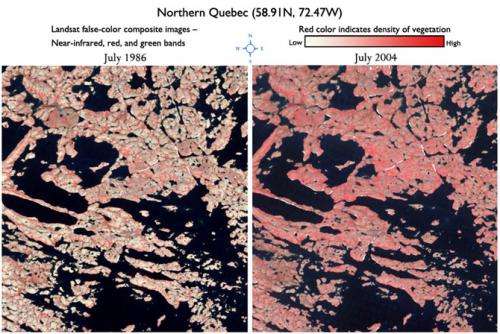
Comparison of area in Northern Quebec showing increased vegetation between 1986 and 2004. In this false-color Landsat image, more red color indicates more vegetation. Credit: Jeff Masek, NASA

(PhysOrg.com) -- Scientists have used satellite data from NASA-built Landsat missions to confirm that more than 20 years of warming temperatures in northern Quebec, Canada, have resulted in an increase in the amount and extent of shrubs and grasses.

"For the first time, we've been able to map this change in detail, and it's because of the spatial resolution and length-of-record that you can get with Landsat," says Jeff Masek, the program's project scientist. He's based at NASA's Goddard Space Flight Center in Greenbelt, Md.

Masek and his co-authors will present their study at the American Geophysical Meeting in San Francisco on Friday, Dec. 9.

The study, focusing on Quebec, is one of the first to present a detailed view of how warmer temperatures are influencing plant distribution and density in northern areas of North America.
Study shows more shrubbery in a warming world
Enlarge

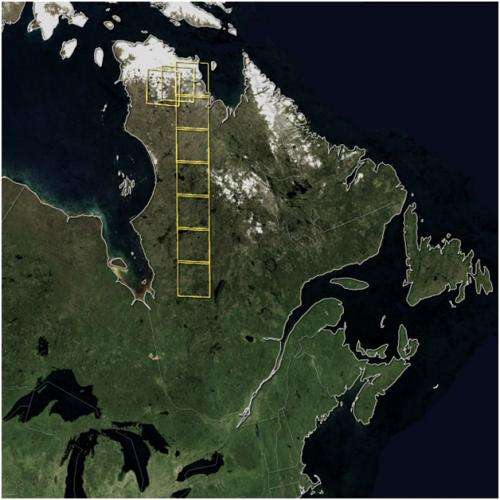
Yellow outlines mark the location of the nine Landsat scenes used in this study. Credit: Jesse Allen

"Unlike the decline of , which is a dramatic effect that we're seeing as a result of global warming, the changes in vegetation have been subtle," Masek says.

Computer models predict the northward expansion of vegetation due to warmer temperatures. "They predict a dramatic change over the next 100 years, and people have been wondering why we weren't seeing these changes already, Masek says.

The difference between the computer predictions and real-life vegetation may have to do with all the other factors that come into play with plants, like the availability of water and sunlight; the type of terrain; competition from other plants for soil, resources and space; and plant predators like caribou.

"The are only part of the equation," says Doug Morton, the Principal Investigator of the study and a researcher at Goddard.

Scientists track vegetation with satellites by measuring the 'greenness' of a study area. Morton says previous studies used yearly compilations, making it difficult to determine if the increase in 'greenness' was due to expansion of vegetation cover or if what scientists were seeing was instead just the effect of a longer growing season.

For this study, the scientists focused only on 'greenness' measurements during the peak summer growing seasons from 1986 to 2010.

By using Landsat's higher, 30-meter (~98 foot) resolution and viewing the same area at the same time for 23 years, Masek and his colleagues were able to track the areas as they continued to show more 'greenness' over the years. "It makes sense," Masek says. "This is how shrub encroaching occurs. They increase in size, they increase in density, and then they move northward."

In contrast to the expansion of shrubs, the scientists found little evidence for 'greenness' trends in forested areas, suggesting that forest response to recent warming may be occurring more slowly. Masek adds that it shows how getting the big picture of warming's effect on forests will rely on continued observations from new U.S. missions that extend and enhance these data records.

Provided by NASA's Goddard Space Flight Center search and more info website

4.7 /5 (3 votes)  

Filter


Move the slider to adjust rank threshold, so that you can hide some of the comments.


Display comments: newest first

omatumr
Dec 08, 2011

Rank: 1 / 5 (2)
Study shows more shrubbery . . .


As CO2 increased (not from warming).

Why? CO2 is a gaseous form of plant food.

Unfortunately for Al Gore, the UN's IPCC, and their army of AGW climatologists, global temperatures did not warm in proportion to the increase of atmospheric CO2 [1-5]

1. The BBC and climate change: A triple betrayal

http://thegwpf.or...-bbc.pdf

2. Deep roots of the global climate scandal (1971-2011)

http://dl.dropbox...oots.pdf

3. The 1975 Endangered Atmosphere Conference, 21st Century Science & Technology (2007)

www.21stcenturysc...Born.pdf

4. Super-fluidity in the solar interior: Implications for solar eruptions and climate, Journal of Fusion Energy 21, 193-198 (2002)

http://arxiv.org/.../0501441

5. The Sun Kings (Princeton University Press, 2007)

www.amazon.com/Su...91126607

OM www.omatumr.com
Rank 4.7 /5 (3 votes)
Relevant PhysicsForums posts

More news stories

Land and sea species differ in climate change response: study

(Phys.org) -- Marine and terrestrial species will likely differ in their responses to climate warming, new research by Simon Fraser University and Australia’s University of Tasmania has found.

Space & Earth / Environment

created 3 hours ago | popularity 3.7 / 5 (3) | comments 3 | with audio podcast

Yale study concludes public apathy over climate change unrelated to science literacy

Are members of the public divided about climate change because they don't understand the science behind it? If Americans knew more basic science and were more proficient in technical reasoning, would public consensus match ...

Space & Earth / Environment

created 5 hours ago | popularity 4.8 / 5 (4) | comments 11 | with audio podcast

10 million years needed to recover from mass extinction

It took some 10 million years for Earth to recover from the greatest mass extinction of all time, latest research has revealed.

Space & Earth / Earth Sciences

created 5 hours ago | popularity 5 / 5 (3) | comments 1 | with audio podcast

Sophisticated simulations predict future warming

The chances of our planet being hit by a global warming of 3 degrees Celsius by 2050 is as likely as it being hit by an increase of 1.4 degrees, new research shows. Presented in the journal Nature Geoscience, the British study ...

Space & Earth / Earth Sciences

created May 22, 2012 | popularity 4.4 / 5 (9) | comments 51

Aliens don't want to eat us, says former SETI director

Alien life probably isn’t interested in having us for dinner, enslaving us or laying eggs in our bellies, according to a recent statement by former SETI director Jill Tarter.

Space & Earth / Space Exploration

created May 25, 2012 | popularity 4.4 / 5 (14) | comments 41


'Unzipped' carbon nanotubes could help energize fuel cells, batteries

Multi-walled carbon nanotubes riddled with defects and impurities on the outside could replace some of the expensive platinum catalysts used in fuel cells and metal-air batteries, according to scientists at ...

Change in developmental timing was crucial in the evolutionary shift from dinosaurs to birds: study

At first glance, it's hard to see how a common house sparrow and a Tyrannosaurus Rex might have anything in common. After all, one is a bird that weighs less than an ounce, and the other is a dinosaur that ...

Computer model used to pinpoint prime materials for efficient carbon capture

When power plants begin capturing their carbon emissions to reduce greenhouse gases – and to most in the electric power industry, it's a question of when, not if – it will be an expensive undertaking.

T cells 'hunt' parasites like animal predators seek prey, study shows

By pairing an intimate knowledge of immune-system function with a deep understanding of statistical physics, a cross-disciplinary team at the University of Pennsylvania has arrived at a surprising finding: T cells use a movement ...

Scientists develop ultra-sensitive test that detects diseases in their earliest stages

Scientists have developed an ultra-sensitive test that should enable them to detect signs of a disease in its earliest stages, in research published today in the journal Nature Materials.

Manufacturing genes to attack flu virus

An international research team has manufactured a new protein that can combat deadly flu epidemics.