Here come the quantum dot TVs and wallpaper
December 13, 2011 by Nancy Owano
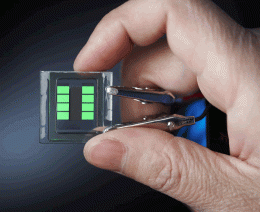
Quantum dot OLED prototype. Image credit: Nanoco Group
(PhysOrg.com) -- A British firm's quantum dot technology will be used for flat screen TVs and flexible screens, according to the companys chief executive.
The quantum dots will be in use for ultra thin, light flat screen TVs by the end of next year, and, in another three years, will be used in flexible screens rolled up like paper or used as wall coverings.
The company, Nanoco Group, is reportedly working with Asian electronics companies to bring this technology to market.
The first products we are expecting to come to market using quantum dots will be the next generation of flat-screen televisions, Nanoco chief executive Michael Edelman has stated.
Nanoco describes itself as the world leader in the development and manufacture of cadmium-free quantum dots. While quantum dots technology is not new, the scientists at Nanoco are succeeding in their goals toward mass production. Earlier this year, the company, which was founded in 2001 and is based in Manchester, announced it successfully produced a1kg batch of red cadmium-free quantum dots specified by a major Japanese corporation.
The ability to mass-produce consistently high quality quantum dots, says the company site, enables product designers to envisage their use in consumer products and other applications for the first time, and then bring the products to market.
Quantum dots are nano-materials with a core semiconductor and organic shell structure. This structure can be modified and built on to ensure the quantum dots work in applications that may use different carrier systems. This includes but is not limited to printing ink including ink jet printing, silicone, polycarbonate, polymethyl methacrylate based polymers, alcohols and water.
Nanocos team says it can manipulate the organic surfaces of the quantum dots to work in applications like electroluminescent displays, solid state lighting and biological imaging.
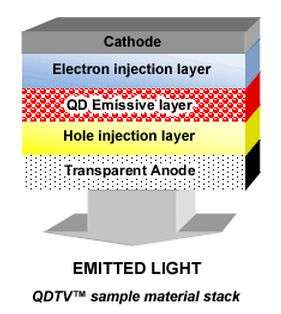
To be sure, flexible displays that can be used as wall coverings have been of interest. Individual light-emitting quantum dot crystals are 100,000 times smaller than the width of a human hair. Large numbers used together potentially create room-sized screens on wallpapers.
The ability to precisely control the size of a quantum dot enables the manufacturer to determine the wavelength of the emission, which determines the color of light that the eye perceives. During production the dots can be tuned to emit any desired color of light. Dots can even be tuned beyond visible light, into infra-red or the ultra-violet.
Nanoco defines itself as a world leader in the development and manufacture of cadmium-free quantum dots at a time when being cadmium-free presents special advantage. Cadmium is generally used in LEDs in lighting and displays. The European Union has made it exempt, though, from its Restriction of Hazardous Substances (RoHS) directive due to the fact that there isnt yet a practical substitute, according to eWEEK Europe. That exemption is to end in July 2014.
Our research and development department is also constantly engaged in the creation of new quantum dots with additional properties sought by the market, such as our RoHS-compliant heavy metal-free quantum dots, says the company.
© 2011 PhysOrg.com
-
From lemons to lemonade: Reaction uses carbon dioxide to make carbon-based semiconductor,
32 comments
-
Thioridazine kills cancer stem cells in human while avoiding toxic side-effects of conventional cancer treatments,
3 comments
-
SpaceX private rocket blasts off for space station (Update),
42 comments
-
Climate scientists say they have solved riddle of rising sea,
31 comments
-
SpaceX capsule has 'new car' smell, astronauts say (Update),
4 comments
-
Need a rigid insulation material???
20 hours ago
-
magnets or EMF in car bumpers to protect from fender bender
May 26, 2012
-
length of wire in a coil of known dimensions?
May 25, 2012
-
India Engineering Powerhouse
May 25, 2012
-
electromagnet core dereference between hard and soft iron
May 25, 2012
-
Measuring water pressure in an open tank
May 24, 2012
- More from Physics Forums - General Engineering
More news stories
Browser wars flare in mobile space
The browser wars are heating up again, but this time the fight is for dominance of the mobile Internet.
13 hours ago |
5 / 5 (2) |
3
Probability of contamination from severe nuclear reactor accidents is higher than expected: study
Catastrophic nuclear accidents such as the core meltdowns in Chernobyl and Fukushima are more likely to happen than previously assumed. Based on the operating hours of all civil nuclear reactors and the number ...
Technology / Energy & Green Tech
May 22, 2012 |
3.7 / 5 (23) |
56
|
HyperSolar shows dirty water no barrier to power world
(Phys.org) -- The Santa Barbara, California, company, HyperSolar, is set to transparently share the ups and downs of its research experiences toward the companys ultimate vision, successfully producing ...
SpotterRF debuts Radar Backpack Kit (w/ Video)
(Phys.org) -- SpotterRF has announced a special radar backpack kit designed to enhance situational awareness for soldiers on the ground. The company says its special radar is designed for warfighters as part ...
Tesla to launch electric sedan in US on June 22
Tesla Motors said Tuesday it would begin deliveries of "the world's first premium electric sedan" on June 22, slightly ahead of schedule.
Technology / Energy & Green Tech
May 22, 2012 |
4.5 / 5 (12) |
18
'Unzipped' carbon nanotubes could help energize fuel cells, batteries
Multi-walled carbon nanotubes riddled with defects and impurities on the outside could replace some of the expensive platinum catalysts used in fuel cells and metal-air batteries, according to scientists at ...
Change in developmental timing was crucial in the evolutionary shift from dinosaurs to birds: study
At first glance, it's hard to see how a common house sparrow and a Tyrannosaurus Rex might have anything in common. After all, one is a bird that weighs less than an ounce, and the other is a dinosaur that ...
Computer model used to pinpoint prime materials for efficient carbon capture
When power plants begin capturing their carbon emissions to reduce greenhouse gases and to most in the electric power industry, it's a question of when, not if it will be an expensive undertaking.
T cells 'hunt' parasites like animal predators seek prey, study shows
By pairing an intimate knowledge of immune-system function with a deep understanding of statistical physics, a cross-disciplinary team at the University of Pennsylvania has arrived at a surprising finding: T cells use a movement ...
Land and sea species differ in climate change response: study
(Phys.org) -- Marine and terrestrial species will likely differ in their responses to climate warming, new research by Simon Fraser University and Australia’s University of Tasmania has found.
Yale study concludes public apathy over climate change unrelated to science literacy
Are members of the public divided about climate change because they don't understand the science behind it? If Americans knew more basic science and were more proficient in technical reasoning, would public consensus match ...
Dec 13, 2011
Rank: 5 / 5 (3)
Dec 13, 2011
Rank: 5 / 5 (3)
Dec 13, 2011
Rank: not rated yet
Dec 13, 2011
Rank: 5 / 5 (2)
Agree, but I am talking about first generation which should be quite convincing, not about ultimate VR :)
Dec 13, 2011
Rank: 5 / 5 (3)
I can do without TV - but a OLED wallpaper that you can change according to mood (or play a live scenery on) would be awesome.
Dec 13, 2011
Rank: 4 / 5 (4)
Or you could cheat with the visuals like they do in games, so you get things like a beach that looks like a beach but you don't make footprints in the sand, because that change into the model would have to be somehow communicated to all the processors. There comes the problems, because you don't have enough memory with each CPU to cache all necessary data unless the model is very simple, and getting it in and out from a central memory is a major logistics problem.
Dec 13, 2011
Rank: not rated yet
Dec 13, 2011
Rank: 5 / 5 (1)
With both eyes open, then you have to inflate the sphere to 60 feet in diameter and not show anything closer than that, because your stereoscopic vision would ruin the illusion - but the amount of data is still the same 114 megapixels.
That only requires about 40-50 ordinary computers to process if all the data is known to all computers in advance and they're just playing it back in synchrony, like a video or something. Simple interactive simulation is fine as well, as long as you don't introduce much new detail.
In fact, that's exactly what they're already doing with flight training simulators.
Dec 13, 2011
Rank: 1 / 5 (1)
Sure, if you can cope with the enormous time delays.
Which is kinda the whole problem, just 1000x worse when you're sending data over the internet.
Dec 13, 2011
Rank: 4 / 5 (2)
Just the graphics card. And graphics cards can be run in parallel. All current graphics cards can run (at least) two displays at the same time. As long as you don't interact much with what is on the screen it's no more difficult than running a movie. Desktop PCs can run multiple movies at the same time already. Using 4 beamers you can flood the walls of a room with anything you like (done that) without any obvious pixellation. Takes all of 2 low end PCs to do. Cave systems have been around for more than a decade. The power needed back then (high end SGI workstation) you can get today in a high end PC.
I don't think you'd want this stuff on the floor, though. That takes expensive covering and soft slippers at all times (and no furniture!).
Dec 13, 2011
Rank: 5 / 5 (6)
But it was totally worth it just for the geek factor.
Dec 13, 2011
Rank: 3.5 / 5 (2)
Yes they can, but they don't necessarily have the power to run at the same level of detail. It's trivial to push out pixels, but non-trivial when you have to actually calculate what they should contain.
Modern graphics cards don't really parallel all that well in processing power either, due to the need to share data through the system bus. If they can work on independent sets of data, then that's fine, but for games you see less than 1.5x increase in actual processing power from doubling the number of GPUs. Four GPUs per machine is just about twice as powerful as one.
Dec 13, 2011
Rank: 5 / 5 (1)
Dec 13, 2011
Rank: 2 / 5 (2)
But because of the structure of our computers, we need a great deal of speed and power because there's relatively few massive CPUs processing big chunks of data at a time, and you hve to do so without making the CPUs wait for too long, so we have to implement all sorts of ways to skirt around the problem of having to move a ton of data just to grab one bit.
Essentially, you have a factory with the tools and the products in different buildings, and there's just one guy shuttling between the two. He may carry stuff with a wheelbarrow, or with a dumptruck, but he will always take the same time going back and forth, so if you ask him to bring you a single bolt, he's going to drive his truck over, load it with a single bolt, and then drive it to you.
Dec 13, 2011
Rank: 5 / 5 (3)
All you need is an eye tracker to know where your eye is looking. You can't read whats behind you or even whats within your periphrial vision. There is a surprisingly small sphere in which resolution matters at all. Try writing something on a piece of paper and reading it without moving your eyes to look directly at it.
Dec 13, 2011
Rank: 1 / 5 (1)
I saw someone do that by strapping a mini projector on a plastic gun and playing Call of Duty in a darkened room.
Though all in all, the dynamic resolution rendering would probably take as much power to calculate where you need the resolution and how much, and applying blur to the image since you don't want things to turn blocky - you'd notice that.
Dec 13, 2011
Rank: not rated yet
I'm not trying to be mean, but that's a pointless question.
It didn't say how small the pixels are, but we can assume that the limit in pixel size is directly related to our limit to create electronic circuits: ~22NM or some multiple thereof.
The size of the quantum dots has nothing to do with the resolution.
That said, it would also be pointless to make a resolution so fine for a consumer product.
So, realistically, the resolution is whatever we want it to be, as long as it is cost effective - That is determined by the process for making the quantum dots, how small the electronics are, and how much computing power we want to throw at it.
If you're going to make a large screen that you can throw up on the wall in 5 or 10 years, you could probably expect a maximum around 4k-8k (As opposed to 1080p ~ 1k).
Higher resolutions would hit diminishing returns as it would only be peripheral vision.
Dec 13, 2011
Rank: 5 / 5 (1)
Not my experience.
It all depends on what you want to do: Watch a movie? Display some looping images/effects? Or play full HD Crysis 2 on 6 walls?
Not so - because today you push most stuff to the graphics card which has many parallel pixel pipes. The speedup is enormous ... as we just found out in our current project for an algorithmically intense graphics filter on 800MB image dataset:
CPU, single thread: 3.5 hours
CPU, Quadcore OpenCL: 600 seconds
GPU 16 pixel pipes: 25 seconds
As long as you're just reading there is no bus bottleneck.
Dec 13, 2011
Rank: not rated yet
Classical computers are going to get down to around 11nm in 4 years or so anyway, so they should be 4 times as powerful.
Also, most video cards tend to be about a generation or two behind in the transistor miniaturization process. So there is a bit more poetential for the video cards going out 10 years than there is for the CPU.
We may see early spintronic or photonic computers by then as well.
The real issue for gaming is the development time.
Making a game to modern standards, i.e. Starcraft 2, already takes a decade.
Starcraft 2 has really failed it's goal, because the vast majority of gamers who bought the game aren't smart enough to play it, but that's another matter.
Since they've damn near got weather forecasting perfected, it seems mostly what we'll be doing with these computers is entertainment and maybe design of new products. Maybe model materials research...
Dec 13, 2011
Rank: not rated yet
yes, many weather models are run on graphics cards now.
NHC's position and timing for forecast track is almost perfect now. In fact, it's more limited by resolution of input data than the computer processing power.
Dec 13, 2011
Rank: not rated yet
Why would this matter? Because you are trying to get stand alone systems to work in parallel.
A modern card has hundreds or thousands of cores that parallel very efficiently. If it is 100% expected to run things in parallel, then it will be designed well. Pixel display and shading are all things that parallel very efficiently. The hard part is designing something to work as a stand alone AND in parallel.
Ridiculous. A modern discrete card can generally display up to 4k video. There is a huge difference between displaying a video, and building up each element piece by piece. In 5 or 10 years, a card capable of 8 or 16k will be nothing.
Dec 13, 2011
Rank: 5 / 5 (1)
"Are you a grain of sand? So am I, and all our neighbors, we are a beach. The user just pressed on me, and you and you. We now show a footprint."
Somewhere else on another section of screen, there is another user input that forms a footprint; those pixels process that, and the first bunch know nothing about it. There is no central processor, there are 115 million processors each doing their thing in concert.
Dec 13, 2011
Rank: 5 / 5 (2)
Um .... no. We're not even close to getting locally accurate climate simulations, much less weather.
Dec 13, 2011
Rank: 5 / 5 (1)
Dec 14, 2011
Rank: not rated yet
You're talking about mimmicking a neural net or a "sensory" style of input with sort of a "cascading" effect.
That may be possible in the next several years, but most forms of entertainment, even interactive entertainment are highly linear, even multi-player games.
If you've ever written a dialogue tree for an RPG or other custom game, you know how comlicated it can be.
Manually writing scripts for that sort of interaction would take decades, so "somebody" would need to write software that can generate life-like outputs on the fly.
You're talking about not just plot decisions in entertainment, or dialogue trees, but interaction with the very physics of the virtual universe.
You basically need a processor (maybe more than one,) for every pixel.