Prime Indonesian jungle to be cleared for palm oil
(AP) -- The man known as Indonesia's "green governor" chases the roar of illegal chainsaws through plush jungles in his own Jeep. He goes door-to-door to tell families it's in their interest to keep trees standing.
That's why 5,000 villagers living the edge of a rich, biodiverse peat swamp in his tsunami-ravaged Aceh province feel so betrayed.
Their former hero recently gave a palm oil company a permit to develop land in one of the few places on earth where orangutans, tigers and bears still can be found living side-by-side - violating Indonesia's new moratorium on concessions in primary forests and peatlands.
"Why would he agree to this?" said Ibduh, a 50-year village chief, days after filing a criminal complaint against Aceh Gov. Irwandi Yusuf.
"It's not just about the animals," he said, men around him nodding. "Us too. Our lives are ruined if this goes through."
Irwandi - a former rebel whose life story is worthy of a Hollywood film - maintains the palm oil concession is by the book and that he would never do anything to harm his province.
But critics say there is little doubt he broke the law.
The charges against him illustrate the challenges facing countries like Indonesia in their efforts to fight climate change by protecting the world's tropical jungles - which would spit more carbon when burned than planes, automobiles and factories combined.
Despite government promises, what happens on the ground is often a different story. Murky laws, graft and mismanagement in the forestry sector and shady dealings with local officials means that business often continues as usual for many companies.
"This is really a test case," said Chik Rini, a World Wildlife Fund campaigner, noting that while it's not uncommon for timber, pulp, paper and palm oil companies to raze trees in protected areas, few developments occur in areas that seem so obviously off limits.
"If they get away with it here, well, then no forests are safe."
Ibduh, the village chief, sits on the floor of a house rolling a cigarette as he and other men try to understand why - after years of stalling - Irwandi agreed on Aug. 25 to give PT Kallista Alam a permit to convert 4,000 acres of peat swamp forest in the heart of the renowned Leuser Ecosytem.
In addition to being home to almost every large animal found in Disney's adaptation of "The Jungle Book," it's teeming with thousands of plant and insect species, many yet to be identified.
Irwandi says there's nothing amiss with the concession. "I know what I have to do for the people of Aceh," the 51-year-old says, alleging that political opponents in coming provincial elections are trying to turn the tide against him.
But Ahmad Fauzi Mas'ud, spokesman for the Forestry Ministry, agrees with critics that things don't sound right.
"We haven't received the documents for this license yet," he said by telephone as he boarded a plane in the capital Jakarta.
"But if it's inside peatland, it can't be converted."
A copy of the map of the new concession, obtained by The Associated Press, has it sitting squarely on a parcel of peatland forest identified as off limits under President Susilo Bambang Yudhoyono's moratorium enacted in May.
For environmentalists, it's an all too familiar story.
Fifty years ago in Indonesia, more than three-quarters of the archipelagic nation of 240 million people was blanketed in tropical rain forest. But half those trees have since disappeared.
Aceh offered a uniquely clean slate when its separatist insurgency came to an end after the devastating 2004 tsunami. The decades-long conflict had kept illegal logging at bay.
Irwandi, well-educated with a laid-back style and quick wit, made protecting Aceh's forests one of his first goals when he surprised the pundits and won the governorship in 2006.
He was a former rebel, but not the fighting kind. For years, he'd led the propaganda campaign for the insurgents who saw the government in Jakarta as self-serving and corrupt.
He was serving a nine-year sentence for treason when the tsunami hit, crashing down the walls of the prison.
"I didn't escape from prison," the rebel-turned-politician likes to say. "It escaped from me."
Irwandi fled to Jakarta, then Malaysia and finally Finland where he ended up joining exiled leaders of the Free Aceh Movement in negotiating an end to fighting after the tsunami - with both sides eager to end the suffering.
After his return and election win, Irwandi immediately banned logging in Aceh. To this day, he can often be seen pulling over on the side of the road when spotting a pile of recently felled trees. He also makes spot checks at old logging camps and saw mills.
Which is why his turnabout on the Tripa swamp forest - home to the world's densest population of critically endangered Sumatran orangutans - has left Ibduh and other villagers so confused and angry.
Already excavators have started knocking down trees and churning up soil.
Drainage canals also have been built and villagers' drinking wells are already noticeably drier as result, they say. Security forces are deployed by the palm oil company along the perimeter of the forest, guns raised when anyone tries to enter.
Ibduh and other older men recall happier times when they could still earn money collecting rattan, honey and herbs for traditional medicine. Not long ago, they say proudly, pristine swamps and the Tripa river were teeming with catfish so large that many of them were able to earn enough at the local market to go to Mecca for the hajj pilgrimage.
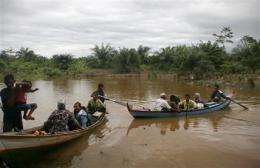
Even now, gliding in a small wooden boat down the broad river that slices through the spectacular Tripa forests, saltwater crocodiles can be seen slipping silently from view. A rhinoceros hornbill lifts off with a gentle helicoptorish whoosh.
And as skies darken, troops of monkeys clamor in the branches above to settle in for the night.
"But for how long?" asks Safari, 32, one of the men. "When that forest is cleared, these animals will all be gone, every last one of them."
©2011 The Associated Press. All rights reserved. This material may not be published, broadcast, rewritten or redistributed.


