Post-doctoral researcher makes strides in fuel cell technology
December 1, 2011 By Gabriella Chiera

UD post-doctoral researcher makes strides in fuel cell technology

Enlarge

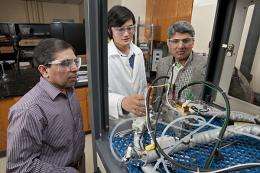
Pictured are (from left) Suresh Advani, Liang Wang and Ajay Prasad. Credit: Evan Krape

Liang Wang, a post-doctoral researcher in the University of Delaware's Center for Fuel Cell Research in the Department of Mechanical Engineering, is developing new materials and structures that can improve the quality of fuel cell technology by increasing the durability of the fuel cell membrane.

Like batteries, fuel cells are electrochemical energy conversion devices that produce electricity. By converting and oxygen into water, they can be a valuable for vehicles, buildings and devices like laptops and cell phones.

Wang’s research is aimed at developing and structures for proton exchange membrane (PEM) fuel cells, which are considered the best type of fuel cell for vehicles, and are predicted to eventually replace gasoline and diesel internal combustion engines.

PEM fuel cells use a solid polymer membrane, or thin plastic film, that is permeable to protons when saturated with water. However, water present in the fuel cell could repeatedly freeze and melt while operating in cold climates, forcing the cell to expand and contract, and causing stress and deterioration of the membrane. 

Wang’s research focuses on improving fuel durability through the development of robust materials that can withstand stress due to temperature change, which is a major challenge for the commercial deployment of automotive fuel cells.

He works with graduate and undergraduate students in the Fuel Cell Research Laboratory to create novel materials and structures for PEM fuel cells targeted at improving durability, reducing cost and increasing fuel cell performance.

They have successfully developed membranes with improved durability based on polymer and carbon nanotube composite materials that exhibit high stress tolerance during freeze-thaw cycling.

Wang is advised by Suresh G. Advani, George W. Laird Professor of Mechanical Engineering and associate director of the Center for Composite Materials, and Ajay K. Prasad, professor of and director of the Center for Fuel Cell Research.

His work, which is part of the Fuel Cell Bus Program and which is supported by the Federal Transit Administration, was recently recognized at the 2011 International Seminar and Exposition. Wang’s poster entitled “Freeze-Thaw Durability Study of MWCNTs Nafion Reinforced Membranes,” earned first place out of over 120 poster submissions. 

“Dr. Wang is full of clever ideas and pursues them with vigor,” said Prasad. “He has been with the University of Delaware for just about one year, yet has already initiated several innovative projects that seek to improve .”

Provided by University of Delaware search and more info website

2.8 /5 (4 votes)  

Filter


Move the slider to adjust rank threshold, so that you can hide some of the comments.


Display comments: newest first

tscati
Dec 01, 2011

Rank: 1 / 5 (1)
Does this press release have a point?
rawa1
Dec 01, 2011

Rank: 1 / 5 (1)
By converting hydrogen and oxygen into water, they can be a valuable power source for vehicles, buildings and devices like laptops and cell phones.
Why we should spend a penny into development of such technology, when the cold fusion changes the rules of game already? We don't need the hydrogen fuel economy at all if we can fuse hydrogen with nickel metal in 100.000x more effective way. It's literally the burning of dollar bills.
Deesky
Dec 01, 2011

Rank: 5 / 5 (1)
Why we should spend a penny into development of such technology, when the cold fusion changes the rules of game already?

Why indeed? The only explanation must be that the entire world is stupid and cannot see what you (choose) to see.
g4danny
Jan 03, 2012

Rank: not rated yet
You smart fellers, Deesky, rawa1, wouldn't happen to know that even fusion energy needs to be stored and transported? Gaseous and liquid hydrogen and hydrocarbons will long be in the game as the energy storage media and, hence, fuels. Cars offer the freedom they do because of the portability of fuels in their tanks and reasonable size of their engines. Fuel cells will replace combustion engines, no matter where the fuel for them will be coming from.
rawa1
Jan 03, 2012

Rank: 1 / 5 (1)
wouldn't happen to know that even fusion energy needs to be stored and transported?
Cold fusion doesn't require to be stored and transported. It could be produced in unlimited quantities at any time, because it can be controlled easily with external pressure of hydrogen. So that the only energy storage part of future electromobiles will be capacitor, providing the energy for next few minutes. In particular, whole the hydrogen technology will become obsolete. because the hydrogen has no advantage with respect to its low energy density. I can even imagine, the cold fusion will be used for production of artificial hydrocarbons (gasoline produced from water and carbon dioxide from air), which could be used in legacy automobiles from compatibility reasons.
Rank 2.8 /5 (4 votes)
Relevant PhysicsForums posts

More news stories

Browser wars flare in mobile space

The browser wars are heating up again, but this time the fight is for dominance of the mobile Internet.

Technology / Software

created 13 hours ago | popularity 5 / 5 (2) | comments 3

Probability of contamination from severe nuclear reactor accidents is higher than expected: study

Catastrophic nuclear accidents such as the core meltdowns in Chernobyl and Fukushima are more likely to happen than previously assumed. Based on the operating hours of all civil nuclear reactors and the number ...

Technology / Energy & Green Tech

created May 22, 2012 | popularity 3.7 / 5 (23) | comments 56 | with audio podcast

HyperSolar shows dirty water no barrier to power world

(Phys.org) -- The Santa Barbara, California, company, HyperSolar, is set to transparently share the ups and downs of its research experiences toward the company’s ultimate vision, successfully producing ...

Technology / Energy & Green Tech

created May 24, 2012 | popularity 4.8 / 5 (16) | comments 17 | with audio podcast report

SpotterRF debuts Radar Backpack Kit (w/ Video)

(Phys.org) -- SpotterRF has announced a special radar backpack kit designed to enhance situational awareness for soldiers on the ground. The company says its special radar is designed for warfighters as part ...

Technology / Hi Tech & Innovation

created May 26, 2012 | popularity 5 / 5 (5) | comments 13 | with audio podcast report

Tesla to launch electric sedan in US on June 22

Tesla Motors said Tuesday it would begin deliveries of "the world's first premium electric sedan" on June 22, slightly ahead of schedule.

Technology / Energy & Green Tech

created May 22, 2012 | popularity 4.5 / 5 (12) | comments 18


'Unzipped' carbon nanotubes could help energize fuel cells, batteries

Multi-walled carbon nanotubes riddled with defects and impurities on the outside could replace some of the expensive platinum catalysts used in fuel cells and metal-air batteries, according to scientists at ...

Change in developmental timing was crucial in the evolutionary shift from dinosaurs to birds: study

At first glance, it's hard to see how a common house sparrow and a Tyrannosaurus Rex might have anything in common. After all, one is a bird that weighs less than an ounce, and the other is a dinosaur that ...

Computer model used to pinpoint prime materials for efficient carbon capture

When power plants begin capturing their carbon emissions to reduce greenhouse gases – and to most in the electric power industry, it's a question of when, not if – it will be an expensive undertaking.

T cells 'hunt' parasites like animal predators seek prey, study shows

By pairing an intimate knowledge of immune-system function with a deep understanding of statistical physics, a cross-disciplinary team at the University of Pennsylvania has arrived at a surprising finding: T cells use a movement ...

Land and sea species differ in climate change response: study

(Phys.org) -- Marine and terrestrial species will likely differ in their responses to climate warming, new research by Simon Fraser University and Australia’s University of Tasmania has found.

Yale study concludes public apathy over climate change unrelated to science literacy

Are members of the public divided about climate change because they don't understand the science behind it? If Americans knew more basic science and were more proficient in technical reasoning, would public consensus match ...