New study illustrates the physics behind great white shark attacks on seals
December 9, 2011

New study illustrates the physics behind great white shark attacks on seals

Enlarge

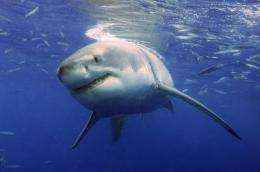
A new study examining the complex and dynamic interactions between white sharks and Cape fur seals in False Bay, South Africa in Marine Biology Review offers new insights on the physical conditions and biological factors underlying predator-prey interactions in the marine environment. Credit: Neil Hammerschlag/http://www.neilhammer.com

A new study examining the complex and dynamic interactions between white sharks and Cape fur seals in False Bay, South Africa, offers new insights on the physical conditions and biological factors underlying predator-prey interactions in the marine environment.

University of Miami (UM) Rosenstiel School of Marine and Atmospheric Science assistant professor Dr. Neil Hammerschlag, and a colleague from the University of British Columbia, describe how sharks are camouflaged as they stalk their prey from below. Low-light conditions, from the optical scattering of light through water, along with a shark's dark grey back and the dimly light rocky reef habitat allow sharks to remain undetected by seals swimming at the water's surface.

"Animal hunting in the ocean is rarely observed by humans," said Hammerschalg, director of the RJ Dunlap Marine Conservation Program at UM. "The high frequency of attacks by white sharks on seals at our study site in South Africa provides a very unique opportunity to uncover new insights about predator-prey relationships."

Sharks typically search, stalk and strike their prey from below. The vast majority of predatory strikes by sharks and Cape fur seals occur against small groups of young-of-the-year seals. Predatory activity by sharks is most intense within two hours of sunrise and quickly decreases as light penetration in the increases.

"Stealth and ambush are key elements in the white shark's predatory strategy," said Hammerschlag.

Cape fur seals also have unique techniques to detect, avoid, outmaneuver and in some cases injure the in order to avoid predation by .

According to the authors, if a seal is not disabled during the shark's initial shark, the small seal can use its highly maneuverable body to leap away from the shark's jaws to evade a second strike.

More information: The study, titled "Marine predator-prey contests: Ambush and speed versus vigilance and agility," was published in the Nov. 30 online edition of the journal Marine Biology Research.

Provided by University of Miami search and more info website


Rank 5 /5 (1 vote)
Relevant PhysicsForums posts

More news stories

Manufacturing genes to attack flu virus

An international research team has manufactured a new protein that can combat deadly flu epidemics.

Biology / Biotechnology

created 5 hours ago | popularity not rated yet | comments 0 | with audio podcast

Scientist: Evolution debate will soon be history

(AP) -- Richard Leakey predicts skepticism over evolution will soon be history. Not that the avowed atheist has any doubts himself.

Biology / Evolution

created May 26, 2012 | popularity 3.5 / 5 (20) | comments 88

More plant species responding to global warming than previously thought

(Phys.org) -- Far more wild plant species may be responding to global warming than previous large-scale estimates have suggested.

Biology / Ecology

created May 22, 2012 | popularity 4.6 / 5 (14) | comments 18 | with audio podcast

For monogamous sparrows, it doesn't pay to stray (but they do it anyway)

It's quite common for a female song sparrow to stray from her breeding partner and mate with the male next door, but a new study shows that sleeping around can be costly.

Biology / Plants & Animals

created May 22, 2012 | popularity 5 / 5 (2) | comments 8 | with audio podcast

Thousands of shellfish found dead in Peru

Thousands of crustaceans were found dead off the coast of Lima following the mystery mass death of dolphins and pelicans, the Peruvian Navy said Friday.

Biology / Ecology

created May 26, 2012 | popularity 4.7 / 5 (7) | comments 7


'Unzipped' carbon nanotubes could help energize fuel cells, batteries

Multi-walled carbon nanotubes riddled with defects and impurities on the outside could replace some of the expensive platinum catalysts used in fuel cells and metal-air batteries, according to scientists at ...

Change in developmental timing was crucial in the evolutionary shift from dinosaurs to birds: study

At first glance, it's hard to see how a common house sparrow and a Tyrannosaurus Rex might have anything in common. After all, one is a bird that weighs less than an ounce, and the other is a dinosaur that ...

Computer model used to pinpoint prime materials for efficient carbon capture

When power plants begin capturing their carbon emissions to reduce greenhouse gases – and to most in the electric power industry, it's a question of when, not if – it will be an expensive undertaking.

T cells 'hunt' parasites like animal predators seek prey, study shows

By pairing an intimate knowledge of immune-system function with a deep understanding of statistical physics, a cross-disciplinary team at the University of Pennsylvania has arrived at a surprising finding: T cells use a movement ...

Land and sea species differ in climate change response: study

(Phys.org) -- Marine and terrestrial species will likely differ in their responses to climate warming, new research by Simon Fraser University and Australia’s University of Tasmania has found.

Yale study concludes public apathy over climate change unrelated to science literacy

Are members of the public divided about climate change because they don't understand the science behind it? If Americans knew more basic science and were more proficient in technical reasoning, would public consensus match ...