PhD research advances understanding on how to mitigate methane emissions
(PhysOrg.com) -- A comparison of methane emissions from three ruminant species eating different forages, with and without feed additives, found chicory will reduce methane emissions in sheep - but also highlighted the challenges in identifying mitigation strategies and shown the need for further research.
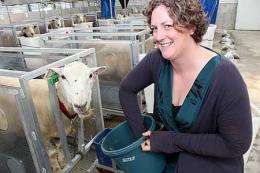
Massey University PhD graduate Natasha Swainson, who grew up on a sheep and beef hill-country farm near Marton, explored animal, dietary and microbial factors that may influence methane emissions from ruminants.
Her thesis was a joint project with AgResearch and Massey University, with the main funder being the Pastoral Greenhouse gas Research Consortium (PGgRc). She measured emissions from sheep, cattle and deer using a tracer technique to explore the animal factors influencing methane emissions.
Dr. Swainson says her research found that methane emissions differ between ruminant species when fed an ensiled lucerne chaff diet at the same relative feeding level. But, she says, further research is still required, as it needs to be confirmed with pasture – the typical diet fed in New Zealand.
The second part of the research was comparing emissions from sheep fed different forages - pasture and chicory, and attempting to alter the rumen microbial population using monensin or/and coconut oil.
“Over a two month period we measured methane emissions using a tracer technique from sheep fed two different forages supplemented with monensin and/or coconut oil.”
Using the tracer technique, it was found that sheep fed chicory emitted less methane per unit of dry matter eaten compared to sheep fed pasture. Since then, her results have been followed up with research using respiration chambers, which are sealed boxes that give greater measurement accuracy. In the chambers, the two forages did not differ in methane emissions.
“Since my PhD experiments, there have been great advances to increase accuracy and capacity to measure methane from ruminants in New Zealand, so research being conducted today has benefited from the learning.
“Researchers overseas have reported that the supplementation of monensin or coconut oil may provide reductions in methane by altering the microbial populations in the rumen, but this wasn’t clearly observed in our experiments.”
The international research was conducted with animals eating large amounts of grains and supplements, and not necessarily fresh forages like in New Zealand.
“Trying to understand why fresh pasture behaves in differently from other diets used for ruminants elsewhere is critical to understand methane emissions in New Zealand.”
Dr. Swainson says the differing results show just how little is known about the digestive system in animals, and how the diet interacts with the microbes in the rumen.
“The rumen is a black box. We know what goes in and what comes out and a little bit about the microbes that are present – but we don’t know enough about how they function and interact. It’s like trying to put the pieces of a very large jigsaw together without a picture to go by.
“We need to understand what the pathways and factors are that lead to methane emissions and how we can manipulate them. The complexity of the rumen may mean that there will not be a “silver bullet” approach to reduce methane from ruminants. Most likely, a few different strategies will need to be utilised in combination to reduce methane emissions from farmed ruminants. The research we are doing is building a strong foundation of knowledge about the function of the rumen. This is leading to a better understanding of the rumen and how the animal, diet and microbial population interact and therefore how to better feed our ruminants to reduce methane emissions, while maintaining or increasing productivity.
Ms. Swainson is now doing post-doctoral study in the Animal Nutrition team at AgResearch Grasslands, focussing on how hydrogen is generated within the digestive system. It’s an extension of her doctoral study, but takes a step back towards the building blocks of what might contribute to methane production. She says AgResearch is a wonderful place to continue her research, as host of the NZ Ruminant Methane Measurement Centre and a world leader in methane emission research.
She says while the field of methane research is very topical, and evolving at increasingly rapid rate here in New Zealand and internationally, it is also making a significant contribution to understanding of ruminant nutrition and how the rumen works.
“Increasing our understanding of the basis of nutrition will lead to improvements in what we feed animals and how we can improve production. This can then be passed on to benefit the New Zealand farmer.”
Provided by Massey University


