Personality clash: scientists discover 'bold' sea anemones excel at fighting
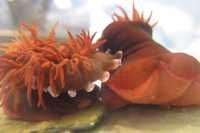
(PhysOrg.com) -- Scientists studying the behavioural traits of the common sea anemone have discovered that fortune favours the brave when it comes to fighting and setting territorial disputes.
Proving the old adage about the size of the fight in the dog, marine biologists at Plymouth University have found that the personality of a sea anemone will play just as crucial a role as physical size and weapon strength when fighting. Furthermore, a sea anemone may undergo a behavioural change and exhibit signs of shyness in the wake of a defeat.
The findings, set to be published in Proceedings of the Royal Society B today, could help to broaden the understanding of the factors that influence territory disputes and dominance in biology.
Dr Mark Briffa, from the School of Marine Science and Engineering at Plymouth University, said: People might not think of sea anemones as fighting creatures, but they regularly battle for the best locations on rocks.
This video is not supported by your browser at this time.
Actinia equina (beadlet anemone) aggressive behaviour
What we have seen is that those anemones that are bold and quickly recover from being startled, tended to land more blows upon their opponent and therefore won more fights.Studying the anemones in laboratories, and at sites along the Devon and Cornwall coast, researchers used a small jet of sea water to trigger the startle response in the organisms, causing them to retract their tentacles. They then measured the time it took for the anemone to return to its normal state.
Dr Briffa said: The anemones would typically hide for around nine minutes but some were noticeably bolder than others. These specimens were the ones that won the most fights.
And what was perhaps even more remarkable, was that when we measured the response rate of the losers, post-fight, we found that they remained in a withdrawn state for an increased amount of time, consistent with a behavioural change.
Anemones are widespread in coastal regions of the country, and settle in rock pools and underwater structures where water will flow over them, bringing them food such as small fish, shrimp and marine detritus.
The tentacles of the anemone are armed with tiny stinging barbs that fire disabling toxins into their prey but they also possess specialist tentacles that are used purely for fighting.
Such battles can last from anywhere between three minutes to two-and-a-half hours, and will result in the loser retreating slowly to a new, and possibly less advantageous spot.
Dr Briffa said: It is fascinating that when we look at such a simple animal as the sea anemone, we see similar personality traits and the same sorts of decision-making during a fight as is seen in much more complex species.
Journal reference:
Proceedings of the Royal Society B
Provided by University of Plymouth
-
From lemons to lemonade: Reaction uses carbon dioxide to make carbon-based semiconductor,
32 comments
-
Thioridazine kills cancer stem cells in human while avoiding toxic side-effects of conventional cancer treatments,
3 comments
-
SpaceX private rocket blasts off for space station (Update),
42 comments
-
Climate scientists say they have solved riddle of rising sea,
31 comments
-
SpaceX capsule has 'new car' smell, astronauts say (Update),
4 comments
-
What would stain as translucent on light-coloured fabric?
May 26, 2012
-
How do I identify different bacteria on culture plates?
May 26, 2012
-
Why Do Dogs do Strange things...
May 25, 2012
-
What does exophillic and endophillic mean in terms of mosquito and their control?
May 24, 2012
-
Semen stains glows under black lights (uv light)?
May 23, 2012
-
Question on Human Chromosome 2
May 23, 2012
- More from Physics Forums - Biology
More news stories
Manufacturing genes to attack flu virus
An international research team has manufactured a new protein that can combat deadly flu epidemics.
5 hours ago |
not rated yet |
0
|
Scientist: Evolution debate will soon be history
(AP) -- Richard Leakey predicts skepticism over evolution will soon be history. Not that the avowed atheist has any doubts himself.
May 26, 2012 |
3.5 / 5 (20) |
88
More plant species responding to global warming than previously thought
(Phys.org) -- Far more wild plant species may be responding to global warming than previous large-scale estimates have suggested.
May 22, 2012 |
4.6 / 5 (14) |
18
|
For monogamous sparrows, it doesn't pay to stray (but they do it anyway)
It's quite common for a female song sparrow to stray from her breeding partner and mate with the male next door, but a new study shows that sleeping around can be costly.
May 22, 2012 |
5 / 5 (2) |
8
|
Thousands of shellfish found dead in Peru
Thousands of crustaceans were found dead off the coast of Lima following the mystery mass death of dolphins and pelicans, the Peruvian Navy said Friday.
May 26, 2012 |
4.7 / 5 (7) |
7
'Unzipped' carbon nanotubes could help energize fuel cells, batteries
Multi-walled carbon nanotubes riddled with defects and impurities on the outside could replace some of the expensive platinum catalysts used in fuel cells and metal-air batteries, according to scientists at ...
Change in developmental timing was crucial in the evolutionary shift from dinosaurs to birds: study
At first glance, it's hard to see how a common house sparrow and a Tyrannosaurus Rex might have anything in common. After all, one is a bird that weighs less than an ounce, and the other is a dinosaur that ...
Computer model used to pinpoint prime materials for efficient carbon capture
When power plants begin capturing their carbon emissions to reduce greenhouse gases and to most in the electric power industry, it's a question of when, not if it will be an expensive undertaking.
T cells 'hunt' parasites like animal predators seek prey, study shows
By pairing an intimate knowledge of immune-system function with a deep understanding of statistical physics, a cross-disciplinary team at the University of Pennsylvania has arrived at a surprising finding: T cells use a movement ...
Land and sea species differ in climate change response: study
(Phys.org) -- Marine and terrestrial species will likely differ in their responses to climate warming, new research by Simon Fraser University and Australia’s University of Tasmania has found.
Yale study concludes public apathy over climate change unrelated to science literacy
Are members of the public divided about climate change because they don't understand the science behind it? If Americans knew more basic science and were more proficient in technical reasoning, would public consensus match ...
Dec 15, 2011
Rank: 1 / 5 (1)
Dec 15, 2011
Rank: 5 / 5 (1)
Ahahahah,.....*wipes spittle from corner of mouth*
You should see 'em when they really get pissed O:
Dec 15, 2011
Rank: 2.3 / 5 (3)
:)