NYU-Poly professor developing bioplastic that acts like regular plastic
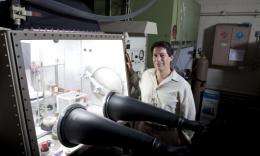
Richard Gross in his lab at the Polytechnic Institute of New York University
When people complained en masse that new biodegradable Sun Chips bags were too noisy, enough for the snacks maker, Frito Lay, to scrap the bags altogether last year, it sent a signal: most consumers expect earth-friendly products to perform like the traditional products theyre used to. Polytechnic Institute of New York Universitys Richard Gross is at work to create just such a product for the plastics industry.
The professor of chemical and biological science and partners recently received grants from the National Science Foundation (NSF) to develop an improved, bio-based alternative to petroleum-based plastics that could be used in everything from bottles to garment bags. One of the grants is for $590,000 and will fund research between Gross and PolyNew, a small Colorado-based company that produces nanocomposites. NYU-Poly will coordinate and also collaborate on the project, which is funded through the NSFs Partnerships for Innovation program, an effort to commercialize academic research by requiring that grantees collaborate with small businesses. The other is for $150,000 and will fund research by Grosss SyntheZyme startup company.
Both projects will build on a method Gross created for producing a strong, highly ductile bioplastic using yeast. The Journal of the American Chemical Society published Grosss findings in 2010. His method involves a fairly quick, relatively low-cost way to use engineered yeast to make large quantities of omega-hydroxyfatty acids from fatty acids of plant oils. When strung together, the omega-hydroxyfatty acids form a polymer, or plastic.
It was a very exciting development in the field, and not just because we created a bioplastic with desirable properties, says Gross. The process uses no fossil fuels, and every step is biologically friendly, from fatty acids in plant oils through the end product, which is a versatile, 100 percent biodegradable plastic.
The polymer from omega-hydroxyfatty acids Gross created will provide tough and flexible new bioplastics. PolyNew will develop natural fibers from cellulose known as cellulose nanowhiskers that will act as a reinforcing agent increasing SyntheZymes bioplastics rigidity. SyntheZyme has also developed blends of their bioplastics with a commercial bioplastic produced by NatureWorks known as polylactic acid. Various combinations of SyntheZymes polymer from omega-hydroxyfatty acids with polylactic acid and cellulose nanowhiskers will lead to the development of a suite of new bioplastics for uses in a wide range of applications including disposable gloves, multilayer food packaging films, produce bags, bottles, fibers in clothing and carpets, and molded plastic articles used as casings for electronic products.
The U.S. Defense Advanced Research Projects Agency (DARPA) tapped Grosss laboratory at NYU-Poly to develop his original bioplastics. The further development of that work led in part to the formation of SyntheZyme, which is a member of the New York City Accelerator for a Clean and Renewable Economy (NYC ACRE), a new-business accelerator for clean technology and renewable energy companies. NYU-Poly operates NYC ACRE with funding from the New York State Energy Research and Development Authority (NYSERDA) within the Varick Street Incubator, which is a partnership of NYU-Poly, the New York City Economic Development Corporation and Trinity Real Estate.
Provided by Journal of American Chemical Society
-
From lemons to lemonade: Reaction uses carbon dioxide to make carbon-based semiconductor,
32 comments
-
Thioridazine kills cancer stem cells in human while avoiding toxic side-effects of conventional cancer treatments,
3 comments
-
SpaceX private rocket blasts off for space station (Update),
42 comments
-
Climate scientists say they have solved riddle of rising sea,
31 comments
-
SpaceX capsule has 'new car' smell, astronauts say (Update),
4 comments
-
Calculating partial pressures Pa and Pw
2 hours ago
-
Gibbs Free Energy Change/Entropy
12 hours ago
-
What's the rule to covalent character
13 hours ago
-
Schwartz reagent-- NMR/MS/IR
May 26, 2012
-
High school chemistry EEI
May 25, 2012
-
oxidation of I- by KMnO4
May 25, 2012
- More from Physics Forums - Chemistry
More news stories
Computer model used to pinpoint prime materials for efficient carbon capture
When power plants begin capturing their carbon emissions to reduce greenhouse gases and to most in the electric power industry, it's a question of when, not if it will be an expensive undertaking.
5 hours ago |
not rated yet |
0
|
Scientists develop ultra-sensitive test that detects diseases in their earliest stages
Scientists have developed an ultra-sensitive test that should enable them to detect signs of a disease in its earliest stages, in research published today in the journal Nature Materials.
Chemistry / Analytical Chemistry
5 hours ago |
not rated yet |
0
|
New CO2-removing catalyst can take the heat
(Phys.org) -- The current method of removing the greenhouse gas carbon dioxide (CO2) from the flues of coal-fired power plants uses so much energy that no one bothers to use it. So says Roger Aines, principal ...
May 24, 2012 |
5 / 5 (9) |
11
|
High-speed method to aid search for solar energy storage catalysts
Eons ago, nature solved the problem of converting solar energy to fuels by inventing the process of photosynthesis.
May 25, 2012 |
5 / 5 (3) |
4
|
Researchers demonstrate possible primitive mechanism of chemical info self-replication
(Phys.org) -- When scientists think about the replication of information in chemistry, they usually have in mind something akin to what happens in living organisms when DNA gets copied: a double-stranded molecule ...
May 25, 2012 |
5 / 5 (4) |
2
|
'Unzipped' carbon nanotubes could help energize fuel cells, batteries
Multi-walled carbon nanotubes riddled with defects and impurities on the outside could replace some of the expensive platinum catalysts used in fuel cells and metal-air batteries, according to scientists at ...
Change in developmental timing was crucial in the evolutionary shift from dinosaurs to birds: study
At first glance, it's hard to see how a common house sparrow and a Tyrannosaurus Rex might have anything in common. After all, one is a bird that weighs less than an ounce, and the other is a dinosaur that ...
T cells 'hunt' parasites like animal predators seek prey, study shows
By pairing an intimate knowledge of immune-system function with a deep understanding of statistical physics, a cross-disciplinary team at the University of Pennsylvania has arrived at a surprising finding: T cells use a movement ...
Land and sea species differ in climate change response: study
(Phys.org) -- Marine and terrestrial species will likely differ in their responses to climate warming, new research by Simon Fraser University and Australia’s University of Tasmania has found.
Yale study concludes public apathy over climate change unrelated to science literacy
Are members of the public divided about climate change because they don't understand the science behind it? If Americans knew more basic science and were more proficient in technical reasoning, would public consensus match ...
10 million years needed to recover from mass extinction
It took some 10 million years for Earth to recover from the greatest mass extinction of all time, latest research has revealed.
Dec 02, 2011
Rank: 5 / 5 (1)
What's up with that ? Was it too close to the " fingernails on a chalkboard " sound ?