Nobel laureates receive 2011 prizes at Stockholm ceremony
December 11, 2011

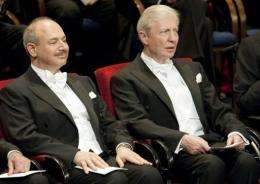
Luxembourg-born French professor Jules A. Hoffmann (R) and Professor Bruce A. Beutler of the US

Enlarge

Luxembourg-born French professor Jules A. Hoffmann (R) and Professor Bruce A. Beutler of the US attend the 2011 Nobel prize award ceremony at Stockholm Concert Hall.

The 2011 Nobel laureates in medicine, literature, economics, physics and chemistry received their prizes from Swedish King Carl XVI Gustaf at a gala ceremony in Stockholm on Saturday.

The formal event, held as tradition dictates on the anniversary of the death of prize founder in 1896, took place at Stockholm's Concert Hall which was decked out in white, yellow and orange flowers for the occasion.

The laureates and guests were clad in white tie and tails for men and evening gowns for women.

Notably absent was one of the three winners of the Nobel Medicine Prize, Ralph Steinman of Canada, who passed away just three days before the award was announced on October 3, unbeknownst to the .

While Nobel prizes are not awarded posthumously, the committee decided to maintain its decision to give him one half of the prestigious prize since it had not been aware of his death.

His wife Claudia Steinman accepted the honour on his behalf at Saturday's ceremony.
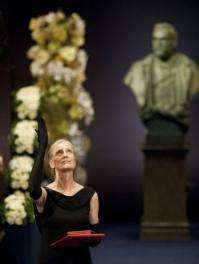
Claudia Steinman (L) gestures after receiving her late husband Canadian Ralph Steinman's 2011 Nobel Prize in Medicine
Enlarge

Claudia Steinman (L) gestures after receiving her late husband Canadian Ralph Steinman's 2011 Nobel Prize in Medicine during the 2011 Nobel prize award ceremony at the Stockholm Concert Hall.

Bruce Beutler of the United States and Luxembourg-born Frenchman Jules Hoffmann shared the other half of the Medicine Prize, which this year honoured research on the immune system.

The Physics Prize was meanwhile awarded to Saul Perlmutter and Adam Riess of the United States and US-Australian Brian Schmidt for their discovery that the expansion of the Universe is accelerating.

Israeli scientist Daniel Shechtman received the chemistry Nobel for discovering quasicrystals, an atomic mosaic whose existence was initially ridiculed before fundamentally altering theories about solids.

This year's Literature Prize went to Swedish poet Tomas Transtroemer, whose works address themes of nature, everyday life and death.

Transtroemer, 80, suffered a stroke in 1990 which left his speech slurred, and he was in a wheelchair on Saturday.

Finally, US researchers Thomas Sargent and Christopher Sims won the Economics Prize for research on the causal relationship between economic policy and different macroeconomic variables, such as GDP, inflation, employment and investments.

The consists of a gold medal, a diploma, and 10 million kronor ($1.48 million dollars, 1.10 million euros), to be shared if there is more than one recipient.

The laureates were also to be honoured at a formal dinner banquet later in the evening attended by the royal family and some 1,400 specially-invited guests.

Earlier Saturday in Oslo, the Nobel Peace Prize was awarded to Liberian President Ellen Johnson Sirleaf, her compatriot and "peace warrior" Leymah Gbowee and Yemeni "Arab Spring" activist Tawakkol Karman.

(c) 2011 AFP


Rank 5 /5 (2 votes)
Relevant PhysicsForums posts

More news stories

Change in developmental timing was crucial in the evolutionary shift from dinosaurs to birds: study

At first glance, it's hard to see how a common house sparrow and a Tyrannosaurus Rex might have anything in common. After all, one is a bird that weighs less than an ounce, and the other is a dinosaur that ...

Other Sciences / Archaeology & Fossils

created 5 hours ago | popularity 5 / 5 (4) | comments 0 | with audio podcast

Social welfare cuts ultimately come with heavy price, researchers say

(Phys.org) -- Slashing government funding for Medicaid, food stamps and other programs that serve the poor – while politically popular with some lawmakers and many conservatives – may do more harm ...

Other Sciences / Social Sciences

created May 24, 2012 | popularity 4.2 / 5 (20) | comments 155

Ancient Bethlehem seal unearthed in Jerusalem

Israeli archaeologists have discovered a 2,700-year-old seal that bears the inscription "Bethlehem," the Israel Antiquities Authority announced Wednesday, in what experts believe to be the oldest artifact ...

Other Sciences / Archaeology & Fossils

created May 23, 2012 | popularity 3.3 / 5 (15) | comments 24

Dollars and sense: Why are some people morally against tax?

As the U.S. presidential election campaigns heat up, the economic debate is dominated by bailouts, austerity and, inevitably, taxation. Now a new study published in Symbolic Interaction asks why tax is such an important issue ...

Other Sciences / Social Sciences

created May 23, 2012 | popularity 2.3 / 5 (3) | comments 16

Oldest Jewish archaeological evidence on the Iberian Peninsula

German archaeologists of the Friedrich Schiller University Jena found one of the oldest archaeological evidence so far of Jewish Culture on the Iberian Peninsula at an excavation site in the south of Portugal, ...

Other Sciences / Archaeology & Fossils

created May 25, 2012 | popularity 4.2 / 5 (6) | comments 12


'Unzipped' carbon nanotubes could help energize fuel cells, batteries

Multi-walled carbon nanotubes riddled with defects and impurities on the outside could replace some of the expensive platinum catalysts used in fuel cells and metal-air batteries, according to scientists at ...

Computer model used to pinpoint prime materials for efficient carbon capture

When power plants begin capturing their carbon emissions to reduce greenhouse gases – and to most in the electric power industry, it's a question of when, not if – it will be an expensive undertaking.

T cells 'hunt' parasites like animal predators seek prey, study shows

By pairing an intimate knowledge of immune-system function with a deep understanding of statistical physics, a cross-disciplinary team at the University of Pennsylvania has arrived at a surprising finding: T cells use a movement ...

Land and sea species differ in climate change response: study

(Phys.org) -- Marine and terrestrial species will likely differ in their responses to climate warming, new research by Simon Fraser University and Australia’s University of Tasmania has found.

Yale study concludes public apathy over climate change unrelated to science literacy

Are members of the public divided about climate change because they don't understand the science behind it? If Americans knew more basic science and were more proficient in technical reasoning, would public consensus match ...

10 million years needed to recover from mass extinction

It took some 10 million years for Earth to recover from the greatest mass extinction of all time, latest research has revealed.