December 16, 2011 report
Nematode research shows stress resistance tied to reproductive fitness
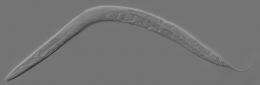
(PhysOrg.com) -- It seems in most everything in life there is a tradeoff. If you work more, for example, you’re likely to do better in your career, but, unfortunately, your personal life is likely to suffer. So it seems only natural to expect that nature has to deal with trade-offs as well. Take the lowly nematode, for example, researchers in Spain have found that those individuals that are better at dealing with changing environmental conditions, wind up developing more slowly than others and as a result, fare less well in reproducing. The team has published the results of their study in the journal Science.
In the study, led by Ben Lehner of the Centre for Genomic Regulation in Barcelona, the team looked specifically at chaperones, which are proteins animals produce to help regulate other proteins and molecules in the body. Their job is to fix things when problems occur. As an example, if a body part experiences too much heat, protein levels can be disrupted; when that happens, chaperones go to work to restore order.
In studying chaperones in nematodes (Caenorhabditis elegans) the researchers found that they not only served as a sort of buffer against environmental hazards, but also helped in reducing mutations or the effects they cause. The team also found in their study that when nematodes were exposed to heat some showed better chaperone protection than others, i.e. had more chaperone cells, and that those that did tended to live longer too, but also unfortunately, demonstrated slow growth, which led to a lowered level of reproduction.
Their findings led the team to wonder what nature was up to; after all, why should some nematodes be better able to survive environmental stress better than others, even at the risk of being less able to reproduce? They surmise that it’s all about variation, or put another way, hedging bets. When nature is forced to make trade-offs, as appears to be the case here, the result is often not making a choice at all. Instead, when two options are available, both become present in a species. That way if circumstances arise, such as undue heat, those with added protection will survive. On the other hand, if the circumstances are normal, the species can propagate to the fullest extent due to those that don’t have such great chaperone protection.
Though a study looking at the same kinds of correlations in humans has not thus far been done, team members seem optimistic that there could be the same types of trade-offs going on due to the similarities between stress responses in human proteins. What implications that might have though, is not really clear.
More information: Fitness Trade-Offs and Environmentally Induced Mutation Buffering in Isogenic C. elegans, Science, DOI: 10.1126/science.1213491
ABSTRACT
Mutations often have consequences that vary across individuals. Here, we show that the stimulation of a stress response can reduce mutation penetrance in C. elegans. Moreover, this induced mutation buffering varies across isogenic individuals because of interindividual differences in stress signaling. This variation has important consequences in wild-type animals, producing some individuals with higher stress resistance but lower reproductive fitness and other individuals with lower stress resistance and higher reproductive fitness. This may be beneficial in an unpredictable environment, acting as a “bet-hedging” strategy to diversify risk. These results illustrate how transient environmental stimuli can induce protection against mutations, how environmental responses can underlie variable mutation buffering, and how a fitness trade-off may make variation in stress signaling advantageous.
Journal information: Science
© 2011 PhysOrg.com


