NASA, industry leaders discuss new booster development for space launch system
December 19, 2011 By Michael Braukus and J.D. Harrington and Jennifer Stanfield

NASA, industry leaders discuss new booster development for space launch system

Enlarge

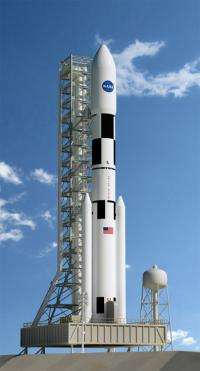
Artist concept of Space Launch System on launchpad. Credit: NASA/MSFC

(PhysOrg.com) -- On Dec. 15, more than 120 aerospace industry leaders from more than 70 companies attended the Space Launch System's Advanced Booster Industry Day held at Marshall Space Flight Center in Huntsville, Ala. The event focused on a NASA Research Announcement for the Space Launch System's (SLS) advanced booster.

Marshall is leading the design and development of the SLS on behalf of the agency. The new heavy-lift will expand human presence beyond low-Earth orbit and enable new missions of exploration across the solar system.

For explorations beyond the first two test flights, the SLS vehicle will require an advanced booster with a significant increase in thrust over existing U.S. liquid or solid boosters.

"As we are forging ahead with Space development, we are pleased to have such a strong response from industry and look forward to their ideas and hardware demonstrations for advance boosters concepts," said Todd May, SLS program manager. "Together, our expertise will enable an entirely new U.S. booster capability -- the largest and highest performing booster system ever produced -- to begin the journey to deep space safely and affordably."

Through this research announcement, NASA is seeking proposals for engineering demonstrations and/or risk reduction strategies for advanced booster concepts. The aim is to reducing risks while enhancing affordability, improving reliability and meeting our performance goals during an initial 30-month phase prior to the full and open Design Development Test and Evaluation (DDTE) competition. The total award value for the research announcement is $200 million with multiple awards anticipated.

NASA anticipates initiating a full and open competition for the advanced booster system in FY2015 with award anticipated in FY2016 and hardware delivery in the FY2019 timeframe. The 130-metric-ton, evolved SLS is slated for completion following the 2021 test flight.

For information about NASA's System development effort, visit: http://www.nasa.gov/sls

Provided by JPL/NASA search and more info website

Filter


Move the slider to adjust rank threshold, so that you can hide some of the comments.


Display comments: newest first

dirk_bruere
Dec 19, 2011

Rank: 3 / 5 (2)
Prediction - the program will be 90% complete when it's cancelled
dan42day
Dec 20, 2011

Rank: 5 / 5 (1)
Prediction - the program will be 90% complete when it's cancelled


And 60% over budget, along with 3 years behind schedule!
Rank 5 /5 (4 votes)
Relevant PhysicsForums posts
  • Distance of planets from stars and revolution
    created5 hours ago
  • revamping general concept and cosmological principle
    createdMay 25, 2012
  • Transiting Exoplanet Light Curve
    createdMay 25, 2012
  • Math behind Theoretical Physics
    createdMay 24, 2012
  • Do we know whats at the center of galaxies yet?
    createdMay 23, 2012
  • Structure of the Milky Way?
    createdMay 20, 2012
  • More from Physics Forums - General Astronomy

More news stories

Land and sea species differ in climate change response: study

(Phys.org) -- Marine and terrestrial species will likely differ in their responses to climate warming, new research by Simon Fraser University and Australia’s University of Tasmania has found.

Space & Earth / Environment

created 3 hours ago | popularity 3.7 / 5 (3) | comments 3 | with audio podcast

Yale study concludes public apathy over climate change unrelated to science literacy

Are members of the public divided about climate change because they don't understand the science behind it? If Americans knew more basic science and were more proficient in technical reasoning, would public consensus match ...

Space & Earth / Environment

created 5 hours ago | popularity 4.8 / 5 (4) | comments 11 | with audio podcast

10 million years needed to recover from mass extinction

It took some 10 million years for Earth to recover from the greatest mass extinction of all time, latest research has revealed.

Space & Earth / Earth Sciences

created 5 hours ago | popularity 5 / 5 (3) | comments 1 | with audio podcast

Sophisticated simulations predict future warming

The chances of our planet being hit by a global warming of 3 degrees Celsius by 2050 is as likely as it being hit by an increase of 1.4 degrees, new research shows. Presented in the journal Nature Geoscience, the British study ...

Space & Earth / Earth Sciences

created May 22, 2012 | popularity 4.4 / 5 (9) | comments 51

Aliens don't want to eat us, says former SETI director

Alien life probably isn’t interested in having us for dinner, enslaving us or laying eggs in our bellies, according to a recent statement by former SETI director Jill Tarter.

Space & Earth / Space Exploration

created May 25, 2012 | popularity 4.4 / 5 (14) | comments 41


'Unzipped' carbon nanotubes could help energize fuel cells, batteries

Multi-walled carbon nanotubes riddled with defects and impurities on the outside could replace some of the expensive platinum catalysts used in fuel cells and metal-air batteries, according to scientists at ...

Change in developmental timing was crucial in the evolutionary shift from dinosaurs to birds: study

At first glance, it's hard to see how a common house sparrow and a Tyrannosaurus Rex might have anything in common. After all, one is a bird that weighs less than an ounce, and the other is a dinosaur that ...

Computer model used to pinpoint prime materials for efficient carbon capture

When power plants begin capturing their carbon emissions to reduce greenhouse gases – and to most in the electric power industry, it's a question of when, not if – it will be an expensive undertaking.

T cells 'hunt' parasites like animal predators seek prey, study shows

By pairing an intimate knowledge of immune-system function with a deep understanding of statistical physics, a cross-disciplinary team at the University of Pennsylvania has arrived at a surprising finding: T cells use a movement ...

Scientists develop ultra-sensitive test that detects diseases in their earliest stages

Scientists have developed an ultra-sensitive test that should enable them to detect signs of a disease in its earliest stages, in research published today in the journal Nature Materials.

Manufacturing genes to attack flu virus

An international research team has manufactured a new protein that can combat deadly flu epidemics.