Researchers measure nanometer scale temperature
Dec 19, 2011
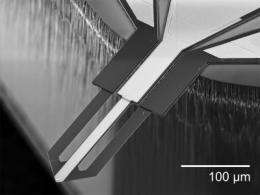
This is an electrothermal cantilever from the University of Illinois, having nanometer-scale electrode tip integrated onto a microheater. Credit: University of Illinois at Urbana-Champaign

Illinois researchers have developed a new kind of electro-thermal nanoprobe that can independently control voltage and temperature at a nanometer-scale point contact. It can also measure the temperature-dependent voltage at a nanometer-scale point contact.

Atomic force microscope cantilever tips with integrated heaters are widely used to characterize polymer films in electronics and optical devices, pharmaceuticals, paints, and coatings. These heated tips are also used in research labs to explore new ideas in nanolithography and data storage, and to study fundamentals of nanometer-scale heat flow. Until now, however, no one has used a heated nano-tip for electronic measurements.

"We have developed a new kind of electro-thermal nanoprobe," according to William King, a College of Engineering Bliss Professor in the Department of Mechanical Science and Engineering at the University of Illinois at Urbana-Champaign. "Our electro-thermal nanoprobe can independently control voltage and temperature at a nanometer-scale point contact. It can also measure the temperature-dependent voltage at a nanometer-scale point contact."

"Our goal is to perform electro-thermal measurements at the nanometer scale," according to Patrick Fletcher, first author of the paper, "Thermoelectric voltage at a nanometer-scale heated tip point contact," published in the journal Nanotechnology. "Our electro-thermal nanoprobe can be used to measure the nanometer-scale properties of materials such as semiconductors, thermoelectrics, and ferroelectrics."

The electro-thermal probes are different than thermal nanoprobes typically used in King's group and elsewhere. They have three electrical paths to the cantilever tip. Two of the paths carry heating current, while the third allows the nanometer-scale electrical measurement. The two electrical paths are separated by a diode junction fabricated into the tip. While the cantilever design is complex, the probes can be used in any atomic force microscope.

Explore further: Stacking 2-D materials produces surprising results

More information: The paper is available online at doi:10.1088/0957-4484/23/3/035401

Provided by University of Illinois College of Engineering

5 /5 (2 votes)

Related Stories

Researchers ink nanostructures with tiny 'soldering iron'

Nov 07, 2011

Researchers with the Lawrence Berkeley National Laboratory (Berkeley Lab) have shed light on the role of temperature in controlling a fabrication technique for drawing chemical patterns as small as 20 nanometers. ...

Improved Method for Nanometer-Scale Patterns Writing

Aug 30, 2004

Researchers from the Georgia Institute of Technology and the Naval Research Laboratory (NRL) have developed an improved method for directly writing nanometer-scale patterns onto a variety of surfaces. The new wr ...

Femtogram-level chemical measurements now possible

Mar 27, 2008

Finding a simple and convenient technique that combines nanoscale structural measurements and chemical identification has been an elusive goal. With current analytical instruments, spatial resolution is too low, signal-to-noise ...

Self-cooling observed in graphene electronics

Apr 03, 2011

With the first observation of thermoelectric effects at graphene contacts, University of Illinois researchers found that graphene transistors have a nanoscale cooling effect that reduces their temperature.

IBM Scientists Effectively Eliminate Wear at the Nanoscale

Sep 07, 2009

(PhysOrg.com) -- IBM scientists have demonstrated a promising and practical method that effectively eliminates the mechanical wear in the nanometer-sharp tips used in scanning probe-based techniques. This discovery can potentially ...

Recommended for you

Stacking 2-D materials produces surprising results

May 16, 2013

(Phys.org) —Graphene has dazzled scientists, ever since its discovery more than a decade ago, with its unequalled electronic properties, its strength and its light weight. But one long-sought goal has proved ...

User comments : 0

More news stories

Graphene joins the race to redefine the ampere

A new joint innovation by the National Physical Laboratory (NPL) and the University of Cambridge could pave the way for redefining the ampere in terms of fundamental constants of physics. The world's first ...

Catching graphene butterflies

Writing in Nature, a large international team led Dr Roman Gorbachev from The University of Manchester shows that, when graphene placed on top of insulating boron nitride, or 'white graphene', the electr ...

Stacking 2-D materials produces surprising results

(Phys.org) —Graphene has dazzled scientists, ever since its discovery more than a decade ago, with its unequalled electronic properties, its strength and its light weight. But one long-sought goal has proved ...

US seizes Bitcoin operator accounts

US authorities seized the accounts of a Bitcoin digital currency exchange operator, claiming it was functioning as an "unlicensed money service business," court documents showed Friday.

Alaska volcano shoots ash 15,000 feet into the air

(AP)—One of Alaska's most restless volcanoes has shot an ash cloud 15,000 feet into the air in an ongoing eruption that has drawn attention from a nearby community but isn't expected to threaten air traffic.

Chinese, Indian airlines face EU pollution fines

Eight Chinese and two Indian airlines face fines of up to several million euros for not paying for their greenhouse gas emissions during flights within the bloc, the European Commission said on Friday.