Like monkeys, pigeons can put numbers in order
December 22, 2011

Pigeons no bird brains when it comes to number sense

Enlarge

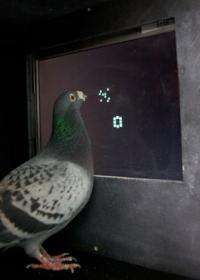
Pigeon participating in Dr Scarf's research. Photo by William van der Vliet

(PhysOrg.com) -- Pigeons are on par with primates in their numerical abilities, according to new University of Otago research appearing in the leading international journal Science.

The Department of Psychology researchers showed that pigeons can compare pairs of images picturing up to nine objects and order them by the lower to higher number with a success rate above chance.

Study lead author Dr Damian Scarf says that up until now, only humans and primates were thought to share the ability to use abstract numerical rules in this way.

“Our research not only shows that pigeons are also members of this exclusive club, but, somewhat surprisingly, their performance is on a par with that of monkeys.”

The researchers initially trained the pigeons by presenting them with 35 sets of three images, each with one, two, or three objects of different sizes, colours and shapes.

They were rewarded with wheat when they pecked the images in the correct ascending sequence.

Next, the researchers sought to test if the pigeons could take what they had learnt from ordering the three images and apply it to images with higher numbers of objects than they had seen before. The pigeons were presented with pairs of images with between one and nine objects and tested on their ability to respond to them in ascending order.

As well as performing above chance in these tests, the pigeons also demonstrated a ‘distance effect’ comparable to that found in landmark US research in 1998 involving rhesus monkeys performing similar tasks. The greater the distance between the numbers in the pairs, the faster and more accurate the pigeons were, Dr Scarf says.

“While this is obviously a long way away from how humans can count, it shows that an animal with a brain structured quite differently to ours is still able to perform complex mental tasks of which only humans were once thought capable. Our findings add to a growing body of evidence that are among a number of avian species exhibiting impressive mental abilities that really do give the lie to the old ‘bird brain’ insult,” he says.

The next phase of Dr Scarf’s pigeon research includes investigating the neural underpinnings of their numerical abilities by recording their brain cell activity when they undertake numerical tasks.

He also plans to test kea, which have been claimed to have some of the intelligence of a six-year-old child. He is currently setting up a project that will utilise the two keas and other parrot species housed at the Dunedin Botanic Garden aviary.

More information: “Pigeons on par with primates in numerical competence,” by Damian Scarf, Harlene Hayne, Michael Colombo. 23 December 2011, Vol 334, Science DOI: 10.1126/science.1213357

Journal reference: Science search and more info website

Provided by University of Otago

Filter


Move the slider to adjust rank threshold, so that you can hide some of the comments.


Display comments: newest first

Tausch
Dec 22, 2011

Rank: not rated yet
What abstract behaviorism projection onto other life is universal to all life?
MrVibrating
Dec 22, 2011

Rank: 5 / 5 (1)
Can't help wondering if their ability to judge quantities would also be affected by tilt, like us..

http://medicalxpr...eft.html

..and likewise for the monkeys..

I do love pigeons tho, can watch them all day. You get to see some interesting behaviors. It's a pity so many folks are so prejudiced against them. They're actually Portuguese Rock Doves, IIRC, and only here cos our buildings replicate their habitat.

Some years ago you'd regularly encounter them using the District Line between Ealing Broadway and Ealing Common stations - New Scientist mentioned it but the consensus from ornithologists was that these were chance occurences, or they'd wandered onto the carriage looking for food... but i saw them myself multiple times, and remain convinced they knew exactly what they were doing...
Isaacsname
Dec 22, 2011

Rank: 5 / 5 (1)
I bet they have fun trying to work with Kea's, those things are so smart it's almost intimidating.
Telekinetic
Dec 22, 2011

Rank: not rated yet
@ Isaacsname:

I think you'd like this-
http://www.huffin...365.html
Isaacsname
Dec 23, 2011

Rank: not rated yet
@ Isaacsname:

I think you'd like this-
http://www.huffin...365.html


I saw that the other day. Looked like a field trip for the youngin's :D
antialias_physorg
Dec 23, 2011

Rank: 3 / 5 (2)
Our research not only shows that pigeons are also members of this exclusive club,

Is this really surprising? I would suspect that any animal that has a brain uses it for the same purpose: pattern recognition and information abstraction.

A brain is a very efficientr foliter that condenses many bits of stimuli into the few relevant bits (responses to those stimuli). Anything that helps make this task easier (like abstraction) is what the brain is perfectly suited for.

One of these abstractions is most certainly to distinguish objects from one another. No use learning what "one seed2 look like, then learning what "two seeds" look like...then "three seeds"....etc, etc.

Much easier to learn what one seed looks like and then learn the concept of aggregatons of seeds.

Naturally it is favorable to choose more seeds over less. So a concept of numbering/ordering is smoething I'd expect to develop very early on.
Rank 5 /5 (8 votes)
Relevant PhysicsForums posts

More news stories

Manufacturing genes to attack flu virus

An international research team has manufactured a new protein that can combat deadly flu epidemics.

Biology / Biotechnology

created 5 hours ago | popularity not rated yet | comments 0 | with audio podcast

Scientist: Evolution debate will soon be history

(AP) -- Richard Leakey predicts skepticism over evolution will soon be history. Not that the avowed atheist has any doubts himself.

Biology / Evolution

created May 26, 2012 | popularity 3.5 / 5 (20) | comments 88

More plant species responding to global warming than previously thought

(Phys.org) -- Far more wild plant species may be responding to global warming than previous large-scale estimates have suggested.

Biology / Ecology

created May 22, 2012 | popularity 4.6 / 5 (14) | comments 18 | with audio podcast

For monogamous sparrows, it doesn't pay to stray (but they do it anyway)

It's quite common for a female song sparrow to stray from her breeding partner and mate with the male next door, but a new study shows that sleeping around can be costly.

Biology / Plants & Animals

created May 22, 2012 | popularity 5 / 5 (2) | comments 8 | with audio podcast

Thousands of shellfish found dead in Peru

Thousands of crustaceans were found dead off the coast of Lima following the mystery mass death of dolphins and pelicans, the Peruvian Navy said Friday.

Biology / Ecology

created May 26, 2012 | popularity 4.7 / 5 (7) | comments 7


'Unzipped' carbon nanotubes could help energize fuel cells, batteries

Multi-walled carbon nanotubes riddled with defects and impurities on the outside could replace some of the expensive platinum catalysts used in fuel cells and metal-air batteries, according to scientists at ...

Change in developmental timing was crucial in the evolutionary shift from dinosaurs to birds: study

At first glance, it's hard to see how a common house sparrow and a Tyrannosaurus Rex might have anything in common. After all, one is a bird that weighs less than an ounce, and the other is a dinosaur that ...

Computer model used to pinpoint prime materials for efficient carbon capture

When power plants begin capturing their carbon emissions to reduce greenhouse gases – and to most in the electric power industry, it's a question of when, not if – it will be an expensive undertaking.

T cells 'hunt' parasites like animal predators seek prey, study shows

By pairing an intimate knowledge of immune-system function with a deep understanding of statistical physics, a cross-disciplinary team at the University of Pennsylvania has arrived at a surprising finding: T cells use a movement ...

Land and sea species differ in climate change response: study

(Phys.org) -- Marine and terrestrial species will likely differ in their responses to climate warming, new research by Simon Fraser University and Australia’s University of Tasmania has found.

Yale study concludes public apathy over climate change unrelated to science literacy

Are members of the public divided about climate change because they don't understand the science behind it? If Americans knew more basic science and were more proficient in technical reasoning, would public consensus match ...